

Building a Reliable Vendor Network for Your Florida Rental
The landlords who never panic about maintenance calls are the ones who built their vendor list before the emergency. Here's how to find, vet, and manage contractors for Florida rental properties.
Building a Reliable Vendor Network for Your Florida Rental
The phone rings at 9 PM on a Saturday. Your tenant's AC just died — in October, which in Florida still means 85-degree days. You don't have an HVAC tech you trust. You start Googling. The first company that answers charges $250 for the emergency call, plus parts. The total: $1,100.
A landlord with a vendor network calls their HVAC contact directly. Same repair, $650. Done the next morning.
The difference between panic maintenance and planned maintenance is a vendor network — a short list of licensed, insured, responsive contractors you've vetted in advance. Here's how to build one for a Florida rental property.
What Trades Does Every Florida Landlord Need?
You don't need 50 contractors. You need 5–7 reliable ones covering the trades that generate 90% of rental maintenance calls.
The core five:
- HVAC technician. Florida's most critical trade. AC failures are the #1 maintenance emergency in Orlando and Tampa rentals. You need someone who answers the phone on weekends and doesn't charge double for it.
- Licensed plumber. Leaks, clogs, water heater failures, and toilet replacements. In Florida, plumbing issues cause more secondary damage (water damage, mold) than the plumbing repair itself. Fast response matters.
- Licensed electrician. Outlet failures, GFCI trips, panel issues, ceiling fan installations. Less frequent than HVAC and plumbing, but when you need one, you need one fast.
- General handyperson. Door hardware, drywall patches, caulking, fixture swaps, minor carpentry, painting touch-ups. The jack-of-all-trades who handles the $50–$300 jobs that don't require a specialist.
- Pest control company. In Florida, pest control isn't optional — it's a line item. Ants, roaches, termites, rodents, and mosquitoes are year-round issues. Most landlords sign an annual contract with quarterly treatments.
Florida-specific additions:
- Pool service. If your rental has a pool (common in Orlando and Tampa), monthly pool maintenance runs $100–$175/month. Don't skip it — pool equipment failures cost $500–$3,000.
- Hurricane shutter installer / impact window company. You won't need them often, but during hurricane season, you need someone who answers your call before the storm hits.
- Pressure washing. Florida's humidity means mold and mildew on exterior surfaces, driveways, and walkways. Annual pressure washing ($150–$300) keeps the property presentable and prevents surface damage.
How Do You Vet Contractors in Florida?
Florida takes contractor licensing seriously. The Department of Business and Professional Regulation (DBPR) regulates all licensed trades through the Construction Industry Licensing Board (CILB). Here's your vetting checklist.
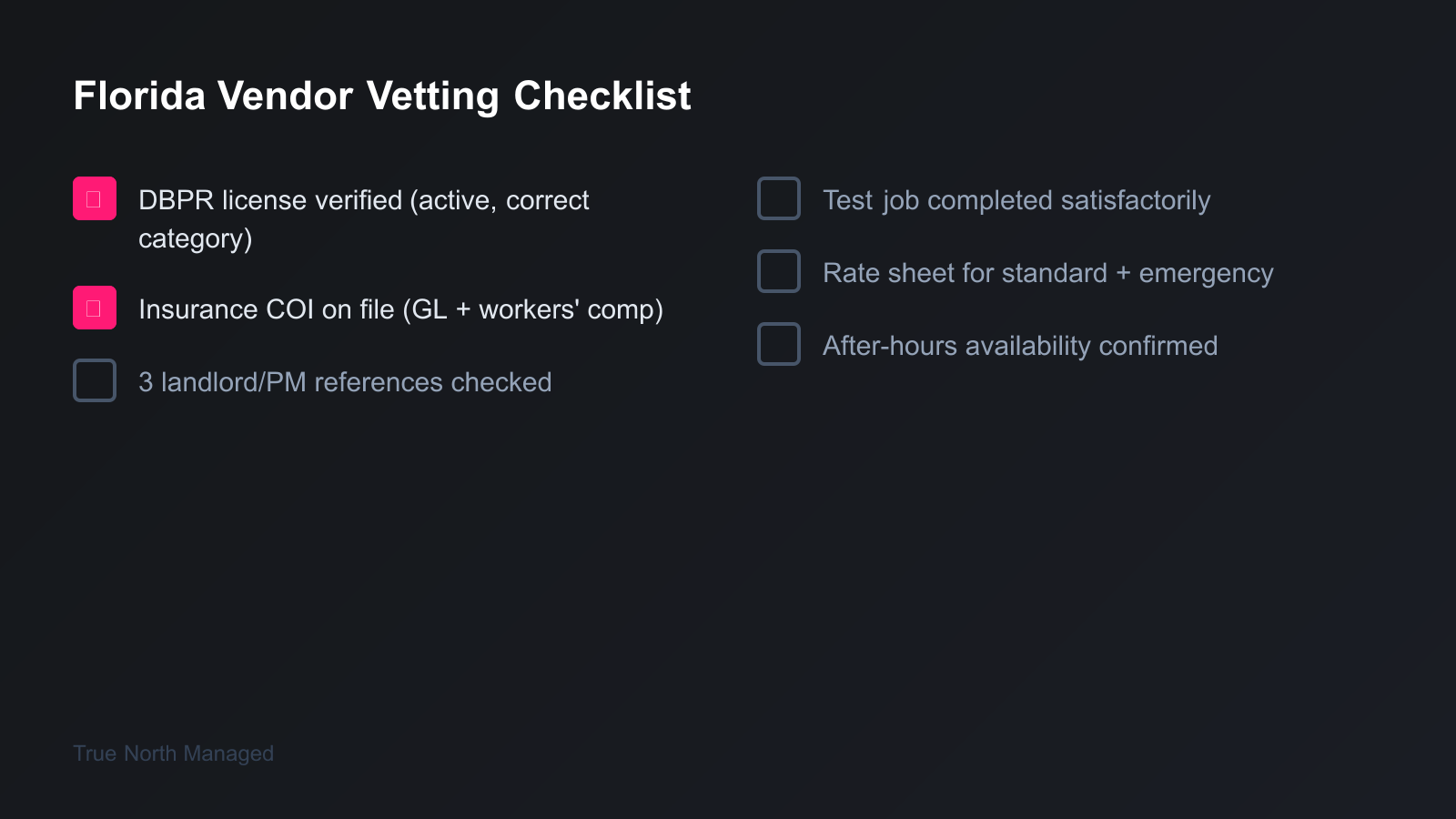
1. Verify the license. Search the DBPR license verification portal (myfloridalicense.com) for the contractor's name or license number. Confirm the license is active, what category it covers, and whether there are any disciplinary actions.
In Florida, HVAC contractors need a Class A (any size) or Class B (under 25 tons) air-conditioning license. Plumbers and electricians need their respective DBPR licenses. General contractors need a certified or registered general contractor license for structural work.
Unlicensed work is a risk to you, not just them. If an unlicensed contractor does work that damages your property or injures someone, your insurance may not cover the claim. And you could face liability for hiring an unlicensed worker.
2. Confirm insurance. Request a Certificate of Insurance (COI) showing:
- General liability insurance (minimum $300,000)
- Workers' compensation insurance (required if they have employees)
If a contractor is injured on your property and doesn't have workers' comp, guess who pays? You. Demand the COI before the first job.
3. Check references and reviews. Google reviews are a starting point, not the finish line. Ask the contractor for 3 landlord or property manager references — people who use them for rental properties, not one-off homeowner jobs. Ask about response time, pricing consistency, and quality of work.
4. Do a test job. Before you commit to a primary relationship, give the contractor a small job — a faucet replacement, a filter change, a minor repair. See how they handle scheduling, communication, invoicing, and cleanup. This tells you more than any interview.
How Do You Negotiate Rates and Response Times?
Contractors give better rates to landlords who bring steady, predictable work. If you own one property, you're a one-off customer. If you own three or have a PM managing a portfolio, you're a relationship worth investing in.
Negotiation strategies:
- Volume commitment. "I have 3 properties and I'll use you exclusively for plumbing if you can hold $95/hour." Most contractors will discount 10–20% for committed recurring work.
- Emergency vs. routine rates. Get two rate sheets: standard rates for scheduled work, and after-hours/emergency rates for 24-hour response. Knowing the premium upfront prevents sticker shock at 10 PM.
- Annual maintenance contracts. HVAC maintenance contracts ($150–$250/year) typically include two tune-ups and priority scheduling for emergencies. Pest control contracts ($300–$500/year) include quarterly treatments and free callbacks.
- Net-30 or Net-15 terms. Contractors who trust you'll pay promptly will prioritize your jobs. Pay faster than their worst clients and you'll be their favorite call.
How Do You Build Emergency vs. Routine Response?
Not every maintenance call is an emergency. Building a two-tier response system keeps costs down and response times fast when they matter.
Tier 1: Emergency (respond within 2–4 hours)
- No AC (Florida-specific: this is a habitability issue during summer)
- Water leak that can't be shut off
- Electrical hazard (sparking, burning smell, no power)
- Sewage backup
- Lock-out or security breach (broken window, door)
Tier 2: Routine (respond within 24–48 hours)
- Running toilet, slow drain
- Appliance malfunction (dishwasher, garbage disposal)
- Exterior maintenance (landscaping, pressure washing, gutter cleaning)
- Cosmetic repairs (drywall patch, paint touch-up)
- Non-urgent electrical (dead outlet, light fixture replacement)
Your vendor list should flag which contractors handle emergency calls and which are routine-only. Some plumbers don't answer phones after 6 PM. Some HVAC companies charge triple for weekends. Know this in advance.
For more on building after-hours emergency response, that's a separate guide worth reading.
When Should You Fire a Vendor?
A vendor relationship that starts strong can decay. Here are the signals that it's time to find a replacement:
- Unreachable. They stopped answering your calls or texts within a reasonable window (same day for routine, 1 hour for emergency).
- Scope creep. Small jobs keep getting "upgraded" to bigger invoices. A $200 faucet fix becomes a $600 "we also noticed the supply line needs replacing."
- Inconsistent pricing. The same type of job costs wildly different amounts each time without explanation.
- Poor communication with tenants. Your vendor represents you. If they're rude, dismissive, or sloppy on-site, the tenant blames you.
- License or insurance lapse. Check annually. If their license expires or they drop workers' comp, you need a new vendor.
Build your replacement list before you need it. Having 2 vetted options per trade means you're never stuck.
Frequently Asked Questions
How many contractors do I need per trade? Two per core trade (HVAC, plumbing, electrical) — a primary and a backup. For less frequent trades (pool, pressure washing, pest control), one reliable contact is enough. Having two options prevents you from being stuck when your primary is unavailable.
Should I use the contractor my tenant recommends? Not without vetting them yourself. The tenant's brother-in-law who "does plumbing" may not be licensed. Always verify through DBPR and require a COI before authorizing any work.
What does a typical HVAC maintenance contract include? Most FL contracts include two tune-ups per year (spring and fall), priority emergency scheduling, and a discount on parts and labor. Annual cost: $150–$250. This is one of the highest-ROI maintenance expenses for a Florida rental.
Can I require my tenant to handle minor maintenance? Yes, for certain items — changing HVAC filters, replacing smoke detector batteries, basic drain clearing. Spell it out in the lease. But anything involving the building structure, electrical, plumbing, or systems is your responsibility as the landlord.
Building a vendor network takes time upfront. But the landlord who has five vetted contractors in their phone handles a maintenance emergency in 20 minutes. The landlord Googling "plumber near me" at midnight handles it in 3 days and $400 more.
If you'd rather inherit a vendor network that's already built — with negotiated rates, emergency response, and licensed/insured contractors — get a free rental analysis to see how a property manager handles maintenance for your specific property.