

What Does a Property Manager Actually Do? (Florida)
A Florida property manager runs the day-to-day of your rental — but the real value is the part you never see. Here's what they actually do, and what 8–12% buys.

You own a rental in Florida. Maybe you bought it on purpose, maybe it came with a job relocation or a parent's estate. Either way, you keep hearing the words "property manager" — and you have a fair question that most articles dodge: what does a property manager do all day, and is any of it worth 8% to 12% of your rent?
Here's the short version. A property manager runs the day-to-day operation of your rental so the work stops landing on your phone — leasing it, screening the people who apply, collecting the rent, coordinating repairs, and keeping the whole thing legal under Florida law. That's the visible list, and every property management blog will hand it to you the same way.
But the list isn't the point. The list is the floor. What you're actually paying for is the layer underneath it — the bad applicant who never gets signed, the 11 p.m. call that gets handled correctly, the security-deposit paperwork that keeps you out of court. Let's walk through what a property manager really does, task by task, and the unseen judgment under each one.
Does a property manager in Florida need a license?
Yes. A company that manages your rental for a fee — collecting rent, signing leases, renting it to tenants on your behalf — must hold a Florida real estate broker license. This is the first thing to verify and the easiest to skip.
Florida's definition of a "broker" in Chapter 475 of the Florida Statutes is broader than most owners expect. It covers anyone who, for another person and for compensation, "rents, or offers, attempts or agrees to … rent … real property of another." Renting out someone else's property for a cut of the rent is licensed real-estate activity. The statute says so directly.
There's one exemption worth knowing, because it explains the line. A salaried employee who works the leasing office of one apartment community — paid a wage, not a per-deal commission — doesn't need the license. But a third-party company managing your single-family house for a percentage of the rent is on the other side of that line. They need a broker license, full stop.
Two minutes of homework protects you here. Look the company up on the Florida DBPR license search and confirm an active broker license. While you're at it, don't confuse a CAM license — Community Association Manager — with a broker license. CAM covers HOA and condo associations. It does not cover managing your rental house. If a company says it's "licensed" and only holds a CAM, that's a mismatch worth catching before you sign anything.
What does a property manager do to find and place a tenant?
A property manager fills your vacancy and chooses who lives in your property — and the choosing is where the real money is made or lost. Tenant placement runs from pricing and marketing through screening, lease signing, and a documented move-in. In Florida, every step has a legal guardrail.
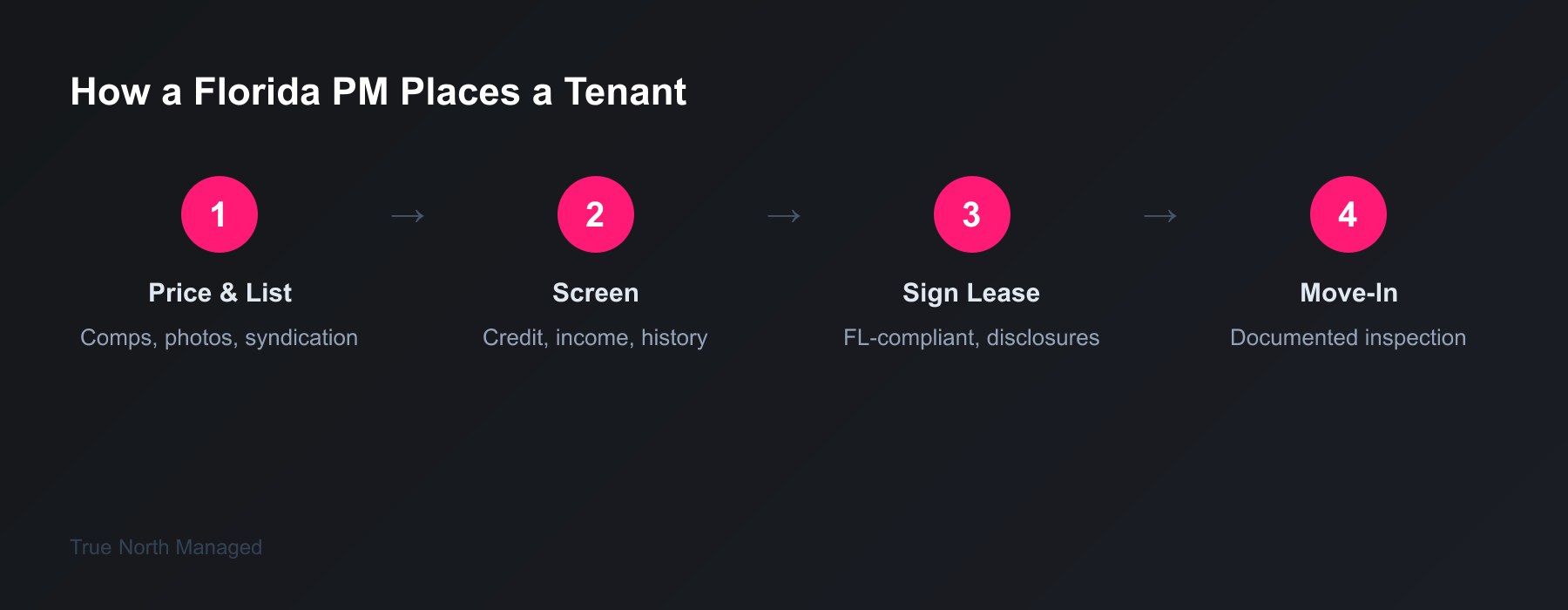
Marketing is the visible part. The manager prices the unit against current local comps, shoots photos, writes the listing, syndicates it across the major rental sites, and runs the showings. Pricing is its own small skill — list a 3/2 at $1,950 when the comps say $1,825 and it sits empty for three weeks, and that vacancy costs you more than the difference ever would have.
Screening is the part you can't see, and it's the most valuable thing on this entire page. A good manager runs credit, income verification, rental history, and a background check against the same written criteria for every applicant. Most use a benchmark like income at three times the rent — that's an industry norm for consistency, not a Florida law, but applied evenly it's also how you stay defensible under Fair Housing rules. The point isn't the checklist. The point is the applicant who looks fine on paper and falls apart on the landlord reference call — the one a manager who screens hundreds of files a year catches, and a first-time owner signs. That single catch is an eviction that never happens, and an eviction in Florida costs you far more than a year of management fees.
Then the lease. A Florida manager drafts and signs a lease built for this state — security-deposit handling, the required disclosures, maintenance terms, pet policy — and runs a documented move-in inspection so there's a clean record of the property's condition. If you want a fuller picture of how the whole handoff unfolds, our guide on what to expect when you hire a property manager in Florida walks through it start to finish.
What does rent collection actually involve?
Rent collection sounds like the simplest task on the list — the tenant pays, you get the money. In practice a manager runs the full financial pipeline: payment processing, late-fee enforcement, the legal notice when rent doesn't come, accounting, and your monthly disbursement.
Most managers collect through an online portal, so rent is paid electronically and you're not chasing checks. When a tenant pays late, the manager applies the late fee per the lease. When a tenant doesn't pay at all, the manager — as your representative — serves the statutory non-payment notice required under Florida law, and if it still doesn't come, walks the eviction toward a filing you authorize. You don't make the uncomfortable phone call or figure out which county court to file in. That work moves off your plate entirely.
There's a Florida-specific layer here that owners rarely think about until it bites them. Under Florida law, the landlord "or the landlord's agent shall either" hold a security deposit "in a separate non-interest-bearing account in a Florida financial institution for the benefit of the tenant or tenants," hold it "in a separate interest-bearing account in a Florida financial institution for the benefit of the tenant or tenants, in which case the tenant shall receive and collect interest in an amount of at least 75 percent of the annualized average interest rate payable on such account or interest at the rate of 5 percent per year, simple interest, whichever the landlord elects," or "post a surety bond" with the clerk of the circuit court, which also means paying the tenant "interest at the rate of 5 percent per year, simple interest." With either account, "The landlord shall not commingle such moneys with any other funds of the landlord." So a licensed manager holding your tenant's deposit keeps it walled off from the company's operating money and accounts for it under Florida Statute 83.49. That statute also runs a tight clock once the rental agreement ends. Miss the 30-day written-notice window to claim against the deposit, and 83.49(3)(a) spells out the result: "If the landlord fails to give the required written notice within the 30-day period, he or she forfeits the right to impose a claim upon the security deposit and may not seek a setoff against the deposit but may file an action for damages after returning the security deposit to the tenant." You can still pursue the damage, but only after the deposit goes back, and only through a separate lawsuit. A self-managing owner blows that deadline all the time. A competent manager treats it as routine. That's not a glamorous service — it's a quiet piece of compliance that keeps you out of a lawsuit, and it's baked into the fee.
What does a property manager do when something breaks?
A property manager takes the maintenance call, decides how urgent it really is, dispatches the right vendor, and follows it to done — so a broken AC in August becomes a work order instead of your problem. The dispatch is the easy half. The decision is the valuable half.

Here's the part the service lists never mention. When a tenant calls at 11 p.m. about water under the kitchen sink, the most important thing the manager does isn't answer the phone — it's triage the call. Is this a shut-off-the-valve-and-send-someone-at-9-a.m. situation, or a get-a-plumber-out-tonight situation? Call it wrong in the cheap direction and a slow leak becomes a four-figure water-damage claim and a mold remediation. Call it wrong in the expensive direction and you've paid emergency rates for a fix that could've waited. In our experience managing Orlando and Tampa rentals, that single judgment — what we call "The Triage Call" — is where a manager earns or loses you real money, and it's invisible on every fee schedule.
Underneath the triage sits the vendor network. A manager who runs hundreds of doors has plumbers, HVAC techs, and roofers who answer the phone, show up, and charge a fair rate — because the manager is repeat business and you're not. A landlord with one rental, calling a stranger off a search result on a holiday weekend, doesn't get that treatment. The manager also documents the work and keeps the receipts, which matters when a repair turns into a deposit dispute or a tax deduction. Most managers act on routine repairs up to a dollar threshold in your agreement and call you before anything bigger.
What does a property manager NOT do?
A property manager does not take over the things that come with owning the property — your mortgage, your property taxes, your insurance, and your legal ownership all stay yours. This trips people up, so it's worth saying plainly.
A manager reduces your workload and your risk. They do not erase your name from the deed or the liability that comes with it. The mortgage payment is yours. The property-tax bill and any exemptions or appeals are yours. Carrying proper landlord insurance — and keeping it current as Florida's market shifts — is your call and your responsibility. The manager operates the rental; you own the asset. That's not a loophole in the contract, it's the honest line between what you're buying and what you're not.
It's the same reason "is it even worth it?" is a separate question from "what do they do?" If you're weighing the fee against doing it all yourself, our honest cost comparison of self-managing versus hiring a PM in Orlando runs the real numbers, and our guide on when it makes sense to hire a property manager helps you decide if you're at that point. This page is about the job itself, not the decision to outsource it.
So what are you actually paying 8–12% for?
You're paying for judgment and absorbed liability, not just labor. The visible tasks — listing, screening, collecting, fixing — are the floor. What moves your return is the layer under them: the mistakes that don't happen.
Run the math so it's concrete. On a $2,000 Florida rental at a 9% management fee, you're paying about $180 a month for the recurring service, charged against the rent the manager actually collects — so if rent doesn't come in, they're not paid either, which keeps your interests pointed the same way. The fee band runs 8% to 12% depending on your market and property; expect a separate one-time leasing fee — often half to a full month's rent — when a new tenant is placed. The honest take from the landlord forums is real: at one or two doors, the math is closer than the brochures admit, and plenty of owners self-manage well. (We'd rather you read our straight cost comparison than take our word for it.)
But here's the reframe that the fee-percentage debate misses. When you compare two managers, you're not really comparing 9% against 10%. You're comparing where each one draws two invisible lines — the screening line that decides who gets signed, and the triage line that decides how the 3 a.m. call gets handled. Neither line appears in the contract. Both decide whether the year costs you a smooth twelve months of deposits or one bad tenant and a flooded kitchen. That's the actual product. The checklist is just how it's delivered.
If you're newer to all of this and want the bigger map of being a Florida landlord, our Florida Owner's Guide pulls the pieces together — leasing, legal, money, and operations — in one place. And if you've read this far and the honest answer is "I'd rather hand off the screening line and the triage line to someone who draws them for a living," that's exactly the work a good Florida manager does every day.