
Snowbird Rentals: Furnished Winter Leases in Florida
Furnished winter leases to snowbirds can out-earn a 12-month lease — if you get the rate, the off-season gap, and Florida's 6-month tax line right.
You own a place in Florida, and every fall you watch retirees from Ohio and Ontario pour in looking for somewhere warm to land until April. So you wonder: would a furnished winter lease to one of them beat a plain 12-month tenant?
It can. Snowbird rentals — furnished seasonal leases, usually October through April — pull 30 to 50% more per month than an unfurnished annual lease. The catch is the empty summer and one line in the tax code: a lease longer than six months skips Florida's transient tax, while a lease of six months or less gets taxed like a hotel room.
Here's the thing. Most owners think of this as a binary — annual tenant or Airbnb. Snowbird rentals are a third path, and they have their own math, their own lease, and their own tax rules. Let's break it down so you can decide whether the premium is worth the gap.
What is a snowbird rental, and how is it different from an Airbnb?
A snowbird rental is a furnished home leased to a seasonal resident for a fixed stretch of the winter — typically three to seven months, October through April. It sits between a nightly vacation rental and a 12-month lease. The tenant is one household, not a rotating cast, and they sign a real lease, not a booking.
That difference matters more than it sounds. A nightly Airbnb is a regulated short-term rental — it needs the right zoning, often a permit, and it answers to the rules we cover in our Florida short-term rental laws guide. A snowbird lease usually doesn't trip those wires, because you're renting to one tenant for months at a time, not turning the place over every weekend.
It's also not the same financial bet as a standard annual lease. The rent is higher, but the property sits empty part of the year, and you're buying and maintaining furniture. If you've been weighing nightly versus annual, our breakdown of short-term versus long-term rentals in Florida covers that fork. Snowbird leasing is the middle lane neither of those fully describes.
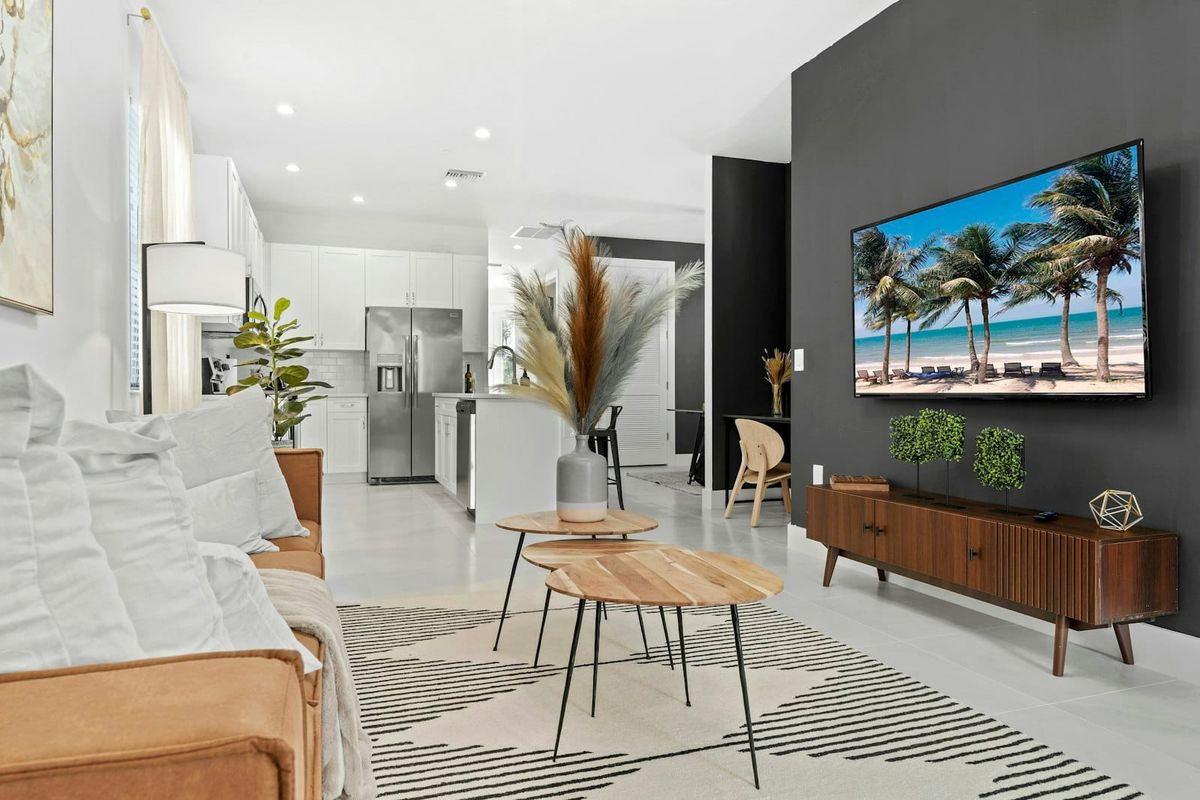
Who actually rents this way? Retirees escaping a northern winter. Remote workers wanting a few warm months. Families relocating who need a furnished place while they house-hunt. They want it move-in ready — sheets on the bed, pots in the kitchen, internet already on. They'll pay for that convenience.
How much more can you charge for a furnished seasonal lease?
A furnished seasonal lease in Florida typically rents for 30 to 50% above the unfurnished annual rate for the same property. The premium pays you for the furniture, the utilities you fold in, and the flexibility a winter tenant values. But it only counts on the months you actually fill.
Here's the formula in plain terms:
Annual rent x 1.30 to 1.50 = your seasonal monthly rate. Then multiply by the months you fill, and compare against twelve months of annual rent.
Example. Say you own a condo in South Tampa. The ZIP 33611 median rent runs about $2,312 a month as of April 2026, per Zillow's observed rent index. Furnish it and lease it for the winter, and you can ask $3,200 to $3,500 a month. Sign a snowbird for seven months at $3,300, and you collect $23,100 for the season. Twelve months of annual rent at $2,312 is $27,744.
So at first glance, annual wins. But that gap narrows fast once you fill the shoulder months — a spring or summer tenant, a few mid-season weeks — and the snowbird rate buys you something annual doesn't: the place is yours again every May, no eviction, no renewal fight, just a lease that ends on its own.
What's good or bad? If you can fill seven-plus winter months and stitch in even a couple months in the off-season, snowbird leasing usually pulls ahead of a flat annual lease. If your property only books three or four winter months and sits dark the rest of the year, the annual tenant is the safer money. The same Lake Nona-area home — ZIP 32827, around $2,341 annual — works as a snowbird rental only if you can actually book the season.
Where's the tax line — and how do you stay on the right side of it?
Florida draws a hard line at six months. Under Florida Statute 212.03, a rental of six months or less is a "transient rental," taxed like a hotel — 6% state sales tax plus your county's tourist development tax. A bona fide written lease for longer than six months is exempt from both.
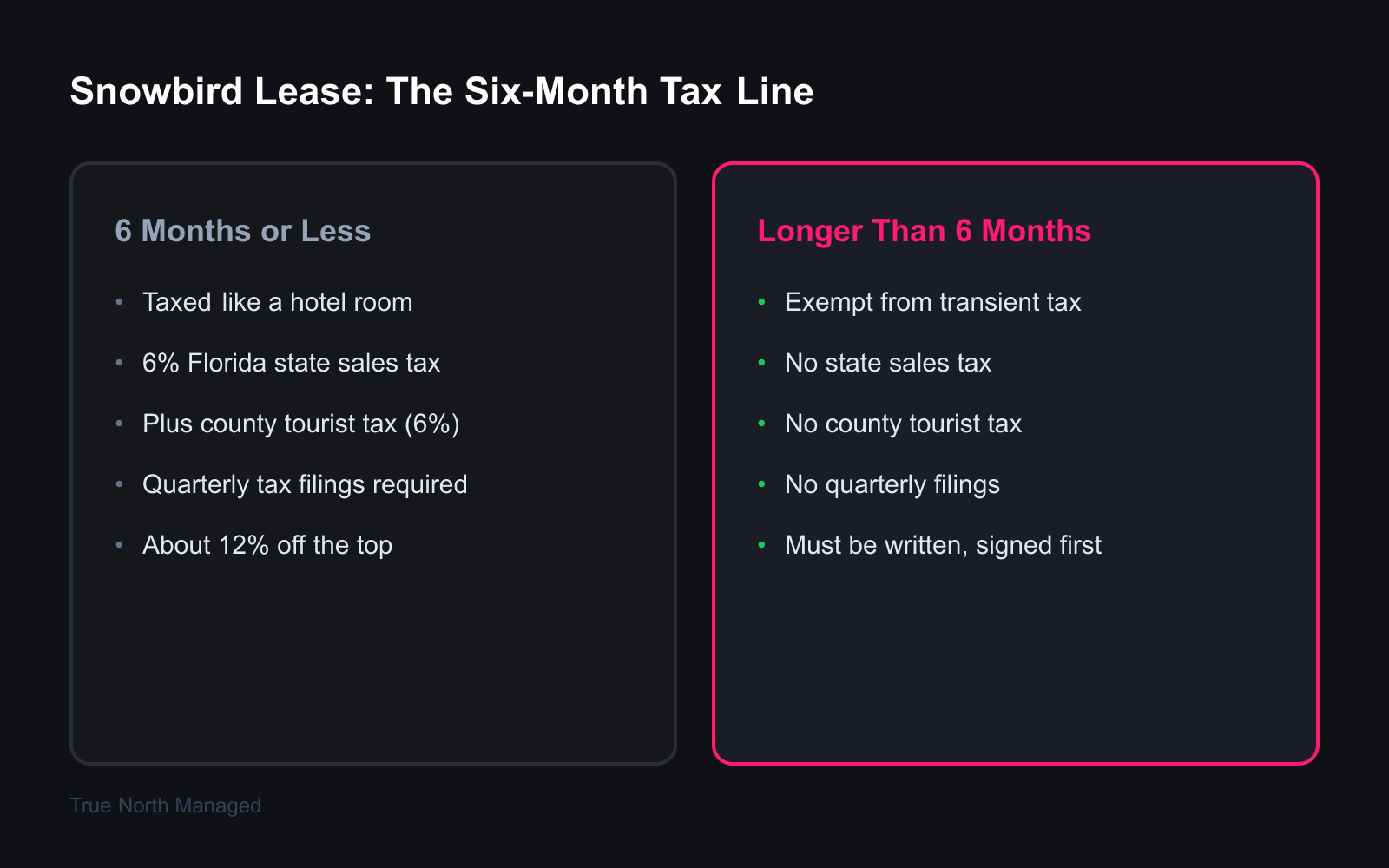
Call it "The Six-Month Line." It's the single most expensive detail in snowbird leasing, and most owners blow right past it.
Here's how it plays out. Lease your place for six months — say November through April — and you owe the state's 6% sales tax on transient rentals on every dollar of rent. On top of that, the county piles on its tourist development tax: 6% in Orange County, 6% in Hillsborough, both applied to stays of 182 nights or fewer. That's roughly 12% off the top, plus the quarterly filings that come with collecting it.
Now stretch that same lease to seven months — late October through late May. It's longer than six months, in writing, signed before move-in. The transient tax vanishes. No 6% state, no county tourist tax, no quarterly returns. The statute is specific: the lease has to be written, has to run longer than six months, and has to be in place before the tenant takes possession. A handshake that "turns into" seven months doesn't count.
The deeper mechanics of how transient tax differs from regular rental income live in our guide to Florida's two rental tax worlds. For snowbird leasing, the takeaway is simple: one extra month on the lease can save you thousands and a stack of paperwork.
So the move is obvious. If a tenant wants November to April, ask whether they'd take late October to late May instead. Many will — they're happy to arrive earlier and leave later in the warm weather. You both win, and the tax man steps aside.
What does it cost to furnish the place, and can you write it off?
Furnishing a snowbird rental usually runs $8,000 to $20,000 depending on size and finish — beds, a sofa, a dining set, kitchen gear, linens, a TV, and the small stuff that makes a place feel ready. The good news: it's deductible. The furniture is a business asset you recover over time.
How you write it off depends on the price tag. Furniture and appliances count as personal property, so the IRS lets you depreciate them over five to seven years under the standard schedule, per IRS Publication 527 on residential rental property. That spreads the deduction across several tax years.
But you don't have to capitalize every throw pillow. The De Minimis Safe Harbor election lets you simply expense any item under $2,500 in the year you buy it. A $1,800 sofa? Write it off now. A $400 nightstand? Same. Most of what goes into a snowbird unit clears under that ceiling, which keeps your bookkeeping sane and your first-year deduction healthy.
Track it all. Keep receipts, photograph the furniture, and build a one-page inventory — that list does double duty as a tax record and as the furniture schedule you'll attach to the lease.
What belongs in a snowbird lease that's not in a standard one?
A snowbird lease needs four things a standard 12-month lease doesn't bother with: a firm end date with no holdover, utilities and internet folded into the rent, a furniture inventory, and — if you're chasing the tax exemption — a term longer than six months. Get those right and the season runs itself.
Start with the end date. A snowbird lease has to end clean, because you may have the next winter tenant or your own plans lined up. Spell out the exact departure date and add a no-holdover clause with a daily penalty if they overstay. Florida law lets a fixed-term lease lapse into month-to-month if you're not careful — you don't want that here.
Fold in the utilities. Snowbirds expect electric, water, trash, and internet handled — they're not setting up accounts for a six-month stay. Build a realistic utility cost into your rate and say plainly in the lease what's covered. Just remember Florida bars you from cutting off a tenant's utilities mid-lease, so this is a service you provide, not a lever you hold.
Attach the furniture inventory. List every item, note its condition, and reference it in the lease so there's no argument in April about the missing barstool. A furnished unit also justifies a healthy security deposit — the furniture is real money on the line. When the lease ends, the same off-season clock starts ticking, and our guide on how to market a vacant Florida rental helps you avoid a long dark summer.
What about the empty summer — insurance and the off-season?
The off-season is where snowbird math gets honest. Your tenant leaves in spring, and the place can sit empty for months — which is fine for your wallet only if you've planned for it, and fine for your insurance only if you've told your carrier.
Insurance is the trap nobody warns you about. Most Florida landlord policies carry a vacancy clause that kicks in after 30 to 60 days of the home sitting empty. Cross that line, and a claim — a burst pipe, a break-in — can get denied. There's a wrinkle that helps you, though: a home that's "unoccupied but still furnished" is treated more kindly than one that's truly "vacant," meaning no people and no contents. Your furnished snowbird unit, sitting full of furniture over the summer, usually reads as unoccupied, not vacant.
Still, don't guess. Call your carrier, tell them the property runs as a seasonal rental, and ask about a vacancy permit endorsement that buys back coverage during the empty stretch. It's a small annual cost against a denied claim you can't afford.
Then there's the carrying cost. Taxes, insurance, HOA dues, and basic upkeep don't pause when the tenant flies home. Those months of empty carrying cost are the real price of the seasonal premium — budget for at least two off-season months of expenses with no rent coming in, and the snowbird strategy stops surprising you.
When should you start lining up next winter's tenant?
Start in the summer. The best snowbird properties book six to twelve months ahead, so if you want a tenant for this coming winter, you list in June or July — not October when the season's already moving. Snowbirds plan early, and the ones who plan early are the reliable ones.
Where you list matters. Furnished-rental and snowbird-specific platforms reach the audience that's actually searching for a winter place, and a furnished listing on the major rental sites catches relocating families and remote workers. Lead with photos of the furnished space, the included utilities, and the move-in-ready pitch — that's what wins a snowbird over a bare annual listing.
Pricing the season is its own skill. Set the rate too high and the place sits empty into November; too low and you've left the premium on the table. Comps move with demand, neighborhood, and how move-in-ready the unit feels.
Common mistakes snowbird landlords make
Three errors cost owners the most:
- Signing a six-month lease when seven would've dodged the tax. This is the big one. A lease of exactly six months sits on the wrong side of The Six-Month Line and owes the full transient tax. One more month flips it to exempt.
- Treating off-season vacancy as a $0 cost. The empty summer still bills you for taxes, insurance, and HOA. Owners who ignore the carrying cost overstate what the seasonal premium really earns.
- Skipping the furniture inventory and the deposit math. A furnished unit is thousands of dollars of stuff in a stranger's hands. No inventory and a thin deposit, and you eat the loss when something walks.
Is a snowbird rental right for your property?
Snowbird leasing rewards the right property — furnished-friendly, in a place winter visitors want, owned by someone who can absorb a quiet summer — and punishes the wrong one. The premium is real, the tax exemption is real, but so is the gap.
If you're staring at your property and trying to run the numbers, we can help you see them clearly. Get a free rental analysis, and we'll pull seasonal and annual comps across Orlando and Tampa so you know which lane earns you more before you buy a single piece of furniture.