

Small Claims Court for Florida Landlords: Filing, Costs, and What to Expect
When to use small claims in Florida ($8,000 limit), filing process, costs, service of process, mediation, and collecting judgments.

When a tenant owes you money and won't pay, small claims court is one option. Florida's limit is $8,000. The process is designed for people without lawyers. Here's what landlords need to know.
When Small Claims Makes Sense
Unpaid rent, damages beyond the security deposit, or broken lease terms.In Florida, If the amount is under $8,000 (principal damages; costs, interest, and attorney fees may be added), small claims is the right venue. SeeFlorida Small Claims Rulesfor procedure. Above that, you need county court. FL landlords in Orlando and Tampa should check local requirements.
Unpaid rent, damages beyond the security deposit, or broken lease terms. If the amount is under $8,000, small claims is the right venue. Above that, you need county court. Evictions are a separate process; small claims is for money judgments, not possession. See ourtenant not paying rent guidefor the eviction path.
Filing Process
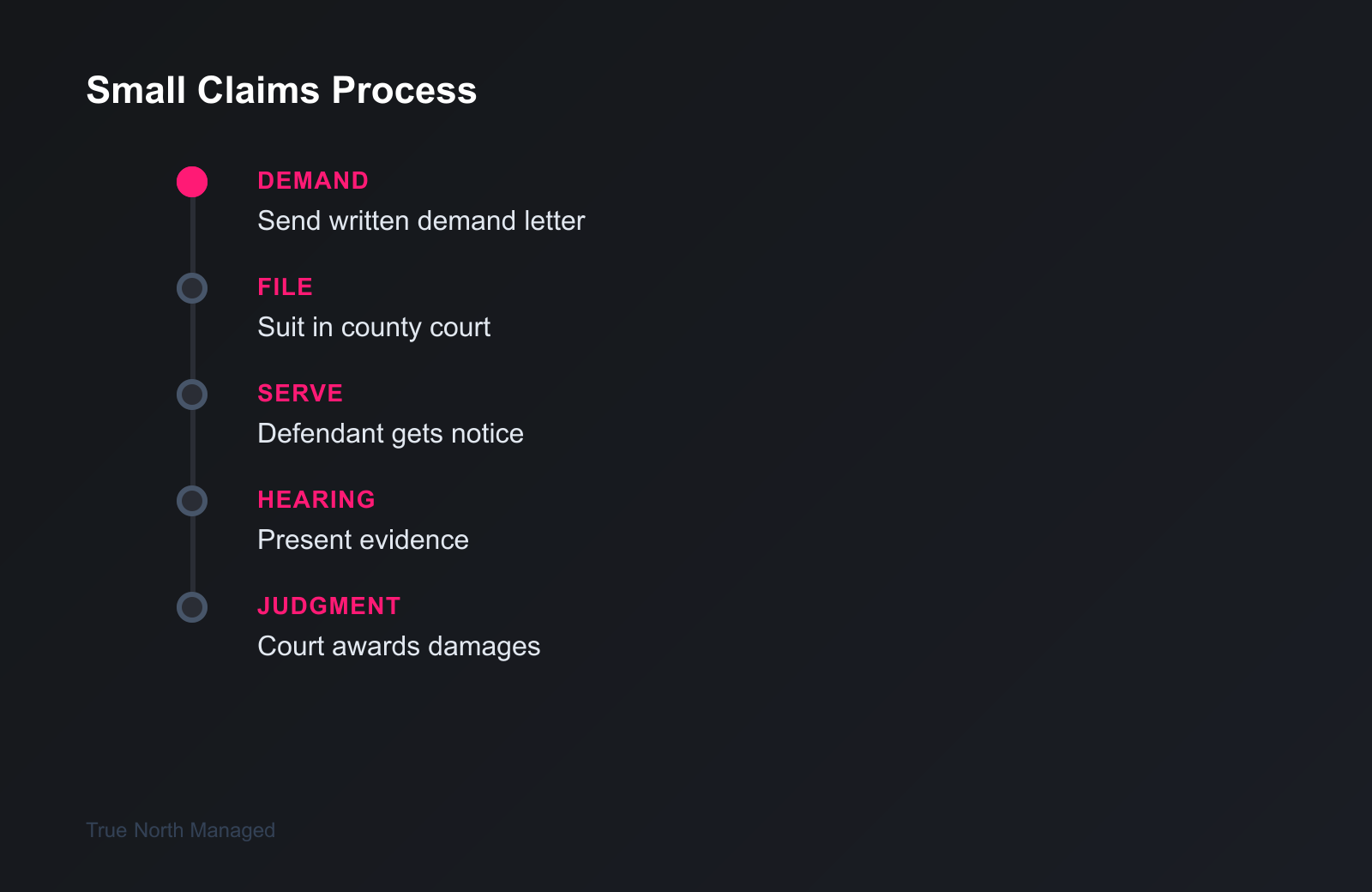
File at the county clerk's office in the county where the property is located.In Florida, You'll need the tenant's full name and address for service. The clerk has forms. FL landlords in Orlando and Tampa should check local requirements.
File at the county clerk's office in the county where the property is located. You'll need the tenant's full name and address for service. The clerk has forms. You pay a filing fee (typically $100–$300 depending on the amount claimed). The clerk issues a summons.
Service of Process
The defendant must be served.In Florida, You can use the sheriff, a process server, or certified mail in some cases. Service costs $50--$100. FL landlords in Orlando and Tampa should check local requirements.
The defendant must be served. You can use the sheriff, a process server, or certified mail in some cases. Service costs $50–$100. If the tenant has moved and you can't find them, you may need to use -- publication, which is more expensive and slower.
Mediation
Florida requires mediation before a small claims trial in many counties.A mediator tries to help you settle. If you reach an agreement, it's put in writing. FL landlords in Orlando and Tampa should check local requirements.
Florida requires mediation before a small claims trial in many counties. A mediator tries to help you settle. If you reach an agreement, it's put in writing. If not, you proceed to the hearing.
The Hearing
You present your evidence: lease, rent ledger, invoices, photos.In Florida, The judge asks questions. You don't need a lawyer, but you need to be organized. FL landlords in Orlando and Tampa should check local requirements.
You present your evidence: lease, rent ledger, invoices, photos. The judge asks questions. You don't need a lawyer, but you need to be organized. Bring copies of everything. If you win, you get a judgment.
Collecting the Judgment
Winning doesn't mean you get paid.In Florida, The tenant may ignore the judgment. You can pursue wage garnishment, bank levy, or a lien on property. FL landlords in Orlando and Tampa should check local requirements.
Winning doesn't mean you get paid. The tenant may ignore the judgment. You can pursue wage garnishment, bank levy, or a lien on property. Each has steps and costs. Some tenants are judgment-proof (no job, no assets). See ourtenant damage recoveryguide for how to document and pursue claims.
Florida Small Claims Rules
The Florida Small Claims Rules govern procedure.County clerk websites have local forms and fee schedules. Orange County Clerk and Hillsborough County Clerk both have small claims guides online. FL landlords in Orlando and Tampa should check local requirements.
TheFlorida Small Claims Rulesgovern procedure. County clerk websites have local forms and fee schedules. Orange County Clerk and Hillsborough County Clerk both have small claims guides online.
Small claims is a tool, not a guarantee. For help with tenant disputes and evictions in Orlando or Tampa,get a free rental analysisand we can discuss how property management handles legal matters.
The $8,000 Limit
Florida small claims courts handle civil disputes up to $8,000, including unpaid rent, damages, and security deposit disputes.Claims above that go to county court. You can reduce a claim to fit small claims to avoid higher filing fees and a longer process, but you waive the excess.
Florida small claims courts handle civil disputes up to $8,000, including unpaid rent, damages, and security deposit disputes. Claims above that go to county court. You can reduce a claim to fit small claims to avoid higher filing fees and a longer process, but you waive the excess. Calculate whether the savings justify it.
Filing Steps
File a Statement of Claim at the county clerk.In Orange County, use the Orange County Clerk of Court ; in Hillsborough, the Hillsborough County Clerk . Pay the filing fee (typically $300 to $400 for small claims).
File a Statement of Claim at the county clerk. In Orange County, use theOrange County Clerk of Court; in Hillsborough, theHillsborough County Clerk. Pay the filing fee (typically $300 to $400 for small claims). Serve the defendant by certified mail, sheriff, or process server. The clerk can provide service options.
Mediation and Hearing
Many courts require mediation before a hearing.In Florida, Mediation is often free or low-cost and can resolve disputes quickly. If it doesn't, you get a hearing date. FL landlords in Orlando and Tampa should check local requirements.
Many courts require mediation before a hearing. Mediation is often free or low-cost and can resolve disputes quickly. If it doesn't, you get a hearing date. Bring copies of the lease, notices, and any documentation of damages or unpaid rent. Judges expect organized evidence. Ourtenant damage recovery guidecovers documenting losses.
Evidence Gathering Before You File
Organize your case before you walk into the clerk's office.Bring the lease, copies of all notices sent, rent ledgers, photos of damages, and any written communication. Judges expect clear documentation. FL landlords in Orlando and Tampa should check local requirements.
Organize your case before you walk into the clerk's office. Bring the lease, copies of all notices sent, rent ledgers, photos of damages, and any written communication. Judges expect clear documentation. UnderFlorida Statute 83.49, you must have provided a list of damages that could result in deposit deductions. Ourtenant damage recovery guidecovers documenting losses.
Mediation Tips
Bring the lease, rent ledger, copies of notices, and any photos or receipts.Organize everything in chronological order. Florida small claims limit is $8,000 for most landlord-tenant disputes. FL landlords in Orlando and Tampa should check local requirements.
Evidence Preparation
Bring the lease, rent ledger, copies of notices, and any photos or receipts.Organize everything in chronological order. Florida small claims limit is $8,000 for most landlord-tenant disputes. FL landlords in Orlando and Tampa should check local requirements.
Bring the lease, rent ledger, copies of notices, and any photos or receipts. Organize everything in chronological order. Florida small claims limit is $8,000 for most landlord-tenant disputes. You can represent yourself. The judge will want to see that you gave proper notice and documented the damages or unpaid rent.
Judgment Collection
Winning is one step; collecting is another.In Florida, You can garnish wages, levy bank accounts, or place a lien on property. Each has a process and cost. FL landlords in Orlando and Tampa should check local requirements.
Winning is one step; collecting is another. You can garnish wages, levy bank accounts, or place a lien on property. Each has a process and cost. Some tenants are judgment-proof -- no job, no assets. Run a credit check before leasing to gauge collectability. A judgment on record can motivate payment over time.
Collecting After You Win
Winning a judgment in Florida small claims court is only half the battle -- collecting it's the other half.A judgment gives you the legal right to the money, but it doesn't put cash in your hand. Your collection tools include wage garnishment (up to 25% of disposable earnings), bank account levies, and liens on real property.
Winning a judgment in Florida small claims court is only half the battle -- collecting it's the other half. A judgment gives you the legal right to the money, but it doesn't put cash in your hand. Your collection tools include wage garnishment (up to 25% of disposable earnings), bank account levies, and liens on real property. Filing a judgment lien costs about $10 per county. Most former tenants will negotiate a payment plan once they realize the judgment follows them on credit reports and can be renewed for up to 20 years.
Many courts require mediation before a hearing. Mediation is often free and can resolve disputes in an hour. Come prepared with a number you'll accept. Listen to the tenant's position. A partial payment or payment plan may be better than a judgment you can't collect. Document any agreement in writing before you leave.
Filing and Costs
Hillsborough and Orange County small claims courts handle up to $8,000. Filing fees run $300–400. You'll need to serve the defendant—usually by sheriff or process server. Allow 2–4 months for a hearing.
Bring your evidence: lease, invoices, photos, correspondence. Judges want documentation. If you're organized, you'll have a better shot.