

Florida Security Deposit Law: What Landlords Get Wrong
Florida Statute 83.49 gives landlords 15 or 30 days to return deposits. Here's the timeline and the mistakes that trigger lawsuits.

You collected the deposit. Now what?
Your tenant moved out last Tuesday. The place needs cleaning, there's a hole in the drywall behind the bedroom door, and you're pretty sure that carpet stain wasn't there when they moved in. You're holding $1,800 in security deposit funds. Can you keep some of it? All of it?
The answer depends entirely on whether you follow Florida Statute 83.49 to the letter. And most Orlando landlords don't -- not because they're trying to cheat anyone, but because the deadlines are shorter than you'd expect and the rules are more specific than "just keep what's fair."
The Short Answer
you've 15 calendar days after your tenant moves out to return the full deposit if you're not claiming any deductions. If you want to keep part of it, you've 30 calendar days to send an itemized claim by certified mail. Miss either deadline and you forfeit your right to any of it -- plus you could be on the hook for the tenant's attorney fees. That's not a suggestion. It's Florida Statute 83.49(3)(a).
Tampa landlords face additional local requirements under theHillsborough County Tenant Bill of Rights— including bilingual disclosure forms and written late fee notices on top of the statewide deposit rules covered here.
Why This Matters in Orlando
Orlando's rental market has over 3,400 active listings right now and vacancy is running around 14.6% metro-wide. Tenants have options. And tenants who feel burned by a landlord who mishandled their deposit don't leave quietly -- they file complaints with the Florida Department of Agriculture and Consumer Services, leave one-star reviews, and sometimes file in small claims court. See ourfiling in small claims courtfor more.

Here's what makes deposit disputes expensive in Orlando: Section 83.49 includes an attorney fees provision. The winning party in a deposit lawsuit can recover their attorney fees and court costs. That means if your tenant sues you over a $1,800 deposit and wins -- because you sent the notice on day 32 or forgot to itemize -- you're paying back the full depositplus$2,000-5,000 in their attorney fees. Many tenant attorneys in Orange County take deposit cases without charging the tenant upfront. They know a procedural violation by the landlord is almost a guaranteed win.
We've seen Orlando landlords lose $3,000+ in disputes they should have won -- cases where the damage was real, the photos existed, but the claim notice went out on day 32 instead of day 30. The statute doesn't care about your intentions. It cares about your calendar.
On top of that, Florida updated its deposit rules in 2025. Two changes that matter: electronic notices are now allowed (with written consent), and landlords can offer a nonrefundable monthly fee as an alternative to a traditional deposit. If you're still operating on what you learned five years ago, you're operating on outdated information.
How do you store a security deposit in Florida?
Florida Statute 83.49(1) gives you three options. Pick one:
- Separate non-interest-bearing accountin a Florida banking institution. This is what most landlords use. Simple, no interest calculations, no complications.
- Interest-bearing accountin a Florida banking institution. If you go this route, your tenant is entitled to at least 75% of the annualized average interest rate, or 5% simple interest per year -- whichever you choose at the beginning of the tenancy.
- Surety bondposted with the clerk of the circuit court in the county where the property is located. The bond amount must equal the total deposits you're holding, and you owe the tenant 5% simple interest per year.
Here's what trips people up: you must notify your tenant in writing within 30 days of receiving the deposit. That notice has to include the name of the bank, the account type, and whether it's interest-bearing. Skip this notice and you've already started the tenancy with a procedural violation.
One exception worth knowing:if you own fewer than five rental units in Florida, you're technically exempt from this 30-day disclosure requirement under the statute. But we still recommend doing it. It takes five minutes, it sets expectations, and it removes an argument your tenant could use later if things go sideways.
Most Orlando landlords we work with use option 1. It's the cleanest. No interest math, no surety bond premium, no headaches.
What can you actually deduct?
Florida law lets you deduct for:
- Unpaid rent (including the last month if they skipped it)
- Damage beyond normal wear and tear
- Cleaning costs to return the unit to the condition documented at move-in
- Lease violation costs
- Early termination fees if your lease includes them
But -- and this is where landlords get into trouble -- you can't deduct for normal wear and tear. And Florida courts have been specific about what that means.
InBurley v. Mateo(Broward County, 2011), the court ruled that carpet cleaning, general house cleaning, and interior painting after a tenancy were normal wear and tear -- not deductible from the deposit. Scuffed baseboards after a two-year tenancy? Wear. Faded paint near windows where the sun hits? Wear. A worn path in the carpet from the front door to the living room? Wear. Small nail holes from hanging pictures? Also wear.
What youcancharge for: a fist-sized hole punched in a wall, pet urine damage soaked into the subfloor, broken windows, burn marks on countertops, or a unit left in a condition that goes beyond "needs a good cleaning" into "the health department would have questions."
Courts also consider proration. If your tenant lived in the unit for four years and you're trying to charge them full replacement cost for carpet that was already three years old when they moved in, a judge is going to look at you sideways. The carpet had seven years of use on a product with a 10-year lifespan. You don't get to charge for a brand-new carpet.
The documentation rule is everything. We do a 200+ photo move-in inspection on every property we manage, timestamped and signed by the tenant. Without that, deduction disputes become your word against theirs -- and Florida courts tend to side with the tenant when the landlord can't produce evidence. If you'rescreening tenants properlyand documenting the property at move-in, you're already ahead of 80% of Orlando landlords.
What are the exact deadlines?
This is the part that gets Orlando landlords in trouble more than anything else. Think of it as the "15-30-15" rule.
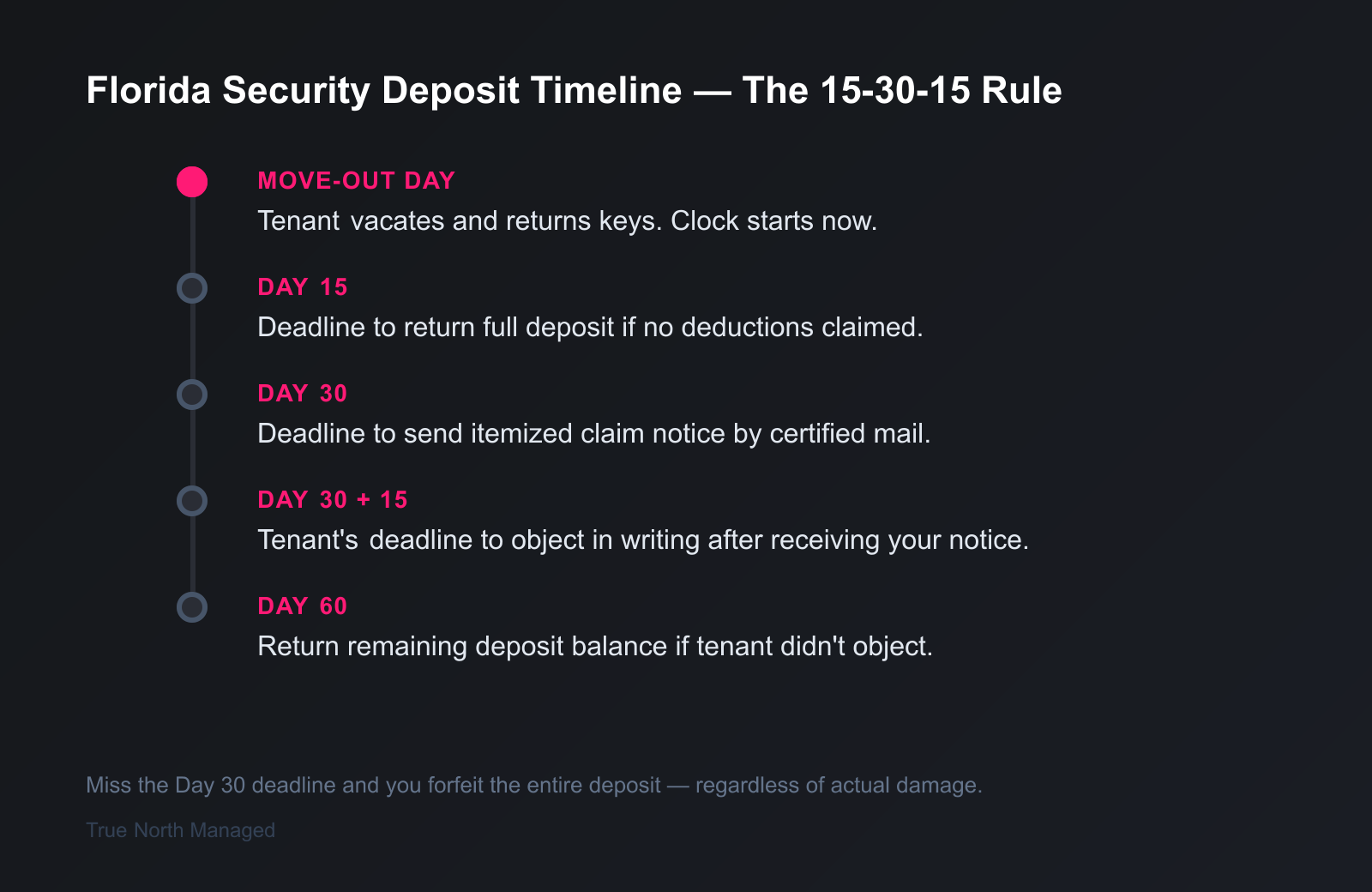
No deductions -- 15 days:Return the full deposit within15 calendar daysof the tenant vacating and returning keys. Not 15 business days. Calendar days. If your tenant moves out on March 1, that deposit needs to be in their hands (or postmarked) by March 16.
Claiming deductions -- 30 days:Send written notice bycertified mailwithin30 calendar daysof the tenant vacating. The notice must include:
- Your intent to impose a claim on the deposit
- An itemized list of every deduction with specific dollar amounts
- A statement that the tenant has 15 days to object in writing
"General cleaning and repairs -- $800" won't cut it. You need specifics: "$175 for professional carpet cleaning (receipt attached). $340 for drywall repair in master bedroom (contractor invoice attached). $285 for deep cleaning of kitchen and bathrooms (receipt attached)." That level of detail.
Tenant response -- 15 days:After the tenant receives your notice, they've 15 days to object in writing. If they don't object within that window, you can keep the claimed amount and return the rest within 30 days of your original notice date.
Miss the 30-day window? You lose every penny of the deposit. Even if the tenant left the place looking like a demolition site. The statute is that strict.
New as of July 2025:Florida Statute 83.49 now allows landlords and tenants to agree to electronic notices -- email, text, whatever you both sign off on. But both parties have to sign a written consent addendum under Section 83.505. You can't just decide to email the claim notice because it's easier. Without that signed addendum, certified mail is still the only option that counts.
What happens if your tenant disputes the claim?
This is the section most landlord guides skip -- and it's the part that actually matters when things go wrong.
If your tenant sends a written objection within that 15-day window, you're in a dispute. The deposit money sits frozen. Florida law doesn't spell out a mandatory next step here, which means you've three options:
- Negotiate.Sometimes a tenant objects to one line item but not others. You can agree to split the difference and move on. This is the cheapest, fastest outcome for everyone.
- Wait.You hold the deposit, and the tenant decides whether to sue you. Here's the thing most landlords don't realize: your tenant has up tofive yearsto file a lawsuit for the disputed amount. Five years. Over a $500 argument about carpet cleaning.
- File first.You take the dispute to small claims court yourself. In Orange County, that means filing at the downtown Orlando courthouse (425 N. Orange Avenue), or the branch locations in Apopka, Ocoee, or Winter Park. You can also file through Florida's e-filing portal. Filing fees for most deposit disputes run$175(for claims $500-$2,500) or$300(for claims $2,500-$8,000).
The reality? Most deposit disputes never make it to a courtroom. A well-documented claim with photos, receipts, and a signed move-in report usually ends the argument before it starts. The landlords who end up in court are the ones who skipped the documentation or missed a deadline.
And remember the attorney fees provision: whichever side wins can collect their legal costs from the losing side. That's why getting the paperwork right the first time matters more than being "right" about the damage.
What about the monthly fee alternative?
This one's new. Florida Statute 83.491, effective 2025, lets landlords offer tenants anonrefundable monthly feeinstead of a traditional security deposit. Think of it like deposit insurance from the tenant's perspective -- they pay less upfront, and you still have protection.
Here's how it works: you offer the option (you can't require it), the tenant agrees in writing, and they pay a recurring monthly fee for the duration of the lease. If they cause damage or skip rent, you file a claim against the fee program, not the tenant directly.
It's still new enough that most Orlando landlords haven't adopted it yet. We're watching how it plays out in practice before we recommend it broadly. The upside is obvious -- tenants prefer lower move-in costs, which means faster lease-ups and a larger applicant pool in a market where theaverage Orlando rent of $1,943already pushes the affordability limit. The downside is the claims process adds a third party between you and your money.
Common Mistakes Orlando Landlords Make
- Spending the deposit.This one should be obvious, but it happens more than you'd think. The deposit isn't your money until the tenant moves out and you've followed the proper claims process. We've seen landlords use deposit funds to cover their own mortgage shortfall mid-lease. That's a violation -- and if the tenant demands it back at move-out, you owe it immediately regardless of what the tenant did to the unit.
- Sending the claim notice late.Day 31 is too late. There's no grace period, no "I was on vacation," no exceptions. Set a calendar reminder on the day your tenant gives notice. Better yet, set two reminders.
- Not itemizing deductions.Vague deductions are the fastest way to lose a deposit dispute. Every charge needs a specific description and dollar amount. Attach receipts or contractor estimates. If you can't explain a deduction in one sentence with a number attached, it's not ready to include.
- No move-in documentation.If you didn't take photos and get a signed condition report at move-in, you've got almost nothing to base your deductions on. Judges know this. Tenants' attorneys know this. Start every tenancy with a thorough move-in inspection or accept that you're giving the full deposit back regardless of what you find at move-out.
- Trying to charge for normal wear and tear.Repainting walls after a three-year tenancy, replacing carpet that was already showing age, cleaning grout that's a little discolored -- none of these are deductible. If you can't point to specific damage that wouldn't exist with reasonable use, don't include it.
Next Steps
Security deposit law isn't complicated once you know the deadlines and the paperwork. But it's unforgiving if you're sloppy about it. One missed deadline, one vague deduction, one missing photo from move-in -- and you're writing a check for the full deposit plus potentially the tenant's attorney fees.
A lot of the landlords we work with in Orlando came to us after a deposit dispute that cost them more than the deposit itself. Some were managing from out of state -- dealing withvacant properties and deferred maintenanceon top of the legal paperwork. If you want someone to handle the deposit process correctly from day one -- move-in inspections, proper storage, timely notices, itemized claims -- that's exactly what we do.
Start with a free rental analysis and we'll show you where your property stands.