
Repair vs. Replace: A Florida Landlord's Decision Guide
Should you fix that rental fridge or buy a new one? The 50% rule decides it — but in Florida you have to move the math, because appliances here die years early.
Florida's heat decides this call before you do
The repair tech is standing in your Tampa rental, hands on hips, looking at a fridge that just quit cooling. "I can fix it," he says. It's the third time you've heard that about this unit. The national lifespan chart on your phone says a refrigerator lasts 13 years and yours is only nine, so you say yes again.
Here's the problem. That chart wasn't written for Florida.
Quick answer: Use the 50% rule — if a repair costs more than half the price of a comparable new appliance, or the unit is more than halfway through its useful life, replace it. The catch for Florida landlords: appliances and HVAC here wear out faster than the national tables say, so the "halfway" line lands sooner. Index the rule to a Florida lifespan, not the manufacturer's, and the decision gets clearer fast.
This guide walks the actual math, the climate reasons behind it, the Florida law that puts a clock on the decision, and how the repair-vs-replace choice changes your taxes.
When should a Florida landlord repair an appliance instead of replacing it?
Repair when the fix costs less than half the price of a comparable new unit and the appliance is in the first half of its realistic Florida lifespan. Replace when either test fails. The 50% rule is the standard. What changes in Florida is the lifespan number you measure against — it's shorter here.
The rule has two parts, and a lot of landlords only run the first one. Part one is cost: a $700 repair on a $1,200 fridge is 58% of replacement — too much, replace it. Part two is age: even a cheap repair on an appliance that's past its midpoint is usually money you'll spend again within a year or two.
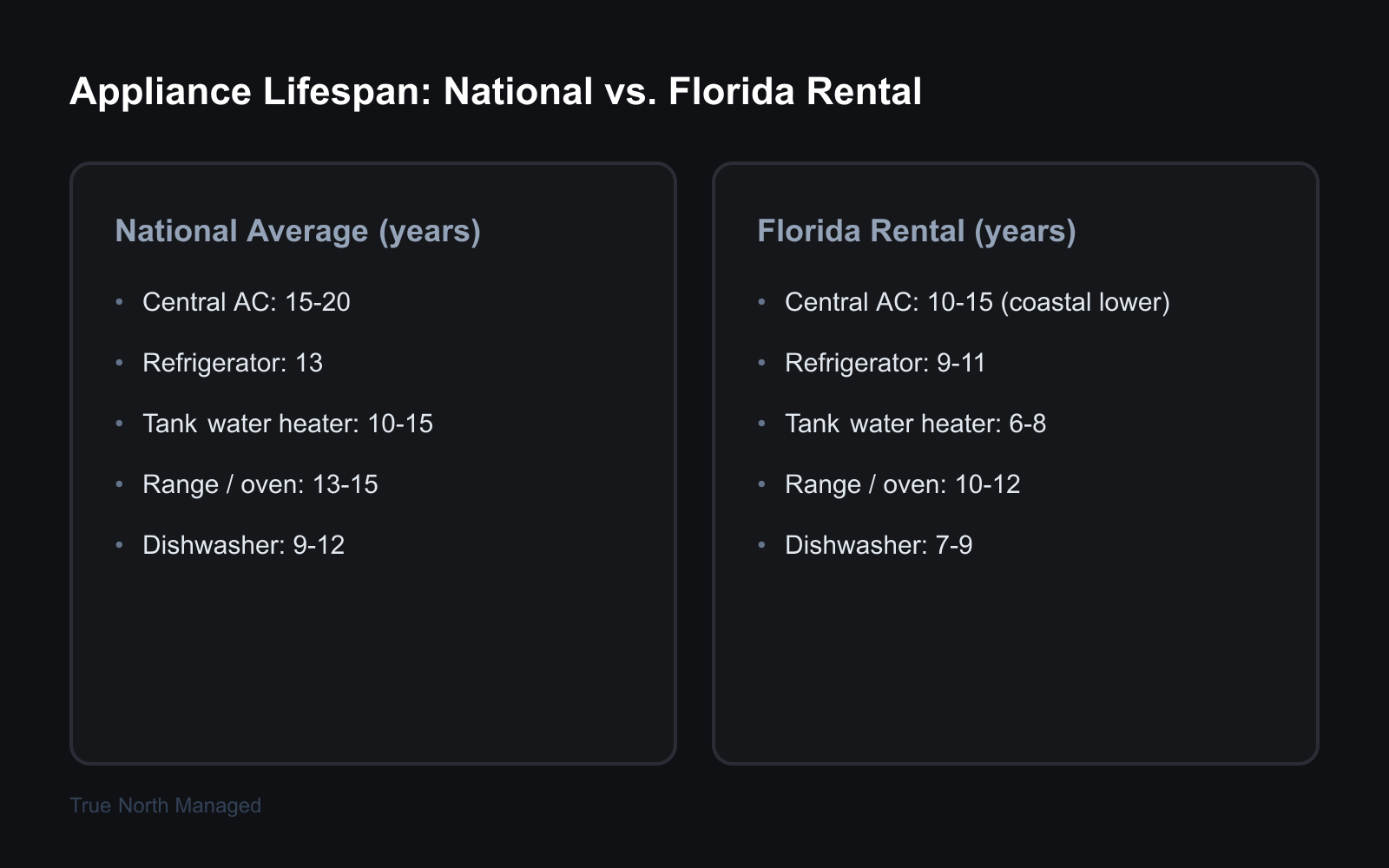
That second part is where Florida bites. National lifespan numbers come from charts like the InterNACHI life-expectancy reference that every property blog quotes. They're averages built across the whole country — Ohio basements included.
Call the adjustment "Florida's Shortened Clock." Every appliance lifespan number you read should be trimmed for a Florida rental — roughly 20% to 40%, more if the property is near salt water. An appliance that's "only nine years old" by the national chart may already be well past its real midpoint here. Run the 50% rule against the Florida number and the borderline repairs stop being borderline.
Why do appliances die faster in Florida rentals?
Three things shorten appliance and HVAC life in Florida: constant humidity, a cooling system that runs most of the year, and salt air near the coast. Together they push HVAC lifespans down to 10 to 15 years, and tank water heaters to 6 to 8 years.
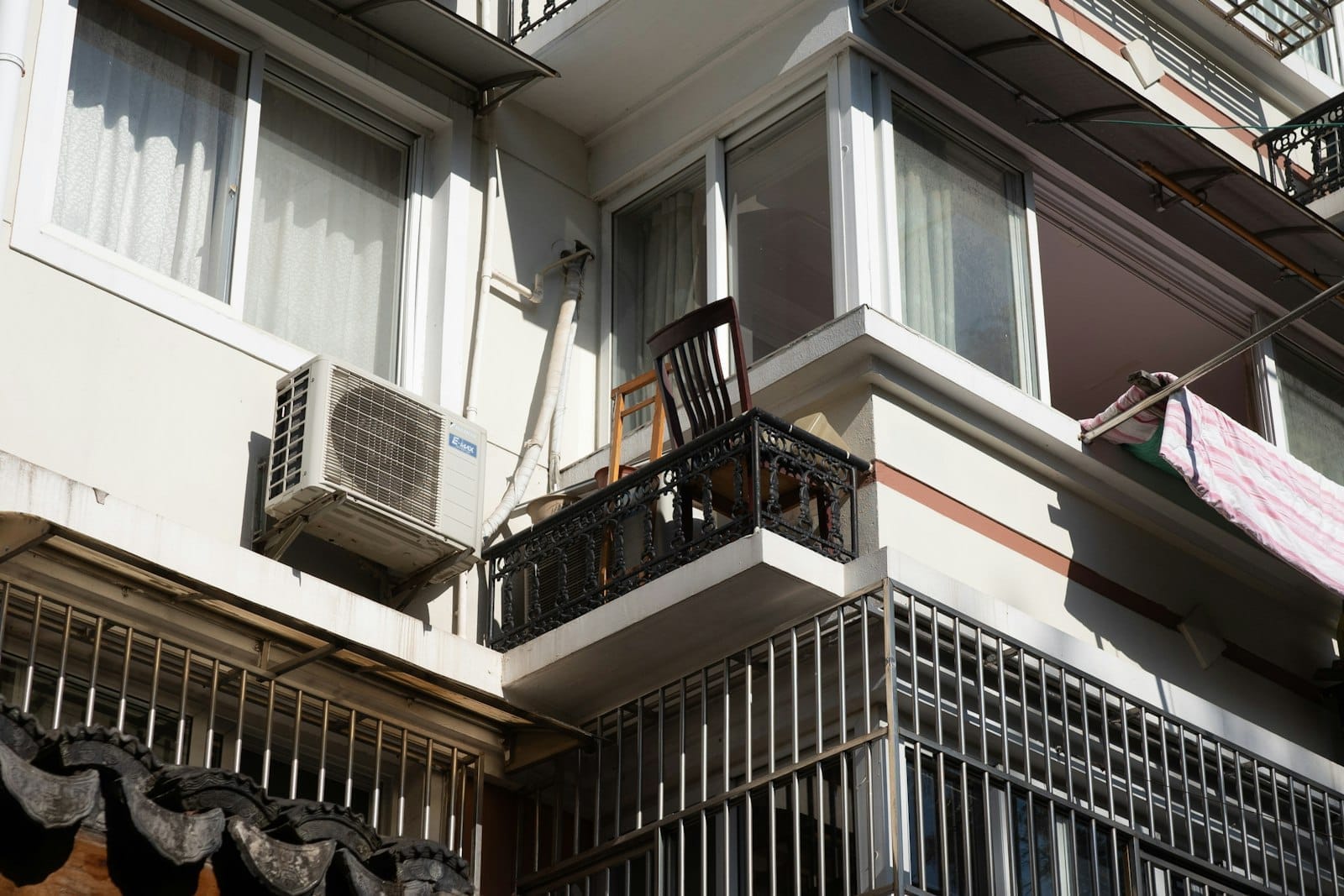
Start with the air conditioner, because it's the most expensive thing on the list. A central AC in a northern state might run 1,000 hours a year. A Florida system runs 3,000 to 4,000 hours a year — close to year-round. More runtime means more wear on the compressor, blower motor, and coils. Humidity makes it worse: the system works harder to pull moisture out of the air, and that moisture also feeds rust on metal components. Florida HVAC contractors put real-world lifespan at 10 to 15 years, and that's the inland number.
Then there's water. Much of Florida runs hard water — 15 to 25 grains per gallon in many areas. That mineral load builds sediment inside a tank water heater fast, and sediment is what kills the tank. The result: Florida landlords often replace water heaters every six to eight years.
Coastal property has a fourth problem. Salt air corrodes condenser coils and fins. A condenser that lasts 10 to 15 years inland can fail in three to five years near the beach, and coastal units commonly lose 30% to 40% of their expected life without protective coatings or extra maintenance. If your rental is in South Tampa or anywhere a sea breeze reaches, assume the short end of every range.
Maintenance buys some of that life back. A system serviced twice a year outlasts a neglected one by years — see our Florida rental maintenance calendar for what to schedule and when. But maintenance slows the clock; it doesn't reset it.
How do you actually run the repair-vs-replace math?
Take the repair quote, divide it by the cost of a comparable new appliance, and check where the unit sits in its Florida lifespan. Over 50% on cost, or past the Florida midpoint on age — replace. Under both — repair. The formula is simple; getting the lifespan number right is the part most landlords miss.
Here's the structure, with real 2026 Florida numbers.
Formula: Repair cost ÷ comparable new-unit cost = repair ratio. Combine that with lifespan position (how far through its realistic Florida life the appliance is).
Example one. Your Orlando rental's refrigerator — a basic rental-grade unit — needs a new compressor. The quote is $700. A comparable new fridge runs about $675 to $2,500 installed; a builder-grade replacement lands near $1,000. That's a 70% repair ratio. The fridge is also eight years old, past the Florida midpoint. Both tests fail. Replace it.
Example two. Same repair, $700, same compressor — but this fridge is a four-year-old mid-range unit that cost $2,200 new. Repair ratio: 32%. The unit is in the first half of its Florida life. Both tests pass. Repair it, and expect several more good years.
What's good or bad? Under 35% on a young appliance: an easy repair. 35% to 50% on a mid-life unit: a judgment call — lean toward replacement if it's already been fixed once. Over 50%, or any major repair on an appliance past its Florida midpoint: replace. And watch for "The Repair Trap" — the pattern where a landlord approves a $200 fix, then a $300 fix, then a $400 fix on the same unit, and the three repairs together cost more than one replacement would have. Appliances age as systems. When one major part goes from heat and runtime stress, the others usually aren't far behind.
What if you own the property from out of state? You can't stand in the kitchen and judge whether the tech's "I can fix it" is optimism or fact. Lean harder on the two numbers you can verify from anywhere: the appliance's age and the repair ratio. Ask your property manager or a trusted contractor for the comparable new-unit cost and the unit's age, run the 50% math yourself, and treat a second repair on the same appliance as a replace signal. A reliable local vendor network is what makes that call trustworthy when you're 1,000 miles away.
What does Florida law say about timing the decision?
Florida Statute 83.51 doesn't name a fridge, range, dishwasher, or central AC. Its core duty, in 83.51(1), is that the landlord "at all times during the tenancy shall: (a) Comply with the requirements of applicable building, housing, and health codes; or (b) Where there are no applicable building, housing, or health codes, maintain the roofs, windows, doors, floors, steps, porches, exterior walls, foundations, and all other structural components in good repair and capable of resisting normal forces and loads and the plumbing in reasonable working condition." The same subsection adds: "The landlord's obligations under this subsection may be altered or modified in writing with respect to a single-family home or duplex." For a unit other than a single-family home or duplex, 83.51(2)(a) goes further: "Unless otherwise agreed in writing, in addition to the requirements of subsection (1), the landlord of a dwelling unit other than a single-family home or duplex shall, at all times during the tenancy, make reasonable provisions for" a short list that includes "Functioning facilities for heat during winter, running water, and hot water" — which can reach a water heater. So an appliance duty comes mainly from your lease and from any code that covers the appliance — and when a failure is material, a tenant's written seven-day notice turns a slow capital decision into a legal deadline.
You're not required to provide a dishwasher or a microwave you never supplied. But once the lease lists an appliance or makes you responsible for it, its upkeep is generally on you under the lease — and if the lease is silent about one that came with the unit, don't assume it's the tenant's problem. Florida Statute 83.51 makes it a statutory duty where a building, housing, or health code covers it.
The timing piece is what catches landlords off guard. Under Florida Statute 83.56(1), "If the landlord materially fails to comply with s. 83.51(1) or material provisions of the rental agreement within 7 days after delivery of written notice by the tenant specifying the noncompliance and indicating the intention of the tenant to terminate the rental agreement by reason thereof, the tenant may terminate the rental agreement." So a tenant's written notice over a material failure gives you seven days to fix it before they can end the lease. Withholding rent runs through a different section, Florida Statute 83.60(1)(b): "The defense of a material noncompliance with s. 83.51(1) may be raised by the tenant if 7 days have elapsed after the delivery of written notice by the tenant to the landlord, specifying the noncompliance and indicating the intention of the tenant not to pay rent by reason thereof." That defense is tied to the code and structural duties in 83.51(1). Under 83.60(2), "In an action by the landlord for possession of a dwelling unit, if the tenant interposes any defense other than payment, including, but not limited to, the defense of a defective 3-day notice, the tenant shall pay into the registry of the court the accrued rent as alleged in the complaint or as determined by the court and the rent that accrues during the pendency of the proceeding, when due." In practice, a tenant who withholds over a repair has to deposit that rent with the court once you file for possession. For most appliances, seven days is a manageable window. For central AC in a Florida summer, it's a problem — a dead compressor in July gives you seven days, not seven weeks. Our guide to the Florida AC repair obligation covers that timeline in detail.
The practical lesson: don't start an HVAC repair-vs-replace decision in July. If your system is aging — past 10 years, or coastal and past seven — get the lifespan assessment done in spring. A planned March replacement is a calm decision with competing quotes. A July one is a panic buy during peak-season contractor backlog, with a seven-day clock running.
Repair or replace — does it change your taxes?
It can. A repair is deductible in full the year you pay for it. An improvement has to be depreciated. But for single rental appliances, a safe-harbor rule often lets you deduct a replacement now anyway — so "replace" doesn't automatically mean a slow write-off.
The IRS draws the line with what's called the BAR test: an expense is an improvement if it's a Betterment, an Adaptation, or a Restoration of the property. Swapping a worn-out fridge for a new one technically restores the property, which sounds like an improvement you'd depreciate. IRS Publication 527 puts "appliances, carpeting, and furniture used in a residential rental real estate activity" in the 5-year class, so a capitalized fridge is depreciated over 5 years.
Here's the part that helps you. The de minimis safe harbor lets a landlord currently expense items costing $2,500 or less per invoice — $5,000 with an applicable financial statement. Most single rental appliances fall under that threshold. So a $1,000 replacement fridge or an $800 range can often be deducted in the year you buy it, the same as a repair, instead of being spread over five years. Talk to your accountant about electing it — and read our Florida rental depreciation guide for how appliances fit into the bigger tax picture.
One 2026 note for HVAC specifically. New federal rules require A2L refrigerants in new systems, which has pushed installed prices up over older models. Florida's minimum efficiency standard is 14.3 SEER2 for most residential split systems. A full HVAC replacement is a bigger number than it was two years ago — another reason to make that decision deliberately, not under a seven-day clock.
Common mistakes Florida landlords make on this call
The biggest errors are trusting a national lifespan chart, paying for a third repair on the same dying unit, and waiting until an appliance fails completely before making any decision at all. Each one costs real money in a Florida rental, and each one is avoidable.
Trusting the national chart. A 12-year-old AC isn't "middle-aged" in Florida — it's near the end. A nine-year-old water heater isn't "fine" — it's on borrowed time. Run every decision against the Florida-adjusted number, not the chart.
Falling into the Repair Trap. If you've already paid for one repair on an appliance and it breaks again, the second quote isn't really a $300 question. It's a signal. Add up what you've spent — parts, labor, and the next quote — and compare the total to a replacement. Most of the time the unit is telling you it's done.
Waiting for total failure. A dead AC in August, a flooded laundry room from a burst water heater tank — those are emergencies, and emergencies cost more and box you into the seven-day cure window. Worth knowing how you'll handle a 2 a.m. failure before it happens — our emergency maintenance protocol for Florida rentals lays that out. But the landlords who handle this best replace aging appliances on a schedule, between tenants, when there's no tenant calling and no statutory clock running.
Repair-vs-replace isn't guesswork. It's the 50% rule, run against a Florida lifespan instead of a national one, with the law and the tax code factored in. Get the lifespan number right and most of these calls answer themselves.
If you'd rather not track the age of every appliance across your Florida rentals — or you want a manager who already knows which units are coming due — a free rental analysis from True North Managed is a straightforward place to start. We manage properties across Orlando and Tampa, and keeping appliances out of the emergency column is part of the job. For more on running a Florida rental well, the Florida Owner's Guide collects our operations and maintenance playbooks in one place.