

Renting Without a Lease in Florida: What Landlords Risk
A handshake tenancy is legal in Florida, but it costs you the protections you'd want most. Here's what a verbal lease can and can't do, and why you can't charge late fees without one.
What you must know: Renting without a written lease in Florida is legal. A handshake tenancy with monthly rent and no agreed term is month-to-month under Florida Statute 83.46. But it strips you of the protections you'd want most. You can't charge a late fee, you can't enforce custom terms, and you still owe every duty Chapter 83 puts on a landlord. The smart move is almost always to put it in writing.
Is it legal to rent without a written lease in Florida?
Renting without a lease in Florida is legal. An oral or handshake agreement creates a valid tenancy, and Florida Statute 83.46 sets its length: "If the rental agreement contains no provision as to duration of the tenancy, the duration is determined by the periods for which the rent is payable," and "if payable monthly, tenancy is from month to month." The catch: a verbal deal is hard to prove and strips you of contract-based protections like late fees.
Most landlords who end up with no written lease didn't plan it that way. You inherited a house and the relative living there just kept paying. You rented to a friend, a coworker, or your kid's college roommate, and a written lease felt cold for a handshake situation. Or the old lease expired, the tenant stayed, and nobody got around to signing a new one.
If that's you — one property, an informal arrangement, and a question you need answered — this guide is for you. Florida law still treats your tenant as a tenant with full rights, and it still treats you as a landlord with full duties. What you lose by skipping the paper is the leverage.
Is a verbal lease enforceable in Florida?
A verbal lease is enforceable in Florida for a term of one year or less. Florida's Statute of Frauds, Section 725.01, requires any lease "for a period longer than 1 year" to be in writing and signed. So an oral one-year tenancy holds up. An oral two-year deal does not.
Here's the nuance that confuses people. The Statute of Frauds blocks a long-term oral commitment. It does not erase the tenancy. If you struck a verbal two-year deal, a court won't enforce the two-year term, but the person living there and paying you rent is still a tenant. The arrangement simply collapses into a month-to-month tenancy that you and the tenant can each end with proper notice.
And a monthly oral tenancy doesn't magically become a "more than one year" lease just because it keeps running. A handshake month-to-month that goes on for three years is still an enforceable month-to-month. It never crosses the Statute of Frauds line, because each month is its own period. What you can't prove is anything you agreed to beyond the bare fact of rent for occupancy — the rent amount if it's disputed, who pays for what, whether pets were allowed. Without writing, it's your word against theirs.
Can a landlord charge late fees without a written lease in Florida?
No. A Florida landlord cannot charge or enforce a late fee without a written agreement that spells it out. A late fee is a contract term, not a right granted by statute — Florida has no law that imposes one. If there's no written lease (or the lease is silent on late fees), there is no fee to collect, no matter how late the rent is.
This is the single most-searched question about no-lease tenancies, so let's be clear about why the answer is no. Florida's residential landlord-tenant law, Part II of Chapter 83, never mentions late fees. There's no statutory late fee and no statutory cap. The nearest it comes is the definition of rent in 83.43(12): "'Rent' means the periodic payments due the landlord from the tenant for occupancy under a rental agreement and any other payments due the landlord from the tenant as may be designated as rent in a written rental agreement." So a late fee counts as rent, and can go on a three-day notice, only if a written lease designates it that way. The only reason a late fee is ever enforceable is that the tenant agreed to it in a written lease — the exact dollar amount or percentage, the trigger date, and the grace period. Take away the written agreement and you've taken away the agreement to pay the fee.
So the verbal-tenant who pays on the 20th instead of the 1st owes you rent. They do not owe you a $75 late charge, because they never agreed to one in writing. If you try to deduct it from the deposit or tack it onto a balance, the tenant can challenge it and win.
The fix is straightforward: get a signed lease (or even a signed late-fee addendum) in place before the next rent period. Our Florida late fee guide for landlords walks through how to word a clause that actually holds up in court — the reasonable range, the grace period, and the one-time-per-payment structure that survives a challenge. The point here is simpler: with no written lease, you don't get to the wording stage at all.
What rules still apply when there's no written lease?
All of Chapter 83 still applies. A verbal tenancy doesn't get you out of a single landlord obligation — maintenance, deposit handling, proper notice, and the eviction process all bind you exactly as they would under a written lease. The Florida Residential Landlord and Tenant Act governs the relationship, not the paper.

This is the part that catches landlords off guard. People assume "no lease" means "no rules." It's the opposite. You lose the contract terms that protect you, and you keep every duty the statute puts on you. Here's what still applies, in full:
You still have to maintain the property. Florida Statute 83.51 requires you to "Comply with the requirements of applicable building, housing, and health codes," or, "Where there are no applicable building, housing, or health codes," to "maintain the roofs, windows, doors, floors, steps, porches, exterior walls, foundations, and all other structural components in good repair and capable of resisting normal forces and loads and the plumbing in reasonable working condition." That second list is the fallback where no code applies, not a floor under the codes. For a unit other than a single-family home or duplex, 83.51(2)(a) adds, on top of either duty, running water, hot water, heat, locks, and pest control. None of it is conditioned on a written lease. A handshake tenant has the same right to a habitable home as a tenant who signed a 12-page document.
You still owe the deposit back on the statutory clock. If you collected a security deposit on a handshake, Florida Statute 83.49 still governs how you return it. You have 15 days after the rental agreement ends to return the full deposit if you're claiming nothing, or, if you are, 30 days to send written notice of your claim and the reason for it, by certified mail to the tenant's last known mailing address or by e-mail, but only if you and the tenant both signed the written e-mail addendum s. 83.505 requires. Miss that 30-day window and the statute is specific about what you lose: "If the landlord fails to give the required written notice within the 30-day period, he or she forfeits the right to impose a claim upon the security deposit and may not seek a setoff against the deposit but may file an action for damages after returning the security deposit to the tenant." The real damage isn't written off, but the whole deposit goes back first, and recovering the damage becomes a separate lawsuit. The oral nature of the tenancy doesn't pause that clock. Our Florida security deposit law guide covers what you can actually deduct.
You still have to give proper notice to end it. Because a verbal monthly tenancy is month-to-month, either of you can end it by "giving written notice in the manner provided in s. 83.56(4)" and, for a month-to-month tenancy, "by giving not less than 30 days' notice prior to the end of any monthly period," under Florida Statute 83.57. (That's the current rule — it changed from 15 days in 2023.) Part II of chapter 83, Florida's residential landlord-tenant law, sets no rent-increase notice period for a month-to-month tenancy, but the safe practice is to give the same 30-day written notice. You can't just tell a handshake tenant to leave by the weekend, and you shouldn't bump the rent with a text message. Our Florida month-to-month tenancy guide breaks down the notice mechanics and how to count the days.
You still have to go through the courts to remove them. No written lease does not mean self-help. Florida Statute 83.67 makes it illegal to change the locks, shut off utilities, or remove a tenant's belongings to force them out. Do it and 83.67(6) makes you "liable to the tenant for actual and consequential damages or 3 months' rent, whichever is greater, and costs, including attorney's fees." To remove a non-paying handshake tenant, you serve a three-day notice, then file for eviction in county court — same process as any other tenancy.
Can you raise rent or evict without a written lease?
Yes, but you follow the same process as a written month-to-month. To raise rent, give at least 30 days' written notice before the increase takes effect; chapter 83 sets no such period for a month-to-month tenancy, but it's the safe practice. To evict for non-payment, serve a three-day notice to pay or vacate, then file in county court if rent stays unpaid. A verbal tenancy changes nothing about the procedure.
Florida Statute 83.46(1) says: "Unless otherwise agreed, rent is payable without demand or notice; periodic rent is payable at the beginning of each rent payment period." So a handshake tenant who pays monthly owes rent on the 1st, late fee or not. If they don't pay, the three-day pay-or-vacate notice is your starting gun — the same notice you'd use on a written lease.
What the verbal tenancy does change is your proof problem. In an eviction over non-payment, you'll need to show the rent amount and that it wasn't paid. With a written lease, that's one document. With a handshake, you're rebuilding the agreement from rent receipts, bank deposits, and texts. Judges accept that evidence, but it's a heavier lift, and a tenant who disputes the rent amount can drag the case out. That alone is a reason to get terms in writing.
What are the real risks of renting without a lease?
The risks of renting without a lease in Florida land almost entirely on the landlord. You can't enforce late fees, you can't prove custom terms, you carry a harder burden in any dispute, and you have no documented record of the property's move-in condition. The tenant keeps full statutory protection; you give up the upper hand.
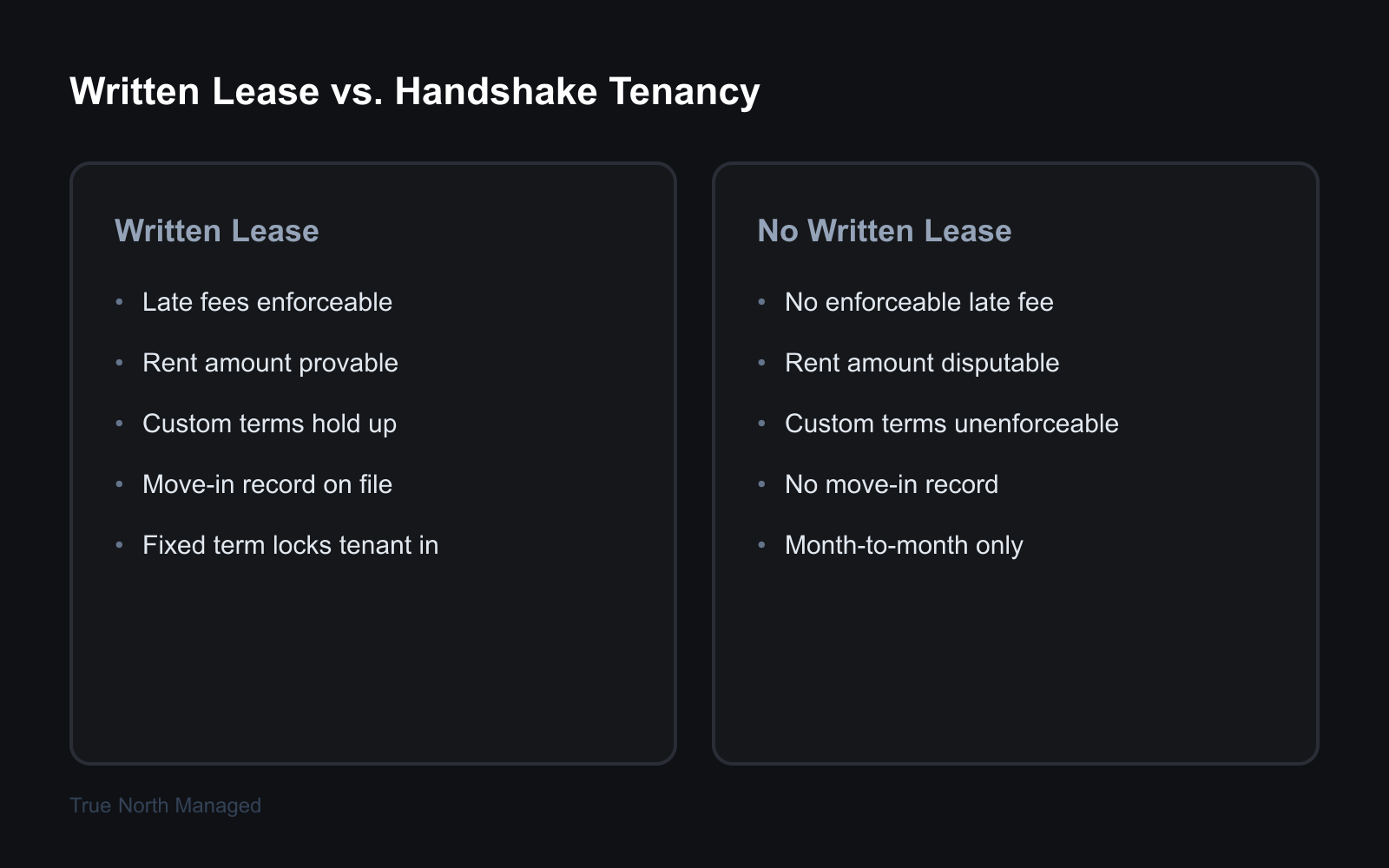
Walk through what a written lease would have given you that a handshake doesn't:
- Late fees you can collect. Covered above — no written clause, no fee.
- A provable rent amount. If the tenant claims the rent was $1,400, not $1,600, you're arguing from memory.
- Custom terms. Pet rules, who handles lawn care, smoking, guests, parking, subletting. None of it is enforceable if it was never written down.
- A move-in condition record. No signed move-in checklist means a deposit dispute becomes a "the carpet was already stained" standoff you'll probably lose.
- A fixed term. A handshake with monthly rent and no agreed term is month-to-month, so your tenant can give 30 days' written notice before the end of any monthly period and leave. You have no lease term locking them in for the year.
- Clear deposit terms. Without writing, even the deposit amount and purpose can be contested.
For an out-of-state owner especially, an unwritten arrangement is a trap. You can't see the property, you can't verify what was agreed, and you're managing a relationship with no record from a thousand miles away. The handshake that felt friendly becomes the thing you can't prove when it goes sideways.
Should you ever rent without a written lease?
Almost never. The only situations where a handshake is defensible are extremely short, low-stakes ones — a relative staying a month, a house-sitter paying token rent. For any real tenancy with real money changing hands, a written lease costs you nothing and protects you on every front a handshake can't.
We get the instinct. Renting to family or a longtime friend, asking them to sign a lease can feel like you don't trust them. But a written lease isn't about distrust — it's about both of you knowing the rules so a misunderstanding doesn't blow up the relationship. The clearest leases we write are often the ones between people who like each other, because nobody wants the friendship to be the casualty of a vague deal.
If you're already renting on a handshake, you don't have to wait for the tenancy to end. You can sign a written lease or a simple addendum mid-tenancy that documents the rent, the terms, and a late-fee clause going forward. Our Florida lease agreement guide walks through the clauses that matter and what Florida law lets you include. Converting a handshake to paper is one of the highest-value hours a landlord can spend.
Common mistakes landlords make without a written lease
Three errors show up again and again with no-lease tenancies, and each one is avoidable:
Assuming "no lease" means "more freedom." It means less. You shed your protections and keep every duty. A landlord who thinks the handshake lets them charge what they want, enter when they want, or remove the tenant at will is setting up an expensive lesson.
Trying to charge late fees anyway. A late fee with no written agreement behind it isn't enforceable. Charging it, or deducting it from the deposit, exposes you to a challenge you'll lose — and can muddy a deposit return that was otherwise clean.
Skipping the move-in documentation. Even without a formal lease, photograph the unit at move-in and move-out and keep dated copies. A deposit claim with no condition record is a deposit claim you're likely to lose under Statute 83.49's itemization rules.
Get a lease signed and most of this disappears. The handshake feels easier on day one and costs you on the day a dispute starts.
The bottom line on renting without a lease in Florida
Renting without a lease in Florida is legal, and an oral monthly tenancy is fully enforceable as month-to-month. But "legal" isn't the same as "smart." A handshake keeps every obligation Chapter 83 puts on you — habitability, deposit deadlines, proper notice, the court eviction process — while taking away the protections you'd want most. No enforceable late fee. No provable terms. No move-in record. A heavier burden in every dispute.
The fix is cheap and fast: put it in writing. Even mid-tenancy, a signed lease or addendum turns a vague arrangement into something you can actually enforce.
If you own one rental and you'd rather not figure out leases, notices, and deposit deadlines on your own, you don't have to. We manage single properties across Orlando and Tampa — including drafting enforceable leases for owners who started on a handshake. Get a free rental analysis and we'll walk through your situation, no pressure.