

Rental Property Tax Deductions: The Complete Florida Checklist
Every deductible expense for Florida rental owners: mortgage interest, depreciation, repairs vs improvements, insurance, travel, and professional services.

Florida landlords get the same federal tax deductions as landlords everywhere. The difference: no state income tax means you keep more of what you save. Here's the full checklist of what you can deduct and how to document it.
What Can Florida Landlords Deduct?
Rental income and expenses go on IRS Schedule E .In Florida, You report gross rent, subtract allowable expenses, and arrive at net rental income or loss. IRS Publication 527 is the official guide. FL landlords in Orlando and Tampa should check local requirements.
Rental income and expenses go onIRS Schedule E. You report gross rent, subtract allowable expenses, and arrive at net rental income or loss.IRS Publication 527is the official guide. The IRSrecordkeeping tipsfor rental real estate spell out what to keep. The big categories: mortgage interest, property taxes, insurance, repairs, maintenance, depreciation, professional services, and travel. For 2025, the IRSstandard mileage ratefor rental activity is 70 cents per mile.
Mortgage Interest and Property Taxes
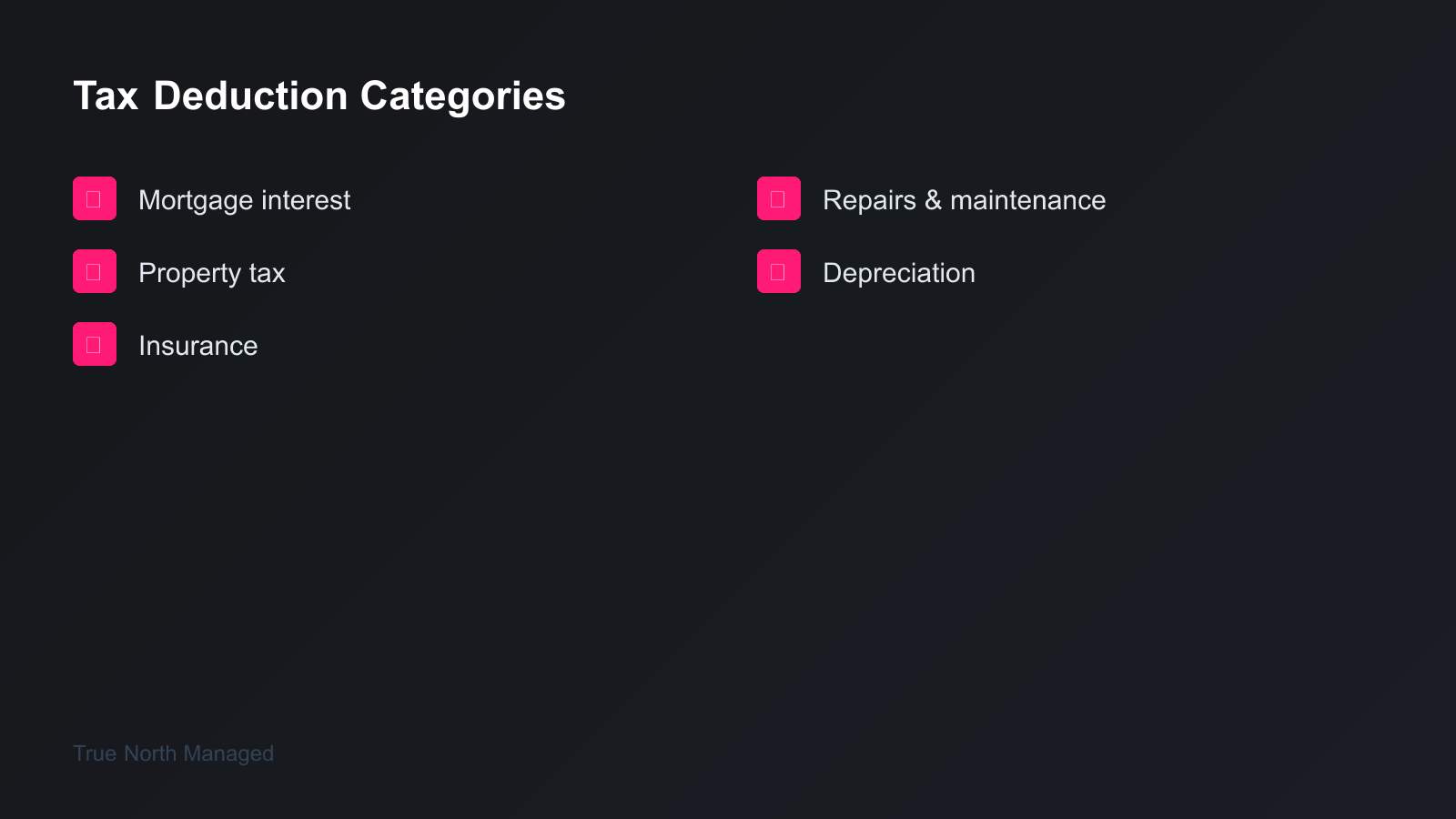
Mortgage interest on rental property is fully deductible.So are property taxes. Florida has no state income tax, but you still pay county property tax and, in some cases, tangible personal property tax on furnishings and equipment.
Mortgage interest on rental property is fully deductible. So are property taxes. Florida has no state income tax, but you still pay county property tax and, in some cases, tangible personal property tax on furnishings and equipment. All of it goes on Schedule E. See ourFlorida rental property tax guidefor how assessments work.
Depreciation: The 27.5-Year Rule
Residential rental property is depreciated over 27.In Florida, 5 years. You don't deduct the full purchase price in year one. FL landlords in Orlando and Tampa should check local requirements.
Residential rental property is depreciated over 27.5 years. You don't deduct the full purchase price in year one. You take a fraction each year. Land isn't depreciable; only the building and certain improvements. Your CPA or tax software will calculate it. The key: keep records of your cost basis and any improvements -- that extend the depreciable life.
Repairs vs. Improvements
Repairs restore the property to its prior condition.In Florida, Fixing a broken AC, patching a roof leak, replacing a damaged cabinet. These are deductible in the year incurred. FL landlords in Orlando and Tampa should check local requirements.
Repairs restore the property to its prior condition. Fixing a broken AC, patching a roof leak, replacing a damaged cabinet. These are deductible in the year incurred. Improvements add value or extend life. New roof, full kitchen remodel, adding a bathroom. These must be depreciated. The line matters for tax timing. A $500 repair is a $500 deduction this year. A $15,000 kitchen upgrade spreads over 27.5 years.
Insurance Premiums
Landlord insurance, flood, windstorm, and umbrella policies are all deductible.Florida's insurance market is volatile; keep premium records for every policy year. If you bundle with a personal policy, only the rental portion is deductible.
Landlord insurance, flood, windstorm, and umbrella policies are all deductible. Florida's insurance market is volatile; keep premium records for every policy year. If you bundle with a personal policy, only the rental portion is deductible.
Travel and Mileage
Trips to the property for management, repairs, or tenant meetings are deductible.In Florida, So are mileage for hardware store runs, contractor meetings, and property inspections. The IRS rate changes annually. FL landlords in Orlando and Tampa should check local requirements.
Trips to the property for management, repairs, or tenant meetings are deductible. So are mileage for hardware store runs, contractor meetings, and property inspections. The IRS rate changes annually. Log date, miles, and purpose. The IRS can ask for documentation.
Home Office
If you use a dedicated space in your home exclusively for rental management, you may deduct a portion of home expenses.In Florida, The rules are strict. A desk in the corner of a bedroom usually doesn't qualify.
If you use a dedicated space in your home exclusively for rental management, you may deduct a portion of home expenses. The rules are strict. A desk in the corner of a bedroom usually doesn't qualify. A separate office used only for rental business might.
Professional Services
Property management fees, attorney fees, accountant fees, and eviction costs are deductible.If you use a property manager in Orlando or Tampa , their monthly fee is fully deductible. Same for leasing fees and maintenance coordination.
Property management fees, attorney fees, accountant fees, and eviction costs are deductible. If you use aproperty manager in OrlandoorTampa, their monthly fee is fully deductible. Same for leasing fees and maintenance coordination.
Florida-Specific: Tangible Personal Property Tax
Florida counties assess tangible personal property (TPP) on business assets.Furnished rentals, appliances, and equipment may be subject. If you receive a TPP return, file it. FL landlords in Orlando and Tampa should check local requirements.
Florida counties assess tangible personal property (TPP) on business assets. Furnished rentals, appliances, and equipment may be subject. If you receive a TPP return, file it. The tax is deductible.
Whether you self-manage or use a property manager, clean records make tax season predictable. If you're in Orlando or Tampa and want help with the operational side so you can focus on the numbers,get a free rental analysisand we can walk through what a managed property looks like on paper.
Home Office Deduction
If you manage rentals from home, you may qualify for a home office deduction.In Florida, The space must be used regularly and exclusively for rental activity. Options: simplified method ($5/sq ft, max 300 sq ft) or actual expenses.
If you manage rentals from home, you may qualify for a home office deduction. The space must be used regularly and exclusively for rental activity. Options: simplified method ($5/sq ft, max 300 sq ft) or actual expenses. Document your use. For more ondepreciation, see our guide.
Common Deduction Mistakes
Claiming personal expenses.Only rental-related costs count. Missing travel: trips to inspect or manage the property are deductible. FL landlords in Orlando and Tampa should check local requirements.
Claiming personal expenses. Only rental-related costs count. Missing travel: trips to inspect or manage the property are deductible. Forgetting to depreciate: you must take it or lose it. Mixing timelines: 2025 expenses go on your 2025 return, not when you paid the bill. Keep receipts organized by property and year. ForFlorida landlord tax filing, see our 2025 guide.
Bottom line: repairs are deductible now; improvements get depreciated. Track everything. Mileage, travel, and home office can add up. Don't miss depreciation—it's a major deduction.IRS Publication 527is the authority. Organize receipts by property and year.
Consider cost segregation for a major purchase or renovation. It accelerates depreciation and can create a paper loss that offsets other income. Requires a study ($1,500–3,000) but can save thousands in year one. A CPA can run the numbers for your situation.
Keep a mileage log. Every trip to the property, the hardware store for supplies, or a meeting with your property manager counts. The IRS allows a per-mile rate for rental activity. A simple app or spreadsheet works. Missing mileage is leaving money on the table—it adds up over a year.
What to Watch
If you're not sure whether a repair is a deduction or a capital improvement, ask your CPA.In Florida, The line matters -- repairs can be deducted in the year you make them; improvements get depreciated over time.
If you're not sure whether a repair is a deduction or a capital improvement, ask your CPA. The line matters -- repairs can be deducted in the year you make them; improvements get depreciated over time.
Common Deductions Landlords Miss
Mileage for property visits is deductible. Track every trip—IRS allows the standard rate. A property management company can deduct their visits; if you self-manage, you should too. It adds up over a year.
Home office deduction applies if you've a dedicated space for rental business. It doesn't have to be a full room—a desk in a corner counts. The simplified method is $5 per square foot, up to 300 sq ft. That's $1,500 per year.
Depreciation Basics
You depreciate the building, not the land. The IRS assumes 27.5 years for residential. A $275,000 property with $75,000 land value gives you $200,000 to depreciate—about $7,273 per year. That's a paper deduction that reduces taxable income.
When you sell, you recapture that depreciation at 25%. Plan for it. A 1031 exchange defers it. Otherwise, set aside cash for the tax bill.
Bottom Line
Track everything. Mileage, home office, repairs. Depreciation is a paper deduction—plan for recapture when you sell.
Keep receipts for 7 years. The IRS can audit rental returns. A shoebox of receipts beats a reconstructed spreadsheet.
When in doubt, document it. Florida landlords who follow the process and keep a paper trail protect themselves when disputes arise. A few minutes of documentation can save months of headaches.
Keep your receipts organized by property and by category. That makes tax time easier and gives you a clear trail if the IRS ever asks.