

The Real Cost of Self-Managing Your Florida Rental Property
Self-managing a Florida rental costs more than the management fee you're trying to save. Between vacancy, maintenance markup, legal mistakes, and your own time, most landlords underestimate the real number by thousands.

The Real Cost of Self-Managing Your Florida Rental Property
You're trying to save money by managing your own rental. That's reasonable — why pay someone 8–12% of your rent if you can do it yourself? But here's what most Florida landlords don't factor in: the management fee is the cost you can see. The costs you can't see are bigger.
Between vacancy days, maintenance overcharges, legal missteps, and the sheer number of hours you're spending, self-managing a Florida rental typically costs $4,200 or more per year in hidden expenses. That's more than most property management fees for a single-family home renting at $2,000/month.
Let's put real numbers on it.
How Much Is Your Time Actually Worth?
Self-managing landlords spend 8–20 hours per month on a single property. That includes fielding tenant calls, coordinating repairs, showing the unit when it's vacant, handling lease paperwork, and keeping your books straight for tax season.
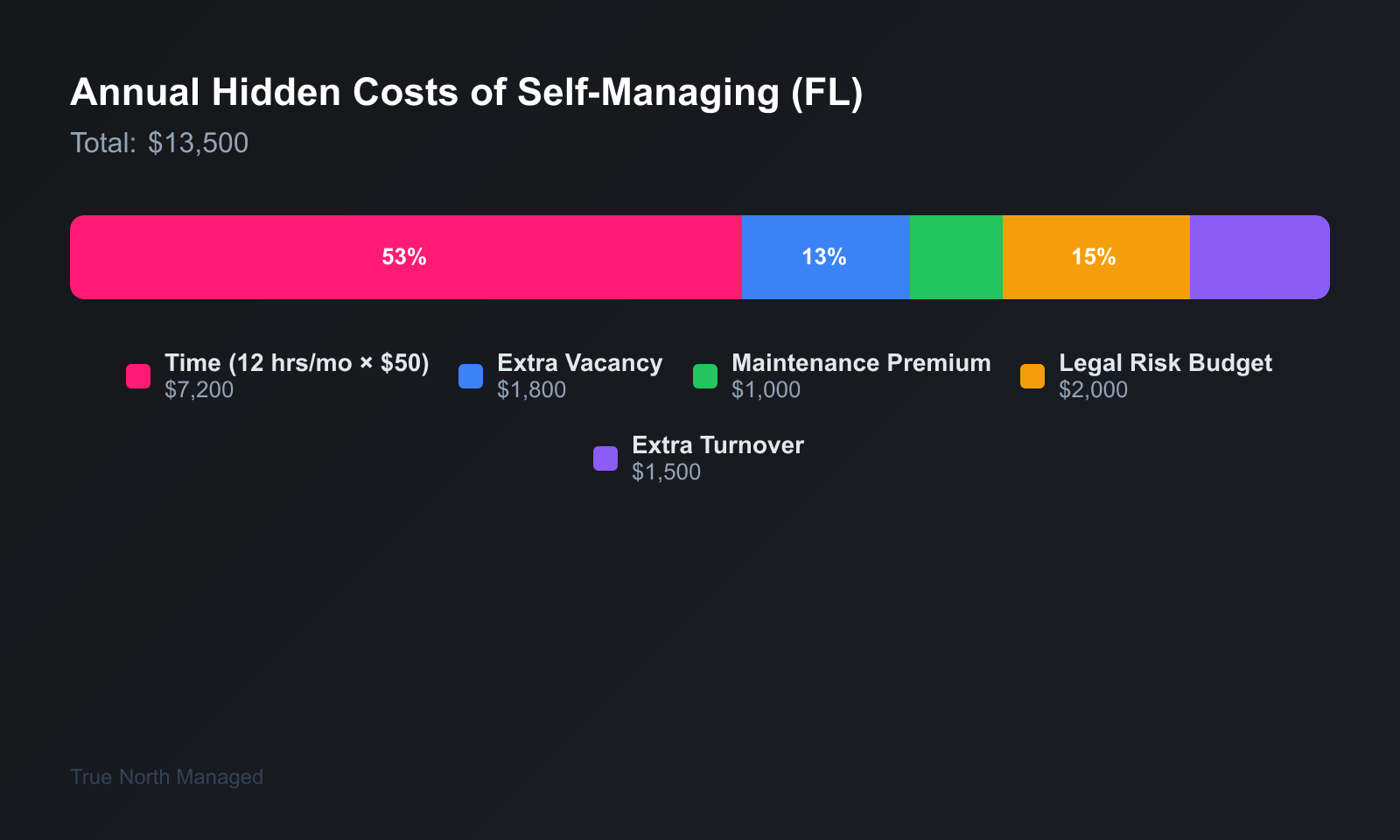
Say you spend 12 hours a month — a conservative middle estimate. If your professional time is worth $50/hour (and if you have a salaried job, it probably is), that's $600/month in opportunity cost. $7,200 a year.
Now compare that to a property management fee on a $2,000/month rental: 10% is $200/month, or $2,400/year.
You're "saving" $2,400 in PM fees while spending $7,200 worth of your time. That's not savings. That's a $4,800 annual loss.
And that math only works if everything goes smoothly. When something goes wrong — and in Florida, something always goes wrong — the time multiplies.
What Does Vacancy Really Cost You?
Every day your property sits empty, you're losing money. Not just the rent — you're still paying the mortgage, insurance, property taxes, and HOA fees (if applicable). On a $2,000/month rental, that's roughly $67/day in lost rent alone.
Professional property managers typically fill vacancies in 2–3 weeks. Self-managing landlords average 4–6 weeks. That two-week difference? $933 in lost rent.
And it compounds. If your tenant leaves and you take 6 weeks to fill the unit instead of 3, you've lost $2,800. That's more than a full year of management fees on a $2,000/month property.
The gap comes from three things self-managers struggle with:
- Pricing. You either set the rent too high (it sits) or too low (you leave money on the table for the entire lease term). A PM who prices 50 units a month knows your zip code's sweet spot down to the dollar.
- Marketing. Listing on Zillow alone isn't enough. PMs syndicate across dozens of platforms and have their own lead pipelines.
- Showing speed. If you can't show the unit at 5:30 PM on a Wednesday because you're at work, you lose qualified applicants to landlords who can.
What Happens When Maintenance Goes Wrong?
Without a vendor network, you're calling whoever pops up first on Google. And you're paying retail.
A property manager with 100+ doors negotiates volume rates with licensed, insured contractors. That same AC repair that costs you $1,200 on an emergency weekend call might cost the PM's owner $800 through their HVAC vendor. The 10% maintenance markup a PM charges ($80 in this case) still leaves you $320 ahead.
Here's where it really adds up: Florida's climate is hard on rentals. The humidity eats HVAC systems. Hurricane season brings wind, water, and insurance claims. Pest control isn't optional — it's a year-round line item.
Self-managing landlords defer maintenance because they don't see the early warning signs. A slow drain becomes a $4,000 mold remediation. A noisy AC compressor becomes a $6,500 full system replacement. A PM running seasonal maintenance schedules catches these before they blow up.
Here's a scenario that plays out every summer in Orlando and Tampa: your tenant calls about the AC running constantly but not cooling below 82 degrees. You don't have an HVAC guy on speed dial, so you Google one. The first company available charges $175 for a weekend diagnostic. Turns out the coils are dirty and the refrigerant is low — $650 for the fix. Total: $825.
A PM with a vendor relationship? Their HVAC tech charges $95 for the call and $400 for the same repair. Total: $495. The PM's 10% markup adds $50, bringing your bill to $545. You still saved $280 — and the tech came out the same day instead of making your tenant wait three days in August.
The typical Florida landlord who self-manages spends $500–$1,500 more per year on maintenance than a comparable PM-managed property, because they're paying retail rates, catching problems late, and dealing with after-hours emergencies without vendor relationships.
How Much Do Legal Mistakes Actually Cost?
This is the category that bankrupts landlords who never saw it coming.
Florida's landlord-tenant law under FL Statute 83 is specific about notice periods, security deposit handling, eviction procedures, and habitability standards. Get one step wrong, and you're not just delayed — you're starting over.
Eviction mistakes. A Florida eviction done correctly costs $500–$1,500 in filing fees and attorney costs, plus 3–6 weeks of timeline. A botched eviction — wrong notice, improper service, missed deadline — restarts the clock. That's another month of lost rent ($2,000) on top of the legal fees. Self-managing landlords who try to evict without an attorney lose cases at higher rates because the paperwork has to be exact.
Security deposit violations. FL 83.49 requires you to notify the tenant within 30 days of receipt about how you're holding the deposit. Miss that deadline, and you forfeit your right to make any claim. That's $2,000–$4,000 in deposit money you can never touch, even if the tenant trashes the place.
Fair housing liability. A discrimination complaint — even an unfounded one — costs $3,000–$10,000 to defend. And if you lose, damages can hit six figures. One inconsistent screening decision, one careless comment during a showing, one ad that says "perfect for young professionals" — that's all it takes.
A property manager who handles tenant onboarding 200 times a year knows exactly where these legal tripwires are. You're learning on the job with your own money at stake.
The Breakeven Formula: When a PM Pays for Itself
Here's a formula you can apply to your own situation:
Your annual PM cost = (Monthly rent × Management % × 12) + (Leasing fee × Placements per year)
Your annual self-management cost = (Hours per month × Your hourly rate × 12) + (Extra vacancy days × Daily rent) + (Maintenance premium) + (Legal risk exposure)
For a $2,000/month rental with a 10% management fee and one placement per year:
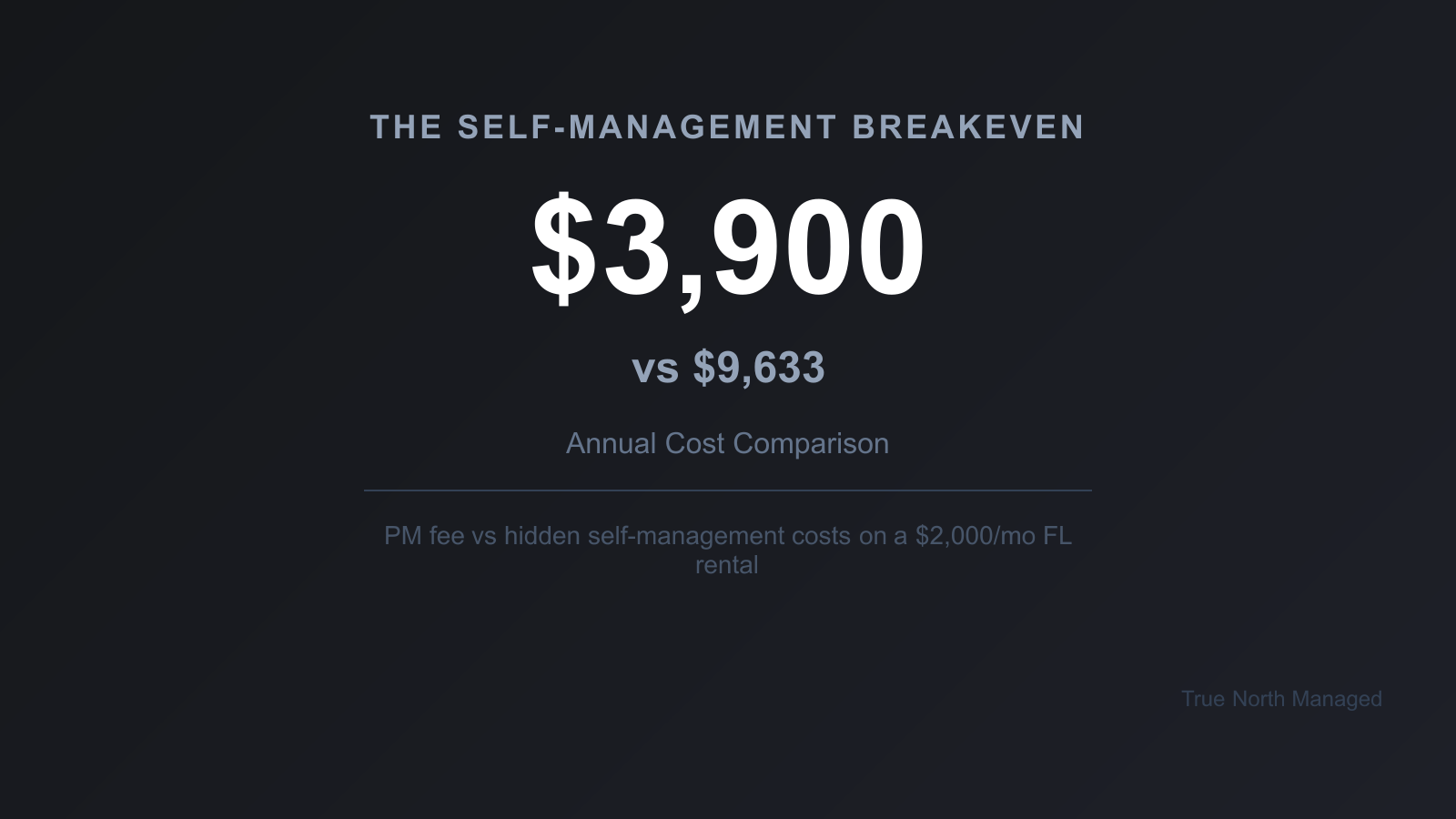
- PM cost: ($2,000 × 10% × 12) + ($1,500) = $3,900/year
- Self-management cost: ($600/month × 12) + ($933 extra vacancy) + ($1,000 maintenance premium) + ($500 legal risk budget) = $9,633/year
The PM saves you $5,733 in this scenario. And that's conservative — it doesn't include the one eviction that eats $4,000 or the mold remediation you didn't prevent.
The breakeven tilts further toward PMs when you own multiple properties. Managing one rental is a part-time hobby. Managing three is a part-time job. Managing five without systems, vendor relationships, and legal expertise? That's where self-management goes from expensive to dangerous.
How Much Does Tenant Turnover Actually Cost?
Every time a tenant leaves, there's a bill — whether you're self-managing or not. But self-managing landlords pay more because they handle each step slower and without systems.
Here's what a typical Florida turnover costs:
- Cleaning: $200–$400 for a professional deep clean
- Paint touch-ups: $300–$800 depending on scope
- Carpet replacement or cleaning: $200–$600
- Minor repairs: $200–$500 (holes, fixture replacements, hardware)
- Re-keying: $75–$150
- Marketing and showing time: 10–20 hours of your time
- Vacancy period: 3–6 weeks of lost rent ($1,400–$2,800 on a $2,000/month unit)
All-in, a single turnover runs $2,400–$5,200 when you include vacancy.
PMs reduce turnover in two ways. First, they screen better — tenants who pass a professional screening process stay longer on average. Second, they manage the relationship. Prompt maintenance, clear communication, and fair lease renewal offers keep good tenants from looking elsewhere.
A PM-managed property averages a turnover every 24–30 months. Self-managed properties average every 18–22 months. Over a 5-year period, that difference means one fewer turnover — saving you $3,000–$5,000.
What Self-Management Gets Right
Let's be honest: there are situations where self-managing makes sense.
If you own one rental, live nearby, have flexible hours, and genuinely enjoy the work — the PM fee might not be worth it for you. Some landlords like the control. They like knowing exactly which plumber is coming and exactly how much the repair costs. They like interviewing tenants face-to-face.
And there's a learning curve that has real value. Managing your first property yourself teaches you what property managers do, which makes you a better client if you eventually hire one.
But "I can do it cheaper" isn't the right frame. The right question is: "What's my time worth, and am I willing to bet on myself handling every legal, maintenance, and tenant situation correctly?"
For most Florida landlords — especially those who work full-time, live out of state, or own more than one property — the answer is no. And the cost of getting it wrong dwarfs the PM fee.
If you're spending more hours managing your rental than you planned, or if the math above looks familiar, it might be time to see what professional management would actually cost for your specific property.
Get a free rental analysis — we'll break down the numbers for your rental, no obligation, and you can decide whether the economics make sense.