
Q1 2026 Market Pulse: Orlando vs Tampa — The Supply Story Splits
Orlando's construction pipeline is shrinking while Tampa's stays elevated. Here's what Q1 2026 data means for landlords in both markets — and why the playbook just diverged.

Orlando and Tampa both swallowed record apartment deliveries in 2025. But heading into spring 2026, these two markets aren't telling the same story anymore.
One market is digesting the supply glut. The other is still chewing.
Here's where the numbers landed for Q1 2026 — and what the divergence means for your rent and your next move.
What's the headline number for Q1 2026?
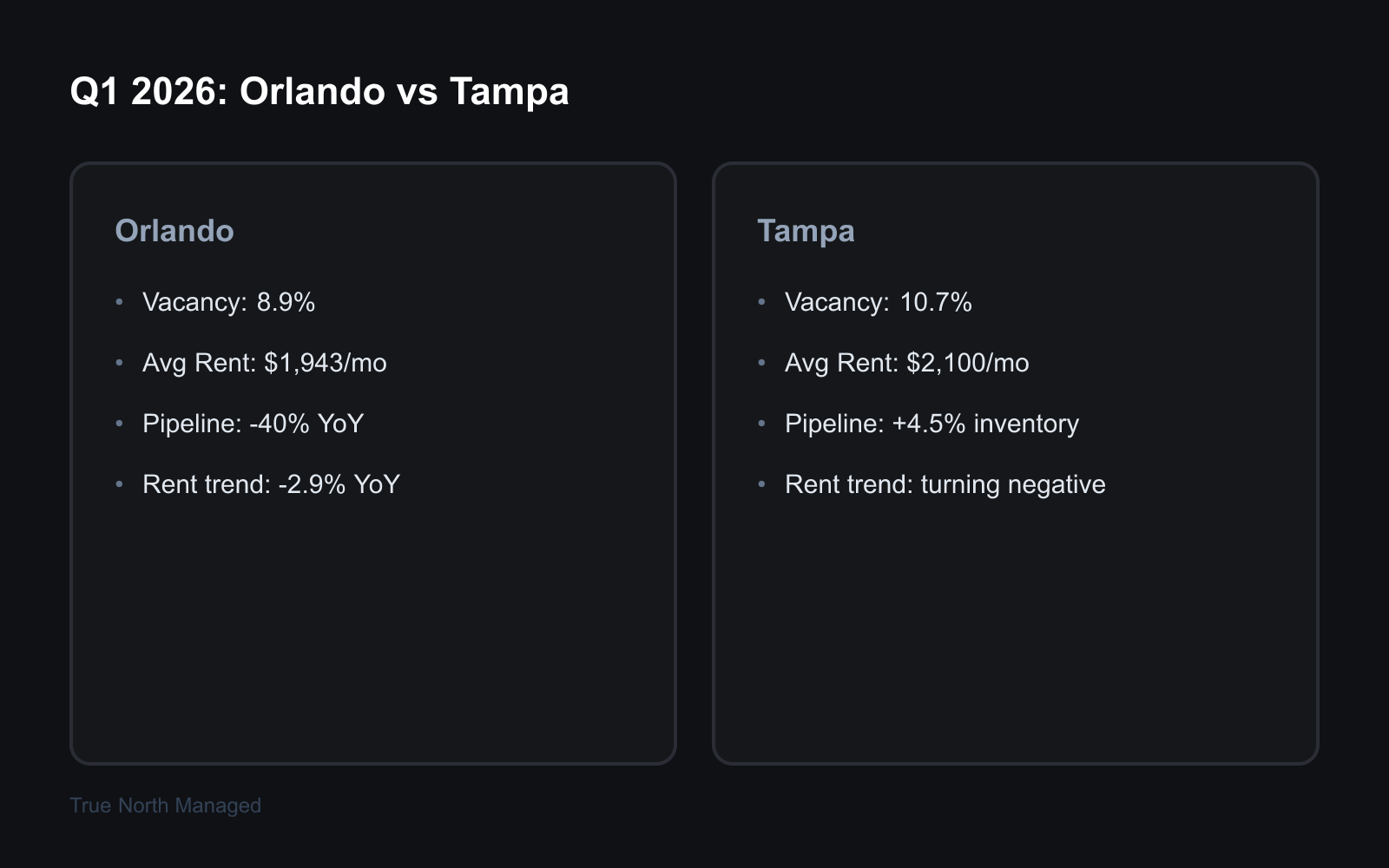
Orlando's vacancy rate is holding at roughly 8.9%, down from peak levels and projected to stay flat through year-end. Tampa's vacancy hit 10.7% — the highest level since CoStar began tracking the market in 2000. That's not a blip. That's a 25-year record.
The side-by-side:
| Metric | Orlando | Tampa |
|---|---|---|
| Average rent (all types) | $1,943/mo | $2,100/mo |
| 3BR SFH rent | $2,365/mo | $2,660/mo |
| YoY rent change | -2.9% | +1.2% |
| Vacancy rate | ~8.9% | 10.7% |
| Net absorption (TTM) | ~8,000 units | ~6,126 projected |
Tampa's rents are higher in dollar terms. But Orlando's vacancy is nearly two full points lower — and that gap is about to widen.
Where is each market's construction pipeline?
Orlando's construction pipeline contracted about 40% year-over-year — far fewer units under construction than 12 months ago. That's the single biggest reason its vacancy is stabilizing. Fewer buildings coming online means less competition from brand-new apartments offering two months free rent.
Tampa? Different story. The metro has about 11,000 units under construction and expects to deliver 7,559 apartments in 2026. Projected absorption? Only 6,126 units. That's a gap of about 1,400 units — and those empty apartments are going to push vacancy even higher before it comes down.
Put differently: Tampa's inventory is expanding by 4.5% this year. The national average is 2.6%.
Orlando landlords are past the worst of the supply wave. Tampa landlords aren't there yet.
How are rents holding up?
Both markets show softness, but the trajectory differs. Orlando's average rent sits at $1,943 according to Zillow — down $57 year-over-year. That decline is decelerating, though. Northmarq projects Orlando rent growth returning to +1.2% by year-end 2026. The floor is close, if it hasn't already arrived.
Tampa's average is $2,100 — technically up $25 year-over-year. But rent growth turned negative in late 2025, and with 7,559 new units competing for tenants this year, landlords in Central Tampa, New Tampa, and Pasco County should expect downward pressure on asking rents through at least mid-2026.
For single-family landlords, the picture is a bit brighter. SFH rents aren't directly competing with the apartment supply wave. A 3BR house in Orlando averages $2,365/mo. In Tampa, $2,660/mo. These held up better because renters choosing houses over apartments aren't the same pool being poached by new Class A buildings offering two months free.
One bright spot both markets share: insurance. Some Florida landlords are seeing premium drops of 30-50% at renewal — driven by fewer hurricane claims and a stabilizing reinsurance market. A Seffner landlord reported premiums falling from $2,738 to $1,371. That's $1,367/year straight to the bottom line. If your renewal is coming up, shop it. Hard.
What should landlords do this spring?
The playbook just split by market. Here's where we'd steer you.
If you own in Orlando:
Hold your rent. Don't panic-cut because you've seen a few listings sit. The supply pipeline is contracting, population growth is the fastest among large US metros (76,000 new residents in the latest year), and employment is projected to grow 1.3% — above both the state and national rate.
One thing to watch: unemployment doubled from 3.0% to 4.4% over the past year. That's not a crisis, but it's a signal. If you're renewing a lease, a $25-50/mo increase is supportable. Don't push for $100+ unless your unit is way below comps.
If you own in Tampa:
Price to market on day one. Don't chase. Tampa's 10.7% vacancy means tenants have options — and the newest buildings are giving them concessions you can't match with a 15-year-old house. If your listing sits for two weeks, drop the price or offer a move-in incentive. A vacant month costs you $2,100+. A $500 concession costs you $500.
The silver lining: Tampa's wage growth hit 5%, and cap rates average 7.1% — higher than Orlando's 6.7%. For investors buying, Tampa actually offers better cash-on-cash returns right now. The pain is in leasing, not in long-term fundamentals.
The Bottom Line
Orlando is past the worst of the supply wave. Tampa isn't — not yet. But both markets still have something working in their favor: Florida adds 838 new residents per day, there's no state income tax, and the job base keeps diversifying beyond tourism. Those aren't going away.
If you're running the numbers on your rental and aren't sure whether to hold, cut, or wait it out — we can help. Get a free rental analysis and we'll show you exactly where your property sits relative to the market.
For deeper dives into each market's monthly data, check our latest Orlando market update and Tampa market update. And if you missed last quarter's comparison, the Q4 2025 Market Pulse is still a useful baseline.