
Mold Prevention for Florida Rental Properties: What Landlords Miss
Florida's humidity creates ideal mold conditions year-round. The landlords who avoid $5,000+ remediation bills are the ones running preventive maintenance — not the ones reacting after tenants complain.

Mold Prevention for Florida Rental Properties: What Landlords Miss
Mold in a Florida rental isn't a matter of if — it's a matter of when you catch it. The state's subtropical climate, with average humidity above 70% for half the year, means every rental property in Orlando and Tampa is one maintenance slip away from a mold problem.
Remediation costs run $1,500–$30,000 depending on how far it's spread. But the prevention side? That's maintenance you're probably already supposed to be doing — just not doing consistently enough.
Here's what actually prevents mold in Florida rentals, and what most landlords miss.
Why Are Florida Properties So Vulnerable?
Florida's climate is basically a mold incubator. Mold needs three things to grow: moisture, oxygen, and a surface to colonize. Florida provides all three in abundance.
Average relative humidity in Central Florida runs 70–80% outdoors from May through October. Inside a poorly maintained rental, it can stay above 60% — the threshold where mold starts growing — even when the AC is running. And mold can colonize a damp surface in as little as 24–48 hours.
The specific conditions that make Florida rentals vulnerable:
- Constant humidity. Unlike northern states where winter dries everything out, Florida's moisture levels stay high year-round. There's no natural "reset."
- AC dependency. Your HVAC system isn't just cooling the air — it's the primary dehumidification system. When it's undersized, poorly maintained, or turned off, humidity climbs fast.
- Flat terrain and high water table. Poor drainage around foundations is endemic to Florida construction. Water pools against slabs instead of draining away.
- Enclosed spaces. Attics, closets, bathrooms without exhaust fans, and laundry rooms trap moisture. HVAC closets in particular — they're a top mold site in Florida rentals.
How Should Your HVAC System Be Set?
Your AC is your first line of defense against mold. When it's working correctly and set properly, it removes moisture as a byproduct of cooling. When it's not, you're running a humidity chamber.
Critical HVAC settings for Florida rentals:
- Thermostat: 76–78°F when occupied. This triggers the compressor to run regularly, pulling moisture from the air. Higher settings mean fewer cooling cycles and more humidity buildup.
- Fan setting: AUTO, never ON. When the fan runs continuously (ON mode), it blows moisture back off the evaporator coils and recirculates it through the ducts. AUTO mode lets the coils drain between cycles.
- Never turn off the AC entirely — not when the unit is vacant, not in winter, not to "save money" while finding a new tenant. An idle AC in a closed Florida rental is a mold guarantee.
Vacant property settings: Set the thermostat to 78°F on AUTO. Even an empty unit needs climate control in Florida. Some PMs install smart thermostats that send alerts if indoor humidity exceeds 60% or if the AC stops running.
Maintenance schedule for mold prevention:
- Change HVAC filters monthly during peak season (May–October) — not quarterly
- Annual coil cleaning and drain line flushing. A clogged condensate drain is the #1 cause of HVAC-related water damage in Florida rentals.
- Check ductwork for condensation annually. Uninsulated or poorly sealed ducts in attics sweat in Florida's humidity.
What Are the Worst Spots in a Florida Rental?
Mold doesn't grow randomly. It grows where moisture accumulates and ventilation is poor. In Florida rentals, the same spots show up again and again.
Bathrooms. The obvious one — but the issue isn't the shower steam. It's the lack of exhaust ventilation. Every bathroom needs a working exhaust fan that vents outside (not into the attic). Tenant education matters here too: if they never run the fan, moisture builds on walls and ceilings within weeks.
HVAC closets. This is the one most landlords miss. The air handler, condensate drain, and drip pan are all in a small enclosed space. A clogged drain or cracked drip pan creates standing water in a warm, dark area — perfect mold conditions. Property inspections should include opening the HVAC closet every time.
Kitchen under-sinks. Slow plumbing leaks under the kitchen sink create moisture that sits against particle board cabinetry for months. By the time the tenant notices, the mold has spread behind the wall.
Attics. If the attic isn't properly ventilated — or if the HVAC ductwork running through the attic is leaking conditioned air — condensation forms on the underside of the roof sheathing. This is invisible until the mold is severe enough to stain the ceiling below.
Exterior walls. Particularly on the north side of the building, where sunlight doesn't dry the surface. Landscaping that holds moisture against the exterior wall (bushes planted too close, mulch piled against the foundation) accelerates mold growth on and through the wall.
What Lease Clauses Protect You?
Your lease should put certain mold-prevention responsibilities on the tenant. Florida law doesn't have a specific mold statute, but the Residential Landlord and Tenant Act requires you to maintain habitable conditions — and a mold-infested unit isn't habitable.
Lease clauses that help:
- Tenant agrees to run bathroom exhaust fans during and for 20 minutes after showers.
- Tenant agrees not to block HVAC vents or adjust the thermostat below the property's recommended minimum.
- Tenant agrees to report any water leaks, condensation, or musty odors within 24 hours of discovery. This is the clause that protects you most — if the tenant sat on a leak for three months and then blames you for mold, the documented reporting requirement matters.
- Tenant agrees not to turn off the AC for extended periods without property manager approval.
These clauses don't eliminate your responsibility — but they establish shared accountability and create a paper trail if a mold dispute ends up in court.
What Should Your Inspection Schedule Look Like?
Quarterly inspections are the standard for Florida rental properties, and mold prevention should be part of every one.
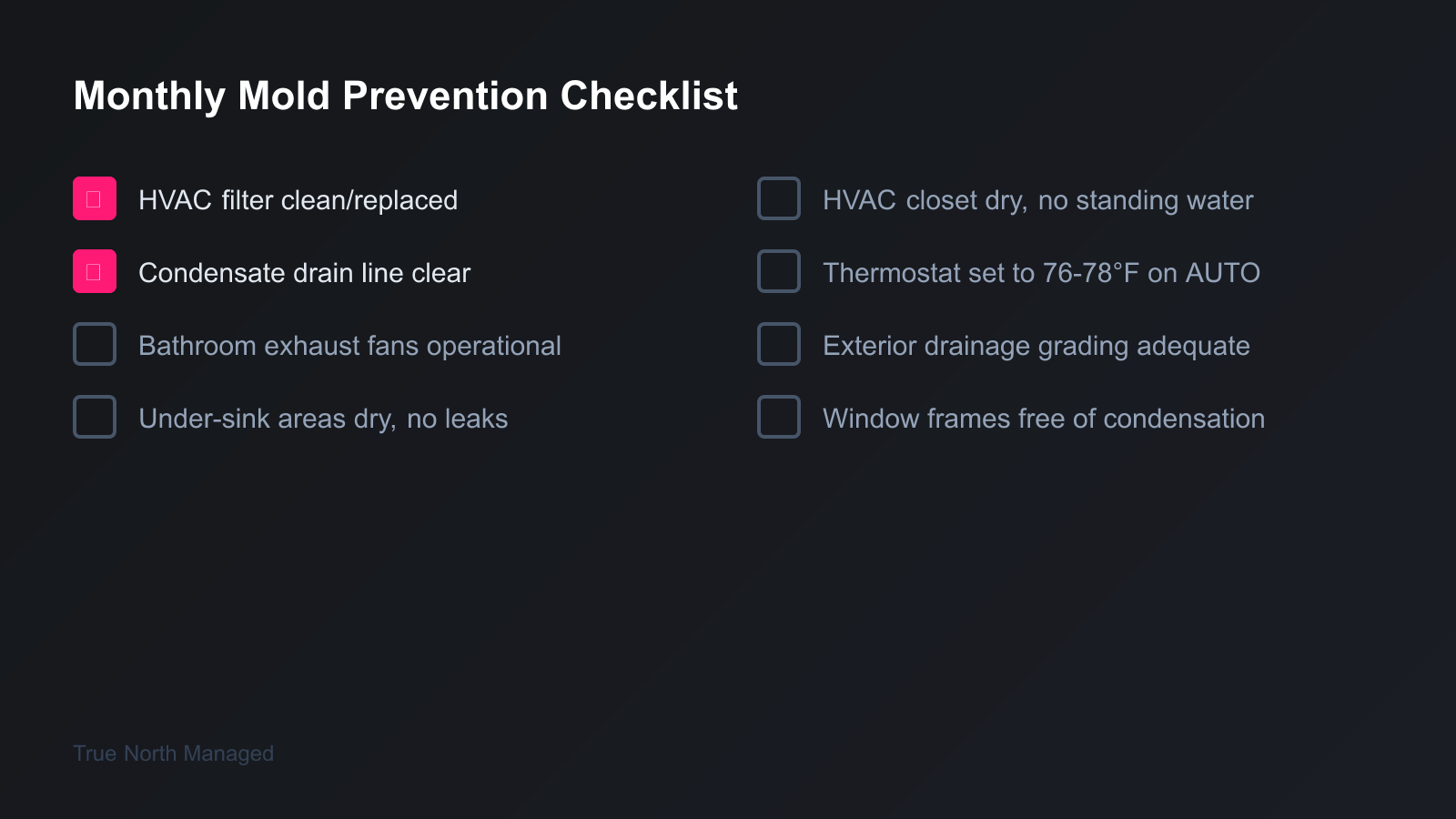
Your mold-focused inspection checklist:
- Open the HVAC closet. Check the drip pan, drain line, and filter. Look for standing water or discoloration.
- Run bathroom exhaust fans. Confirm they're operational and vent outside.
- Check under all sinks for moisture, drips, or musty smell.
- Look at ceiling and wall corners in bathrooms and kitchens for discoloration.
- Check the exterior foundation perimeter — is water pooling? Is drainage grading adequate?
- Inspect window frames and thresholds for condensation stains.
- Check the attic for condensation, wet insulation, or dark spots on sheathing (if accessible).
If you're running seasonal maintenance on a schedule, most of these checks happen naturally. The ones that don't — attic access, exterior drainage — are worth adding explicitly.
What Mistakes Lead to Mold in Florida Rentals?
Deferring HVAC maintenance. A $150 annual service call prevents a $5,000 mold remediation. When the condensate drain clogs and the drip pan overflows, you've got water damage and mold in 48 hours. This is the single most common cause of mold in Florida rentals.
Ignoring vacant units. Vacant properties need the AC running. Period. Turning off the AC to "save on the electric bill" during a 30-day vacancy creates conditions for mold growth across the entire unit. The electric bill for a month of cooling is $80–$120. The mold remediation is $5,000+.
Planting landscaping against the foundation. Bushes, mulch beds, and irrigation systems placed too close to the exterior wall hold moisture against the building. Keep landscaping at least 12 inches from the foundation, and make sure irrigation doesn't spray the walls.
Mold prevention in Florida isn't glamorous — it's HVAC maintenance, inspections, and humidity control. But it's the difference between a rental that generates steady cash flow and one that eats $10,000 in remediation because nobody checked the condensate drain for 18 months.
Frequently Asked Questions
Does Florida have a specific mold law for rental properties? No. Florida doesn't have a standalone mold statute. But mold violations fall under the Residential Landlord and Tenant Act's habitability requirements. If mold makes the unit uninhabitable, the tenant can withhold rent or break the lease under FL 83.51.
Who pays for mold remediation — the landlord or tenant? If the mold results from a maintenance issue the landlord is responsible for (AC failure, roof leak, plumbing), the landlord pays. If the mold results from tenant behavior (blocking vents, never running the exhaust fan, spilling water and not cleaning it up), the tenant may be responsible — but proving this requires documentation.
How quickly does mold grow in Florida? Mold can colonize a damp surface in 24–48 hours when humidity exceeds 60% and temperatures are above 70°F. In a Florida rental with a failed AC, visible mold can appear within a week.
What humidity level should I maintain in a Florida rental? Keep indoor relative humidity between 45–55%. Above 60% creates mold-friendly conditions. A smart thermostat with humidity monitoring costs $150–$250 and can alert you when levels spike.
If you want someone watching these details for you, get a free rental analysis to see how professional maintenance scheduling works for your property.