

Can a Florida Landlord Charge Late Fees Without a Written Lease?
A late fee in Florida is a contract term, not a right the statute hands you. With no written lease, there's no fee to charge. Here's why, and what you can collect instead.

If your tenant pays late and you've got no written lease, here's the short version: in Florida you usually can't charge a late fee. A late fee isn't something the statute hands every landlord. It's a term the tenant agreed to in writing, and with no written lease, there's no term to enforce. Late fees without a written lease in Florida are, in almost every case, uncollectible.
That answer surprises a lot of the owners we talk to in Orlando and Tampa, because it feels backwards. The tenant paid late. You're out the time and the cash-flow hit. Shouldn't there be a consequence? There is one, just not the one most people reach for. Below we walk through why the late fee falls apart without paper, what an oral or month-to-month tenancy changes, and what you can actually do to make the tenant whole.
Can a Florida landlord charge a late fee without a written lease?
No. In Florida, a landlord generally cannot charge a late fee without a written lease that spells it out. A late fee is a contract term, not a statutory right. If there's no written lease, or the lease you have says nothing about late fees, there's no fee to collect, no matter how late the rent shows up.
This is the part that trips people up. Florida's landlord-tenant law, Chapter 83, Part II, never mentions a late fee. There's no statutory late charge and no built-in penalty for paying on the 18th instead of the 1st. Part II does define rent, in section 83.43(12), and the definition is telling: "'Rent' means the periodic payments due the landlord from the tenant for occupancy under a rental agreement and any other payments due the landlord from the tenant as may be designated as rent in a written rental agreement." An extra charge becomes rent only when a written agreement designates it as rent, which is why a late fee can ride on a three-day notice only when a written lease designates it as rent, and a handshake late fee never can. The only reason a late fee is ever enforceable is that the tenant signed a lease agreeing to it. So when you ask whether a landlord can charge late fees without a lease, you're really asking whether you can enforce an agreement that was never made. You can't.
Picture the handshake tenant who pays you on the 20th instead of the 1st. They owe you the rent. They do not owe you a $75 late charge, because they never agreed to one in writing. If you tack that $75 onto their balance or quietly pull it out of their security deposit at move-out, the tenant can challenge it later and win, and you can end up owing them back more than the fee was ever worth.
Why does Florida require a late fee to be in writing?
Florida requires late fees to be in writing because the courts treat them as liquidated damages, a contract concept. A liquidated damages clause only holds up if both sides agreed to it in advance and the amount is a fair estimate of the landlord's actual costs, not a punishment. No signed agreement means there's nothing for a court to enforce.
Think about what a late fee is actually doing. It's a number you and the tenant settle on ahead of time to cover what late rent costs you: the chasing, the bookkeeping, the gap in your cash flow. Because nobody can predict that cost to the dollar, Florida lets you fix it in advance in the lease. That's the liquidated-damages bargain. The catch is that it has to be a bargain. Florida courts have thrown out fees that look like penalties rather than fair estimates.
Now take away the written lease. There's no agreed number, no agreed trigger date, no grace period, nothing the tenant signed off on. There's no contract term to call a fair estimate or a penalty, because there's no term at all. The whole framework that makes a late fee enforceable starts with a signature, and you don't have one. The Florida Bar's consumer guide to tenant and landlord rights makes a narrower point: a renter "becomes a tenant governed by Florida law," and "These facts are true even when there is no written 'lease' agreement." It says nothing about late fees.
What about an oral or month-to-month tenancy?
An oral or month-to-month tenancy is completely legal in Florida, but it still can't carry a late fee. A verbal deal creates a real tenancy, and when nobody agreed on a term, Florida Statute 83.46 ties its length to the rent period: "If the rental agreement contains no provision as to duration of the tenancy, the duration is determined by the periods for which the rent is payable," and "if payable monthly, tenancy is from month to month." What it can't carry are the custom terms, like a late fee, that only exist when they're written and signed.
Most landlords who end up here didn't plan it. You inherited a house and the relative living there just kept paying you. You rented to a friend or a coworker and a formal lease felt cold. Or the old 12-month lease expired, the tenant stayed, and nobody got around to signing a new one, so the arrangement rolled into month-to-month. All three are valid tenancies. None of them comes with a late fee attached.
Here's the nuance worth knowing. Statute 83.46 says: "Unless otherwise agreed, rent is payable without demand or notice; periodic rent is payable at the beginning of each rent payment period." So a month-to-month tenant owes rent on the 1st whether or not you remind them. That much the statute gives you for free. But read the section closely and you'll notice it covers when rent is due and how the tenancy is classified, and says nothing about a late fee. The default tenancy is a gift of the statute; the late fee is not. The same is true of the notice rules: ending a month-to-month tenancy takes "written notice in the manner provided in s. 83.56(4)," given "not less than 30 days' notice prior to the end of any monthly period," under Florida Statute 83.57, whether or not anyone ever signed a lease. For the full picture on how these informal arrangements work, our guide to month-to-month tenancies in Florida covers the notice rules and how to add written terms to one.
One more thing that catches people: a long-running handshake doesn't quietly become a "real" lease. A verbal month-to-month that's gone on for three years is still a month-to-month, and it still has no late fee. Time on the calendar doesn't write a contract term for you.
What can a landlord do instead when there's no late-fee clause?
Plenty, just not a late fee. The rent itself is still owed and fully collectible, the three-day pay-or-vacate notice and the eviction process work exactly the same as with a written lease, and you can put a signed late-fee term in place before the next rent period. What you can't do is invent a fee after the fact.
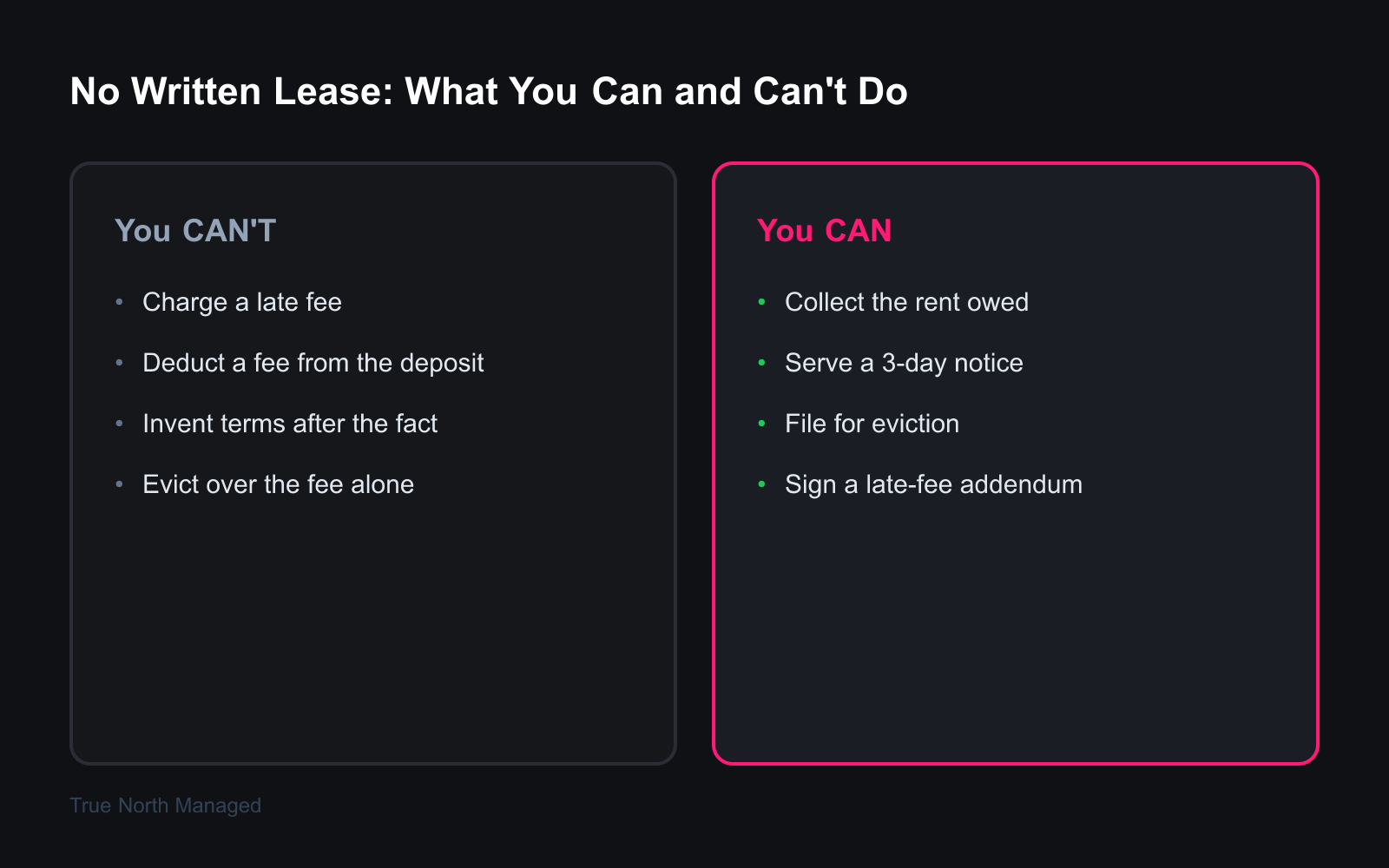
Start with what you keep. Late or not, the rent is a debt the tenant owes you. If they pay on the 20th, you're owed every dollar of that month's rent, and you can pursue unpaid rent through the deposit at move-out or in small claims court. You just can't add a charge on top of it that nobody agreed to.
Your power to evict is also intact. Because rent is due on the 1st under Statute 83.46, a tenant who hasn't paid is in default the same way a written-lease tenant would be. You can serve a three-day notice to pay or vacate and, if the rent stays unpaid, file for eviction in county court. No written lease doesn't weaken that path. What it weakens is your proof, since you'll be rebuilding the rent amount from bank records and texts instead of pointing to a signed document, but the process itself is unchanged.
What you should not do is self-help your way to a fee. Don't deduct an un-bargained-for late charge from the security deposit, don't change the locks, and don't shut off utilities. Florida bars all of that, and a deposit deduction for a fee the tenant never agreed to is exactly the kind of charge they can claw back, often with your attorney's fees on top. The honest answer is the simplest one: collect the rent you're owed, and fix the paperwork so next month you have a fee to charge.
What makes a late fee enforceable in Florida?
An enforceable Florida late fee needs three things: it's written into a signed lease, it states a specific amount and trigger date, and it's a reasonable estimate of your costs rather than a penalty. Florida sets no dollar cap, but courts strike down fees that look punitive.
That's the whole standard in one paragraph, and it's the reason a no-lease tenancy can never satisfy it: you can't have a written, signed, specific clause when there's no document. We won't re-run the clause-wording rules here, because they only matter once you have a lease to put them in. Our full guide to Florida late fees for landlords breaks down the reasonable range, the grace period, and the one-time-per-payment structure that survives a challenge. The point in this post is the step before that one: with no written lease, you never reach the wording stage at all.
How do you fix this going forward?
You fix it by getting it in writing, and you don't have to wait for the tenancy to end to do it. You can sign a full lease or a simple one-page late-fee addendum mid-tenancy that documents the rent, the due date, the grace period, and the fee. Once it's signed, the late fee applies to every rent period after that.
Timing matters. A new written term binds the tenant going forward, not backward, so the fee covers future late payments, not the one that already happened. The cleanest move is to present the addendum before the next rent period: "Starting July 1, here are the written terms, including a late fee of X if rent isn't received by the 5th." A month-to-month tenant can decline and give notice, but most won't blink at a reasonable, clearly written fee, especially when it comes with a grace period.
If you're converting a handshake to paper anyway, do the whole thing at once rather than bolting on a single clause. Put the rent amount, the late fee, the maintenance responsibilities, and a move-in condition record into one signed lease. Our Florida lease agreement guide walks through the clauses that actually protect you and what the law lets you include. An hour spent turning a verbal deal into a signed lease is one of the highest-value hours a landlord can spend, and the late fee is only one of the protections you pick up.
If all of this feels like more lease law than you signed up for when you rented out one inherited house, you're not alone, and you don't need a portfolio to get help. Our Florida owner's guide pulls together the lease, rent-collection, and legal basics in one place for owners managing a single property.
Common mistakes landlords make with no written lease
The same handful of errors show up over and over with no-lease tenancies, and each one is avoidable once you know the late fee isn't yours to charge:
- Charging a fee that was never agreed to. A verbal "I'll charge you if you're late" isn't a contract term. No signed clause, no fee.
- Deducting a late fee from the deposit. Pulling an un-bargained-for fee out of the security deposit is the fastest way to lose a deposit dispute and end up owing the tenant more.
- Assuming "no lease" means "no rules for me." It's the opposite. You lose the terms that protect you and keep every duty the statute puts on you, from maintenance to deposit deadlines to proper notice.
- Waiting to add written terms. You can sign an addendum mid-tenancy. Every month you wait is another month with no enforceable fee.
- Confusing the late fee with the rent. The rent is always owed and collectible. The fee is the part that needs a signature. Don't let "I can't charge a fee" turn into "I can't collect the rent."
- Trying to evict over the fee alone. You can't. Eviction is for unpaid rent. A tenant who paid all their rent and only owes a phantom late fee isn't an eviction case.
The throughline is simple. Without a written lease, the late fee isn't a tool you have. The rent, the notice, and the eviction process all still are. Get the tenancy onto paper, and next month the fee is yours too.
The bottom line on late fees without a written lease in Florida
A Florida late fee lives or dies on a signature. Strip away the written lease and the fee goes with it, because there's no statute that creates one and no agreed term for a court to enforce. The fastest path back to a chargeable late fee is the same hour of work that fixes every other gap in a handshake tenancy: put it in writing, get it signed, and apply it the same way every month.
If you're staring at an inherited tenant, a friend you never papered up with, or a lease that quietly lapsed into month-to-month, that's the move. Collect the rent you're owed, skip the fee you can't enforce, and convert the arrangement to a signed lease before the next rent period so you're not having this conversation again.