

Florida Landlord Responsibilities: What You're Legally Required to Do
Florida law requires landlords to maintain habitability, handle deposits on deadline, and follow specific notice rules. Here's the full list.

You own the property. But that's only half the job.
Being a Florida landlord comes with a specific set of legal obligations that go well beyond collecting rent checks. Miss one -- and your tenant can withhold rent, break their lease, or take you to court. Some of these obligations are obvious (keep the roof from leaking). Some aren't (did you know you need a radon disclosure in every lease?).
Here's the full list. Not the abbreviated version. Not the "top 5 tips" version. Everything Florida law actually requires from you as a landlord.
Your Maintenance Obligations Under FL 83.51
Florida Statute 83.51is the backbone of your maintenance duties. It breaks into two parts.
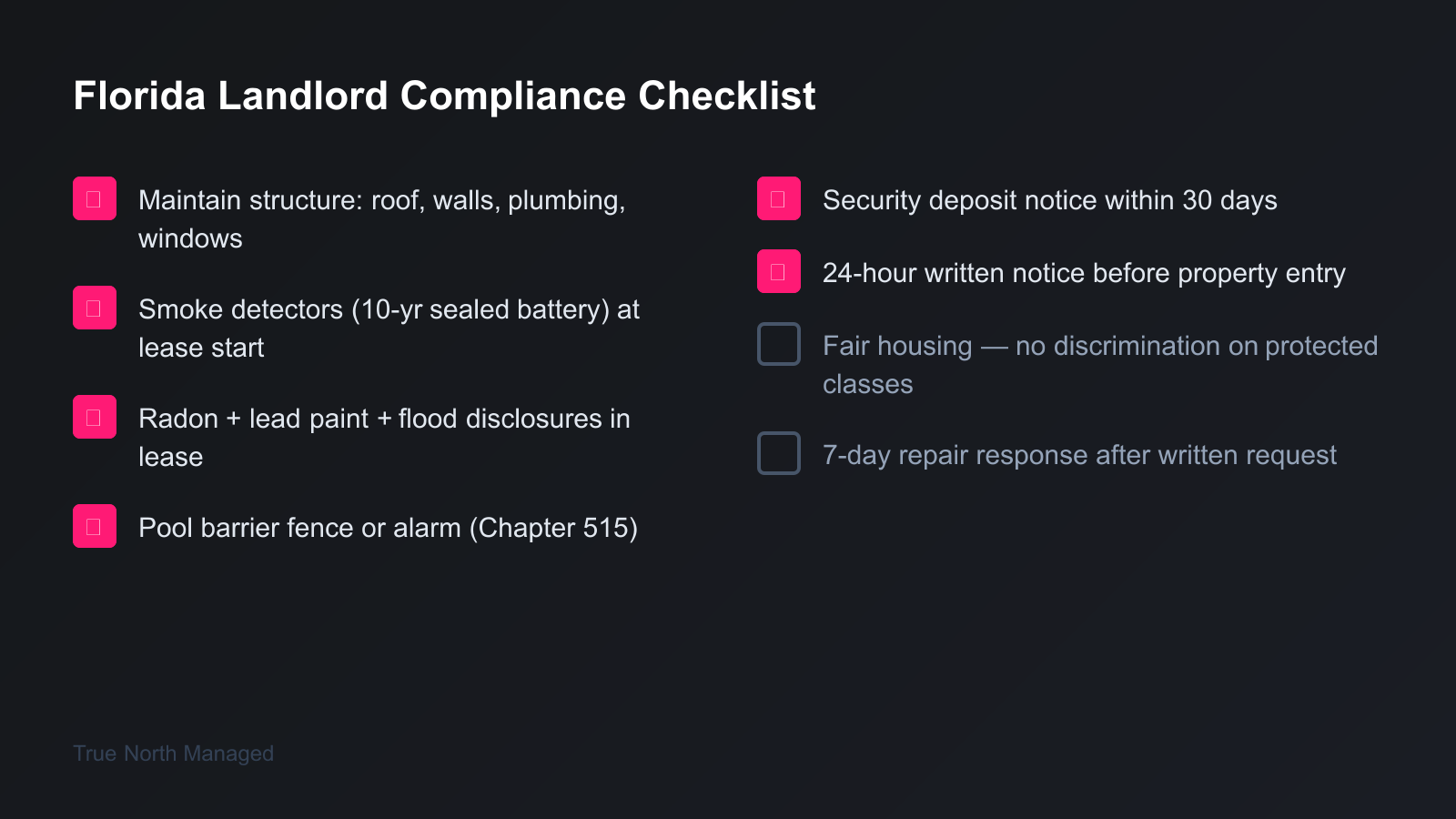
Part 1: Structural and code compliance.You must either comply with all applicable building, housing, and health codes OR (if no codes apply to your area) maintain these elements in good repair:
- Roof, exterior walls, and foundation
- Windows, doors, floors, steps, and porches
- Plumbing in reasonable working condition
- Window screens installed and in reasonable condition at move-in
Part 2: Habitability requirements.For apartments and multi-unit buildings, you must also provide:
- Heat during winter months
- Running water and hot water
- Pest extermination (rodents, roaches, and other bugs)
- Functioning locks and keys
- Clean and safe common areas
- Garbage removal and outside receptacles
For single-family homes and duplexes, some of these can be modified by written agreement in the lease. But the structural requirements in Part 1 can't be waived regardless of what the lease says.
The repair timeline.When a tenant sends you a written repair request, you'veseven daysto make a reasonable effort at completing the repair. If the issue affects health or safety and you don't respond, the tenant can terminate the lease after that seven-day period expires. They can also pursue damages in court.
Emergency repairs -- a burst pipe, a gas leak, a broken exterior door lock -- require an immediate response. Florida courts have held landlords liable for damages when they ignored emergencies. See ouremergency maintenance protocolfor more.
Required Disclosures (Before or at Lease Signing)
Florida requires specific disclosures to every tenant. Missing one doesn't just create a headache -- it can void parts of your lease or expose you to liability.
Radon gas disclosure.Every residential lease in Florida must include this exact language:"RADON GAS: Radon is a naturally occurring radioactive gas that, when it's accumulated in a building in sufficient quantities, may present health risks to persons who are exposed to it over time. Levels of radon that exceed federal and state guidelines have been found in buildings in Florida. Additional information regarding radon and radon testing may be obtained from your county health department."
Lead paint disclosure.If the property was built before 1978, federal law (not just Florida law) requires you to disclose any known lead-based paint hazards, provide the EPA pamphlet"Protect Your Family From Lead in Your Home,"and give the tenant 10 days to conduct a lead inspection before signing.
Landlord identity and contact information.Tenants must know who owns the property and how to reach them for notices and demands. This seems basic, but if you're managing through an LLC or a property management company, the tenant still needs a valid address for sending legal notices underFL 83.50.
Fire protection.Buildings over three stories must disclose the availability and type of fire protection systems.
Flood history.A newer requirement (Senate Bill 948): landlords must provide a written disclosure form before lease signing covering whether the property has received government flood assistance, whether flood insurance claims have been filed, and any known flood damage during the landlord's ownership.
Security Deposit Rules (Yes, All of Them)
We've covered this in detail in ourfull security deposit guide, but here's the summary of your obligations:
- Store the deposit in a separate Florida bank account (non-interest-bearing is simplest)
- Notify the tenant in writing within 30 days of receiving the deposit -- bank name, account type, and interest status
- Return the full deposit within 15 days of move-out if no deductions
- Send an itemized claim by certified mail within 30 days if claiming deductions
- Never comingle deposit funds with your personal or business operating accounts
Miss the 30-day claim deadline and you forfeit the entire deposit -- even if the tenant left real damage. The statute is that strict.
Fair Housing: What You Can't Do
TheFair Housing Actand theFlorida Fair Housing Actprotect tenants from discrimination based on:
- Race, color, and national origin
- Religion
- Sex (including gender identity and sexual orientation at the federal level)
- Familial status (families with children under 18)
- Disability
What this means in practice:You can't refuse to rent to families with children (unless it's a qualifying 55+ community). You can't ask about a tenant's national origin duringscreening. You can't refuse a reasonable accommodation request from a disabled tenant -- including modifying a no-pets policy for a legitimate service animal or emotional support animal. And you can't charge pet fees or deposits for assistance animals.
Getting fair housing wrong isn't just a fine. It's a federal complaint, potential lawsuit, and reputation damage that follows your business for years.
Right of Entry: The 24-Hour Rule
UnderFlorida Statute 83.53, you must give your tenantat least 24 hours' written noticebefore entering the property. Entry is only permitted duringreasonable hours (7:30 AM to 8:00 PM)and for specific reasons:
- Property inspections
- Necessary or agreed-upon repairs
- Showing the property to prospective tenants or buyers
- Supplying agreed services
Exceptions that don't require notice:Genuine emergencies (fire, flood, gas leak), repairs the tenant specifically requested, or when the tenant has clearly abandoned the property.
You can't enter just because you "want to check on things." Every entry needs a valid reason and proper notice. Repeated unauthorized entry gives the tenant grounds to file a noncompliance notice and potentially break the lease.
Smoke Detectors, CO Detectors, and Pool Safety
Smoke detectors.You must install working smoke detectors at the start of every tenancy. New installations require sealed, tamper-resistant units with non-removable 10-year batteries. At least one detector per floor, positioned in hallways outside bedrooms, at least 10 feet from cooking appliances.
Carbon monoxide detectors.Required if the property has fuel-burning appliances (gas furnace, gas water heater, gas stove), a fireplace, or an attached garage. Must be installed within 10 feet of sleeping rooms. This applies to properties built after July 2008, but we recommend installing them in all rentals regardless of age.
Pool safety.If your rental has a pool, Florida'sResidential Swimming Pool Safety Act (Chapter 515)requires at least one of these safety features:
- A barrier fence at least 4 feet tall surrounding the pool
- An approved safety pool cover
- Exit alarms on all doors and windows with direct pool access
- Self-closing, self-latching devices on pool-access gates/doors
- A pool alarm that detects unauthorized water entry
As of October 2024, these requirements apply to any residential pool on property that's transferred or sold. Non-compliance is a second-degree misdemeanor.
Business Licensing and Registration
Orange County Business Tax Receipt.If your rental is in unincorporated Orange County, you need a Business Tax Receipt (BTR) to operate as a landlord. Applications go through Orange County Fast Track and must be approved by the Zoning Division.
City of Orlando rental registration.Orlando requires landlords to register long-term rental properties with the city, including paying a registration fee and filing annual updates. This helps the city maintain housing safety standards and gives your tenants a point of contact with the municipality.
Florida sales tax.Long-term residential rentals (6+ months) are exempt from Florida sales tax. Short-term rentals (under 6 months) require collection and remittance of state sales tax plus the local tourist development tax.
What Changed in 2025-2026
Florida landlord-tenant law isn't static. Here are the changes that matter right now:
Electronic notice delivery (October 2025).You can now serve certain legal notices by email instead of certified mail -- but only if you and the tenant both sign a written consent addendum underFL 83.505. The consent is revocable by the tenant at any time. Keep timestamped records of electronic delivery.
3-day notice expanding to 5 days (July 2026).Senate Bill 716 extends the non-payment notice period from three business days to five. This affects youreviction timeline-- plan accordingly.
Cooling equipment maintenance.A new requirement (HB 241) explicitly requires landlords to provide and maintain cooling equipment (AC) in habitable rooms and repair or replace it within specified timeframes. In Florida, this is as much a health issue as a comfort issue.
Rent reporting to credit agencies (SB 1626).Landlords can now report tenant rent payment history to credit bureaus with the tenant's written consent. This is optional but can be a valuable tool for attracting quality tenants who want to build credit through on-time rent payments.
The Responsibility Most Landlords Forget
Every legal obligation on this list is something you can handle. None of it's rocket science. But handling all of it -- consistently, on time, documented correctly -- while also managing maintenance calls, rent collection, tenant communications, andthe eviction processwhen things go wrong? That's where most landlords who try to self-manage start falling behind.
We manage properties across Orlando for owners who decided their time was better spent on their careers, their families, or their next investment -- not on tracking 30-day deposit notice deadlines or remembering which smoke detector needs a 10-year sealed battery.
If you want a full picture of what your property needs to be compliant and profitable, start here.