

Hurricane Prep for Florida Rental Properties: A Landlord's Checklist
A step-by-step hurricane prep checklist for Florida rental properties — what to do before, during, and after storm season to protect your investment.

Hurricane season starts June 1. Your prep should start in May.
If you own a rental in Orlando, you already know the drill: hurricane season runs June 1 through November 30, with peak activity between mid-August and late October. The 2026 forecast points to a below-average season — 9 to 13 named storms, 4 to 6 hurricanes, 1 to 3 major — but "below average" doesn't mean zero risk. Orlando sits inland, which helps, but we've seen storms reach Central Florida with plenty of punch. The time to get ready is now, before a watch is issued and everyone's scrambling.
Here's your landlord checklist: pre-season prep, insurance review, property hardening, tenant communication, what to do during and after the storm, documentation for claims, and your legal obligations under Florida law.
Pre-Season Prep: Your May Checklist
Don't wait for a hurricane watch. By the time the National Hurricane Center issues a watch (48 hours before hurricane-force winds) or a warning (36 hours), you're in reaction mode. Pre-season work gives you time to fix problems, order supplies, and coordinate with tenants without the pressure of an approaching storm. See our windstorm insurance for landlords for more.
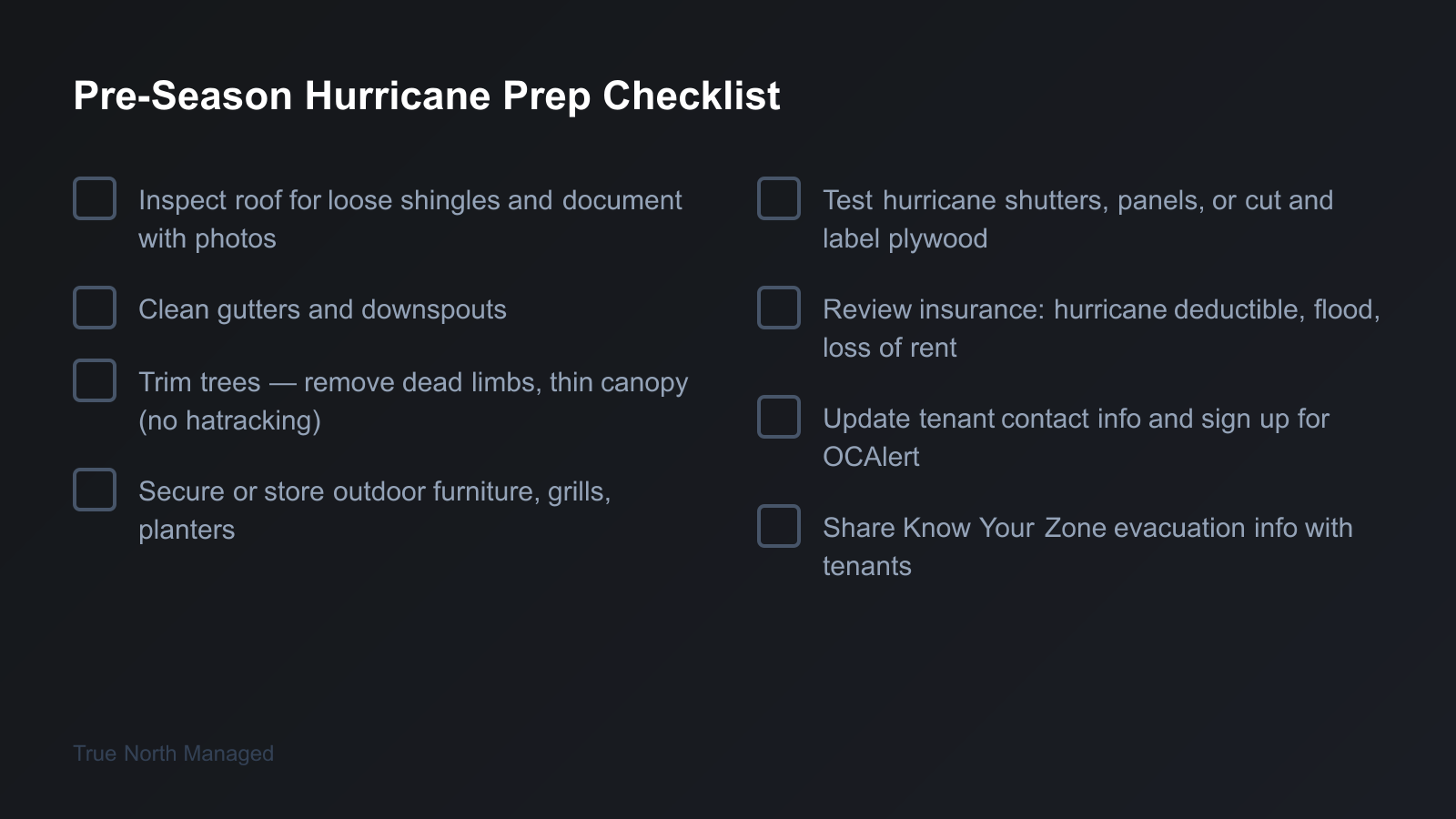
Property tasks:
- Inspect the roof for loose or missing shingles, damaged flashing, and weak spots. Document the condition with photos — you'll need a baseline if you file a claim later.
- Clean gutters and downspouts. Clogged gutters send water where it shouldn't go and can worsen flooding and roof damage.
- Trim trees. Remove dead limbs, thin the canopy so wind can pass through, and clear branches that overhang the roof or power lines. Avoid "hatracking" (topping trees) — it's illegal in many Florida municipalities and creates weak, top-heavy growth. Hire a licensed arborist if you're not sure. UF/IFAS recommends pruning well before storm season, not when a storm is days away.
- Secure or store outdoor furniture, grills, planters, and anything that can become airborne. Tenants should bring items inside or anchor them.
- Check hurricane shutters, panels, or plywood. If you use plywood, cut and label pieces in advance. Minimum 7/16-inch exterior grade; 5/8-inch is better. Store mounting hardware where it's accessible.
- Verify roof straps or clips if your home has them. They help keep the roof attached to the walls in high winds.
Administrative tasks:. See our Tampa Bay flood zones for more.
- Review your landlord insurance policy. Confirm your hurricane deductible (typically 2–5% of dwelling coverage), loss-of-rent limits, and that flood coverage is in place if you're in or near a flood zone.
- Update tenant contact information. You need a reliable way to reach everyone when a storm approaches.
- Sign up for Orange County's OCAlert — text, email, or phone alerts for severe weather, evacuations, and road closures.
- Share Florida's Know Your Zone with tenants so they know their evacuation zone before they need it.
Insurance Review: Hurricane Deductibles and Flood Gaps
Your standard landlord policy covers wind damage from hurricanes — but the deductible works differently. Florida uses percentage-based hurricane deductibles (2%, 5%, or 10% of your dwelling limit). On a $400,000 policy, a 2% deductible means $8,000 out of pocket; 5% means $20,000. The deductible applies when a hurricane warning is issued for any part of Florida and stays in effect for 72 hours after the last watch or warning ends. You only pay one hurricane deductible per calendar year, even if multiple storms hit.
Flood is excluded. Standard landlord policies don't cover flood. If storm surge or heavy rain floods your rental, you need separate flood insurance — either through the National Flood Insurance Program (NFIP) or a private carrier. About 25–30% of flood claims occur outside FEMA's high-risk zones. Orlando isn't coastal, but localized flooding happens. Check your zone and your lender's requirements.
Loss of rent coverage reimburses you when a covered loss makes the unit uninhabitable. Most policies provide 20–25% of your dwelling limit. For a $300,000 policy, that's $60,000–$75,000 — usually enough for several months. It doesn't cover tenant non-payment or lease violations, only damage from a covered peril.
Roof age matters. Florida insurers often restrict or deny coverage on roofs older than 15 years. If your roof is aging, get it inspected and address any issues before a claim.
Property Hardening: Shutters, Straps, and Securing the Site
Florida Building Code requires impact protection for windows and doors in many areas. Shutters must resist windborne debris — think a 9-pound 2x4 at 34 mph. Options include approved roll-down or accordion shutters, impact-resistant windows, or plywood cut to spec. Orlando isn't in the High-Velocity Hurricane Zone (Miami-Dade and Broward), but impact protection still reduces damage and can lower insurance costs.
Before a storm:
- Install shutters or panels at least two days before landfall. Don't wait until winds are rising.
- Lower TV antennas and cover exposed electrical outlets.
- Turn off propane tanks and main gas valves if you're evacuating.
- Place sandbags around doors if you're in a flood-prone area.
- For pools: lower water 12 inches below the rim, add chlorine, and turn off the filter.
Generator rules: If you're considering a permanent generator for a rental, local ordinances apply — setback from property lines, screening, noise limits, and fuel storage. Portable generators are tenant responsibility; remind them never to run one indoors or in a garage.
Three mistakes to avoid: Waiting until a watch to trim trees (arborists book up fast), skipping the pre-storm photo documentation (you need a baseline for claims), and assuming your standard policy covers flood (it doesn't).
Tenant Communication Plan: Before, During, and After
Tenants need to know what to expect and what you expect of them. Reach out early in the season — ideally by mid-May — with a clear, simple plan.
What to share:
- Evacuation zone and Know Your Zone link. If they're in Zone A or a tropical storm zone, they may need to leave first.
- Emergency contacts: your number, property manager if applicable, and Orange County Emergency Management (407-836-9140).
- Expectations: secure outdoor items, stock 3+ days of water and non-perishable food, have flashlights and batteries. Water and power can be out for days.
- Renter's insurance: their belongings aren't covered by your policy. Recommend they carry renters insurance with flood and hurricane coverage for personal property and temporary housing.
- Lease terms: if you've added a hurricane addendum, summarize the key points — who does what before a storm, what happens if the unit becomes uninhabitable.
During a storm: Stay in touch via text or email. Don't ask tenants to put themselves at risk. If they evacuate, that's their call. If they shelter in place, remind them to stay away from windows and in an interior room. Point them to the National Hurricane Center for official forecasts and track updates — it's the authoritative source, updated every six hours when a storm is active.
After the storm: Check on tenants as soon as it's safe. Inspect the property, document damage, and communicate next steps. If repairs will take time, discuss rent abatement or lease termination per Florida Statute 83.63.
During and After the Storm: Safety and Documentation
Safety first. Don't enter a flooded building until authorities say it's safe. Turn off electricity to avoid shock. Check for gas leaks. Watch for downed power lines and structural damage. If the roof is compromised or floors are sagging, get a professional assessment before going inside.
Document before you repair. Take photos and video from multiple angles — wide shots, medium shots, close-ups. Include exterior damage (roof, siding, windows, trees) and interior damage (water intrusion, ceiling stains, flooring). Use your phone's timestamp. Store files in the cloud and on a backup drive. Create a room-by-room list: item, condition, estimated value. This documentation supports your insurance claim. Mitigate further damage — tarp the roof, remove waterlogged items to limit mold — but don't start permanent repairs until you've documented everything and notified your insurer.
File your claim promptly. Contact your insurance company as soon as you've documented the damage. Keep receipts for temporary repairs, additional living expenses, and any out-of-pocket costs. FEMA disaster assistance may be available if the president declares a major disaster; tenants displaced from their primary residence can apply for rental assistance. Landlords can register damaged properties so displaced residents can find housing.
Your Legal Obligations: Habitability, Repairs, and Tenant Rights
Florida law requires landlords to maintain rental properties in habitable condition under the implied warranty of habitability. You must comply with building, housing, and health codes and keep structural components — roofs, windows, doors, foundations — in good repair. Your landlord responsibilities don't disappear when a hurricane hits.
Florida Statute 83.63 governs casualty damage. If hurricane damage (not from tenant negligence) bigly impairs the tenant's enjoyment of the premises, the tenant may terminate the lease and vacate immediately. The statute doesn't give landlords the right to terminate — only tenants. If only part of the unit is unusable, the tenant can stay and pay reduced rent (fair rental value of the damaged portion is deducted). If the tenant terminates, you must return the security deposit and any advance rent per Florida Statute 83.49 — within 15 days, or with a written explanation within 30 days if you're withholding.
Repair timeline: If a tenant sends written notice that the property is wholly untenantable, you have 7 days to respond. You have up to 20 days to complete repairs that restore habitability. Mold can start within 24 hours of water intrusion — act quickly. You can't evict a tenant or raise rent because of hurricane damage.
Lease addenda: Consider a hurricane addendum that clarifies tenant responsibilities (securing outdoor items, maintaining renter's insurance), your responsibilities (structural repairs, habitability), and what happens if utilities are lost or the unit becomes uninhabitable. For single-family homes and duplexes, some habitability obligations can be modified in writing — but get legal advice before doing that.
When a Property Manager Handles It
If you hire a property manager, they typically handle pre-season inspections, tenant communication, vendor coordination for shutters and repairs, and post-storm documentation. You still need to understand your insurance, approve major repairs, and stay informed. Property management costs usually include emergency response; confirm what's covered before storm season.
Bottom Line
Hurricane prep isn't optional in Florida. Start in May. Review insurance, harden the property, communicate with tenants, and know your legal obligations. When a storm hits, prioritize safety, document everything, and file claims promptly. Your future self will thank you.