

Hoarding Tenant in Florida: Legal Options and Health Code Rules
When hoarding becomes a lease violation vs. disability accommodation. Florida health codes, fire safety, and your options as a landlord.

You walk into the unit for a routine inspection and the hallway is stacked with newspapers. The kitchen counters are buried. Exits are partially blocked. A hoarding tenant creates fire hazards, pest risk, and structural concerns. In Florida, you've options, but you also have fair housing obligations. Here's how to handle it.
When Does Hoarding Become a Lease Violation?
Hoarding becomes a lease violation when it threatens health, safety, or habitability.Florida health codes and fire safety rules apply. Pests, blocked exits, mold risk -- document it. Orlando and Tampa landlords who act too fast risk fair housing claims.
Hoarding alone isn't automatically a lease violation. Florida law andHUD guidancerecognize that hoarding disorder can qualify as a disability. You can't evict solely because someone has a lot of belongings. But when hoarding creates health or safety violations, you can act. The line: the behavior's impact on the property and others, not the diagnosis.
Florida Health Codes and Fire Safety
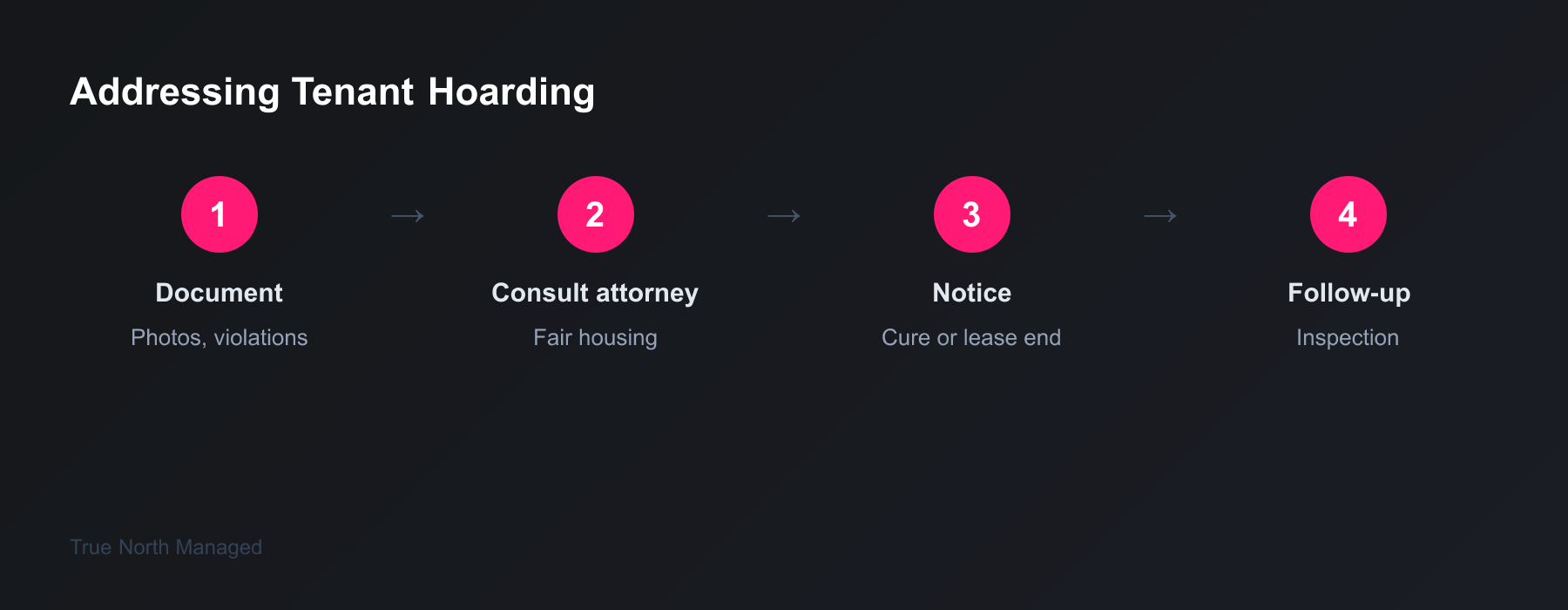
Florida health codes and fire safety rules apply. Blocked exits, pest attraction, and mold risk are violations.Document with photos and inspections. Give the tenant a chance to cure before you escalate.
Local health departments and fire marshals enforce codes that apply to rental housing. Blocked exits, excessive combustible materials, unsanitary conditions, and pest infestation from accumulated items can trigger code enforcement. If code enforcement cites the property, you've a documented basis to demand remediation.Florida Department of Healthand county health departments handle complaints. Document everything: photos, dates, inspection reports.
Reasonable Accommodation Requests
Reasonable accommodation requests: if the tenant claims a disability, you may need to engage in the interactive process.ADA and Fair Housing apply. Don't assume hoarding is always a disability -- but don't ignore a request either.
If the tenant requests accommodation for a disability (including hoarding disorder), you must engage in an interactive process. That doesn't mean you accept unsafe conditions. You can require a plan: professional cleanup, ongoing support, periodic inspections. The accommodation must be reasonable. Allowing fire hazards or code violations isn't required. See ourguide on disability accommodations in Florida rentalsfor the framework.
Documentation Before Action
Document before action: photos, inspection reports, and written notices.Give the tenant a clear cure period. If they don't comply, you've a paper trail for eviction or non-renewal.
Before sending any notice, document the conditions. Photos, written inspection reports, code enforcement citations if any. If you proceed with a cure-or-quit notice, you need to show the tenant had a chance to remedy. If conditions are severe enough for an unconditional quit underFlorida Statute 83.56, you need evidence of material destruction or ongoing violations. A paper trail protects you from retaliation claims.
Eviction as Last Resort
Eviction is the last resort after notice and cure.Florida evictions require proper notice and court process. Hoarding cases can be messy -- an attorney can help.
Eviction should be the last step. Try a cure notice first: give a reasonable timeframe to remove hazards and restore the unit to a safe condition. If the tenant refuses or can't comply, and code enforcement is involved, you may have grounds for termination. Work with an attorney familiar with Florida landlord-tenant law and fair housing. OurOrlando eviction process guidecovers the steps; hoarding cases often need extra care to avoid discrimination claims.
Hoarding situations are emotionally charged. Document, engage in good faith on accommodations, and escalate only when safety demands it. If you're managing a property in Orlando or Tampa and need help handling a difficult tenant situation,get a free rental analysisand we can discuss your options.
Disability Accommodation Considerations
Disability accommodation: engage in the interactive process if the tenant requests it.You may need to allow more time or a different approach. Document everything.
Hoarding can be a symptom of a disability. TheFair Housing Actrequires reasonable accommodation. You can't evict solely because someone has a disability. But you can require that the unit meet health and safety codes. The key is engaging in an interactive process: discuss the issue, consider accommodation requests, and document everything. Blanket refusals or immediate eviction without notice can create liability.
Health Code Violations
Health code violations: document with photos and inspections.Fire marshal or code enforcement can help. Orlando and Tampa have resources.
Excessive clutter can violate fire codes, block exits, attract pests, or create mold risk. County health departments and code enforcement can cite the property. Once cited, you've a duty to remedy the condition. Document inspections, citations, and any correspondence with the tenant. A 7-day notice to cure may be appropriate if the lease allows it. If the tenant doesn't cure and the condition persists, escalation to eviction may be justified.
When to Involve an Attorney
Involve an attorney when the tenant refuses to cure or when fair housing is involved.Hoarding cases can trigger discrimination claims. Get legal advice.
If the tenant asserts a disability accommodation, the situation becomes legally sensitive. Consult an attorney before sending a termination notice. If code enforcement has cited the property, an attorney can help you handle the timeline and document the process. Ourdangerous tenant guidecovers escalation options. For lease violations generally, seetenant non-payment and lease enforcement.
Disability Accommodation Considerations
Accommodation: engage if requested.Document the process.
Hoarding can be a symptom of a disability. TheFair Housing Actrequires reasonable accommodation. You can't evict solely because someone has a disability. But you can require that the unit meet health and safety codes. The key is engaging in an interactive process: discuss the issue, consider accommodation requests, and document everything. Blanket refusals or immediate eviction without notice can create liability.
Health Code Violations
Health code: document.Photos, inspections.
Excessive clutter can violate fire codes, block exits, attract pests, or create mold risk. County health departments and code enforcement can cite the property. Once cited, you've a duty to remedy the condition. Document inspections, citations, and any correspondence with the tenant. A 7-day notice to cure may be appropriate if the lease allows it. If the tenant doesn't cure and the condition persists, escalation to eviction may be justified.
When to Involve an Attorney
Common Mistakes to Avoid
One of the biggest mistakes we see: skipping the written notice. Florida law is strict about documentation. If you don't have a paper trail—or email trail that meets SB 716's requirements—you can lose an eviction or deposit dispute. Document everything.
Another mistake: underbudgeting for turnover. A typical Florida turnover runs $1,500–$3,000 when you include paint, carpet, cleaning, and minor repairs. If you're only setting aside 5% of rent for maintenance, you're short. Plan for 8–12% in year one until you know your property.
Third: treating every tenant the same. A military family near MacDill has different needs than a UCF grad student. Screen for fit, not just credit score. The right tenant in the right property stays longer and costs you less.
Florida-Specific Considerations
Florida Statute 83 applies to residential tenancies. Know the notice requirements: 3 days for non-payment (soon 5 under SB 716), 7 days for cure or vacate for lease violations, 15 days for month-to-month termination. Wrong notice = delayed eviction.
Insurance is another Florida reality. Wind and flood can double your premium in certain zones. Run quotes before you buy. A $200/month insurance difference changes your cash flow by $2,400/year.
Finally, property taxes. Homestead doesn't apply to rentals. You'll pay non-homestead rates. In Florida County, that's typically 1.2–1.5% of assessed value. Appeal if your assessment seems high—many landlords overpay.
When to Get Help
If you're out of state, hire a local property manager. The 8–10% fee pays for itself in faster leasing, better screening, and someone who can show up when the AC dies at 10 PM. Self-managing from another state is a recipe for deferred maintenance and tenant frustration.
For legal issues—evictions, deposit disputes, lease breaks—consult a Florida-licensed attorney. Landlord-tenant law has traps. A $500 consult can save you $5,000 in a botched eviction. We've seen it.
Finally, for complex financial decisions—1031 exchanges, LLC structuring, depreciation—talk to a CPA who works with rental owners. The tax code rewards those who plan. Don't wing it.
When to Get Help
If you're out of state, hire a local property manager. The 8–10% fee pays for itself in faster leasing, better screening, and someone who can show up when the AC dies at 10 PM. Self-managing from another state is a recipe for deferred maintenance and tenant frustration.
For legal issues—evictions, deposit disputes, lease breaks—consult a Florida-licensed attorney. Landlord-tenant law has traps. A $500 consult can save you $5,000 in a botched eviction. We've seen it.
Finally, for complex financial decisions—1031 exchanges, LLC structuring, depreciation—talk to a CPA who works with rental owners. The tax code rewards those who plan. Don't wing it.
Attorney: when it's complex.Eviction or fair housing.
If the tenant asserts a disability accommodation, the situation becomes legally sensitive. Consult an attorney before sending a termination notice. If code enforcement has cited the property, an attorney can help you handle the timeline and document the process. Ourdangerous tenant guidecovers escalation options. For lease violations generally, seetenant non-payment and lease enforcement.