

HOA and Condo Rental Restrictions in Florida: What Investors Must Know
HOA rental caps, approval requirements, lease restrictions, and condo rules. FL 720 and 718 requirements and due diligence before buying.

Buying a rental in an HOA or condo community means your use is governed by the association. Rental caps, approval requirements, and lease restrictions can limit or block your ability to rent. Florida law sets the framework; the documents set the details.
HOA Law: Florida Statute 720
Florida Statute 720 governs HOAs; 718 governs condos. Both allow rental restrictions but with limits. HOAs can cap rentals (e.g., 25% of units); condos can have similar rules. Read the docs before you buy. Florida Statute 720.306(1)(h) governs HOA rental amendments. Effective July 1, 2021, new rental restrictions only apply t
Florida Statute 720 governs HOAs; 718 governs condos. Both allow rental restrictions but with limits. HOAs can cap rentals (e.g., 25% of units); condos can have similar rules. Read the docs before you buy.
Florida Statute 720.306(1)(h) governs HOA rental amendments. Effective July 1, 2021, new rental restrictions only apply to owners who acquire title after the amendment or who consent. Exceptions: a 6-month minimum lease or a 3-times-per-year rental cap apply to all owners. HOAs can adopt rental restrictions through the declaration of covenants and bylaws. Restrictions must be properly recorded and can't be applied retroactively to existing owners Sometimes . Amendments often require a supermajority vote.
Condo Law: Florida Statute 718
Florida Statute 718 governs condos. Rental caps and minimum lease terms are common. Some ban rentals entirely. Grandfathering may apply to existing owners. Florida Statute 718.110(13) governs condo rental restrictions. Amendments only apply to owners who consent or acquire title after the amendment; existing owners retain ren
Florida Statute 718 governs condos. Rental caps and minimum lease terms are common. Some ban rentals entirely. Grandfathering may apply to existing owners.
Florida Statute 718.110(13) governs condo rental restrictions. Amendments only apply to owners who consent or acquire title after the amendment; existing owners retain rental rights. Condo associations can restrict rentals, impose minimum lease terms, require approval of tenants, or cap the number or percentage of units that is rented. The rules must be in the declaration or properly adopted by the association.
Common Restriction Types
In Florida, Rental caps: Only X% of units is rented at any time. If the cap is met, you must wait for a slot to open. Some associations have waitlists. Minimum lease term: No rentals under 6 months or 1 year. This blocks short-term rentals and some medium-term corporate housing. Approval requirements: Tenant applications must
Rental caps: Only X% of units is rented at any time. If the cap is met, you must wait for a slot to open. Some associations have waitlists.
Minimum lease term: No rentals under 6 months or 1 year. This blocks short-term rentals and some medium-term corporate housing.
Approval requirements: Tenant applications must be submitted to the association. The association can approve or deny based on criteria in the documents.
Lease restrictions: Required lease addenda, pet rules, parking rules. Failure to comply can result in fines or loss of rental privileges.
Due Diligence Before Buying
In Florida, Due diligence before buying: read the HOA/condo declaration, bylaws, and rules. Look for rental caps, minimum lease terms, and approval process. Orlando and Tampa have plenty of restricted communities. Read the declaration, bylaws, and any rental policy. Confirm the current rental cap status. Ask the association how many units are rented and whether
Due diligence before buying: read the HOA/condo declaration, bylaws, and rules. Look for rental caps, minimum lease terms, and approval process. Orlando and Tampa have plenty of restricted communities.
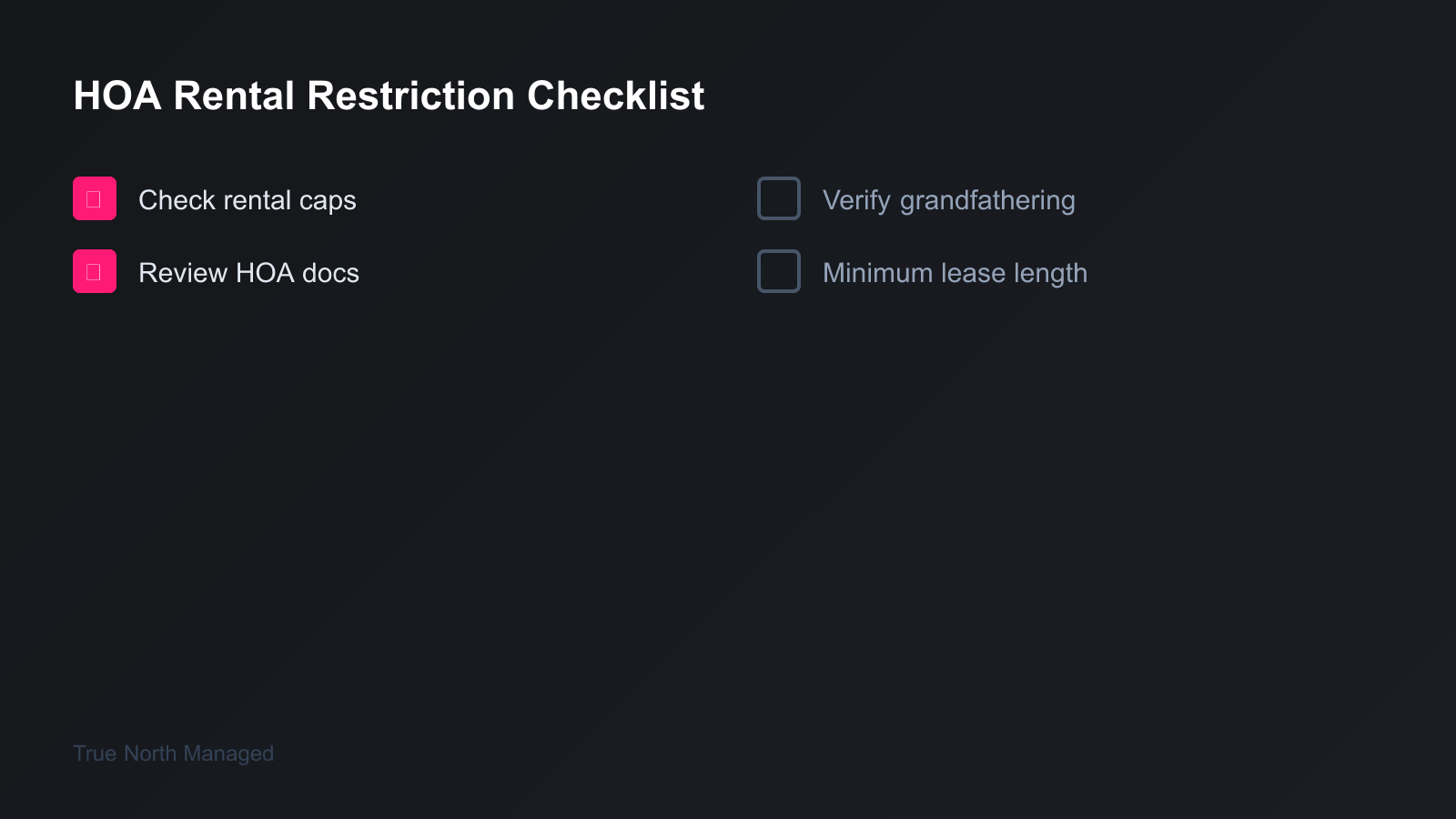
Read the declaration, bylaws, and any rental policy. Confirm the current rental cap status. Ask the association how many units are rented and whether there's a waitlist. Understand the approval process and timeline. See our HOA rental restrictions overview for more.
If you're buying for investment, rental restrictions can make or break the deal. A 25% cap with a 50-person waitlist means you may never rent. A 6-month minimum blocks Airbnb. Know before you close.
Grandfathering and Existing Rights
In Florida, Grandfathering can protect existing owners when new rules are adopted. If you owned before the cap was passed, you is exempt. Check the specific language. Some restrictions grandfather existing owners or existing tenants. If you bought when rentals were allowed and the association later adopts a cap, your right to rent is preserved.
Grandfathering can protect existing owners when new rules are adopted. If you owned before the cap was passed, you is exempt. Check the specific language.
Some restrictions grandfather existing owners or existing tenants. If you bought when rentals were allowed and the association later adopts a cap, your right to rent is preserved. The documents and amendment language determine this. Have an attorney review.
Enforcement
In Florida, Enforcement: HOAs can fine and pursue liens. FL 720 and 718 give associations teeth. Violating rental rules can cost you. Don't assume you can fly under the radar. Associations can fine for violations, suspend amenities, and Sometimes seek to force compliance. Repeated violations can affect your ability to rent. Comply with the rules
Enforcement: HOAs can fine and pursue liens. FL 720 and 718 give associations teeth. Violating rental rules can cost you. Don't assume you can fly under the radar.
Associations can fine for violations, suspend amenities, and Sometimes seek to force compliance. Repeated violations can affect your ability to rent. Comply with the rules or sell.
HOA and condo restrictions are a critical part of Florida rental investing. For help evaluating a potential purchase in Orlando or Tampa, get a free rental analysis and we can discuss how association rules affect your investment strategy.
FL 720 and FL 718: The Statutory Framework
FL 720 and 718: the statutory framework. HOAs and condos can restrict rentals within their authority. Read the declarations. Florida Statute 720 governs homeowners associations; Florida Statute 718 governs condos. Both allow associations to impose rental restrictions through their governing documents. Rental caps--limiting the percentage or number of units that is rented--are common. Some communities
FL 720 and 718: the statutory framework. HOAs and condos can restrict rentals within their authority. Read the declarations.
Florida Statute 720 governs homeowners associations; Florida Statute 718 governs condos. Both allow associations to impose rental restrictions through their governing documents. Rental caps--limiting the percentage or number of units that is rented--are common. Some communities ban rentals entirely for a period after purchase.
Rental Caps in Practice
In Florida, Rental caps in practice: 25% cap means 1 in 4 units can rent. Waitlists are common. Orlando and Tampa have many restricted communities. A 25% or 30% rental cap means once that percentage of units is rented, new leases are blocked until someone sells or moves back in. Waitlists are common. Investors should
Rental caps in practice: 25% cap means 1 in 4 units can rent. Waitlists are common. Orlando and Tampa have many restricted communities.
A 25% or 30% rental cap means once that percentage of units is rented, new leases are blocked until someone sells or moves back in. Waitlists are common. Investors should request the current rental count and cap before buying. Violating a cap can result in fines, forced sale, or litigation. Check the declaration and bylaws before closing.
Grandfathering and Exceptions
In Florida, Grandfathering and exceptions: some owners are exempt. Check if you qualify. Document it. Some restrictions grandfather existing rentals. Others apply only to new purchases. Military deployment and job relocation sometimes qualify for hardship exceptions. The association's attorney can clarify. For Orlando and Tampa specifics, see our Orlando HOA rental restrictions and Orlando HOA rental restrictions and Tampa HOA and condo restrictions guides.
Minimum Lease Terms
In Florida, Minimum lease terms: 6 months or 1 year is common. No short-term rentals. Orlando and Tampa condos often enforce this. Many HOAs and condos require leases of 6 or 12 months. Short-term rentals are often prohibited. If you plan to rent to students or seasonal workers, verify the minimum term. Violations can trigger
Minimum lease terms: 6 months or 1 year is common. No short-term rentals. Orlando and Tampa condos often enforce this.
Many HOAs and condos require leases of 6 or 12 months. Short-term rentals are often prohibited. If you plan to rent to students or seasonal workers, verify the minimum term. Violations can trigger fines and forced termination of the tenancy. Our Florida STR laws guide covers short-term rules.
Due Diligence Checklist
In Florida, Due diligence checklist: declaration, bylaws, caps, minimum lease, grandfathering. Don't skip it. Before buying, obtain the declaration, bylaws, and current rental count. Ask the association or management company for written confirmation. Review the amendment process--some restrictions is changed by owner vote. Factor waitlist time into your investment timeline. See our HOA rental restrictions
Due diligence checklist: declaration, bylaws, caps, minimum lease, grandfathering. Don't skip it.
Before buying, obtain the declaration, bylaws, and current rental count. Ask the association or management company for written confirmation. Review the amendment process--some restrictions is changed by owner vote. Factor waitlist time into your investment timeline. See our HOA rental restrictions overview for the broader landscape.
Enforcement and Fines
In Florida, Enforcement and fines: HOAs can pursue. Violations can cost you. Comply. Associations can levy fines for rental cap violations, unauthorized STRs, or lease term violations. Unpaid fines can become liens. Some declarations allow forced sale for repeated violations. Respond to violation notices promptly and require tenant compliance. Our Orlando HOA guide and
Enforcement and fines: HOAs can pursue. Violations can cost you. Comply.
Associations can levy fines for rental cap violations, unauthorized STRs, or lease term violations. Unpaid fines can become liens. Some declarations allow forced sale for repeated violations. Respond to violation notices promptly and require tenant compliance. Our Orlando HOA guide and Tampa HOA guide cover local specifics.
Key Takeaway
Key takeaway: check HOA/condo before you buy. Rental restrictions can kill your strategy. Rental restrictions in Florida HOAs and condos are enforceable. Do your due diligence before buying. Get the governing documents, confirm the current rental count, and understand the amendment process. Violations can cost you fines, liens, or forced sale. Our Orlando and Tampa
Key takeaway: check HOA/condo before you buy. Rental restrictions can kill your strategy.
Rental restrictions in Florida HOAs and condos are enforceable. Do your due diligence before buying. Get the governing documents, confirm the current rental count, and understand the amendment process. Violations can cost you fines, liens, or forced sale. Our Orlando and Tampa market hubs link to local HOA guides.
Key Takeaway
Common Mistakes to Avoid
One of the biggest mistakes we see: skipping the written notice. Florida law is strict about documentation. If you don't have a paper trail—or email trail that meets SB 716's requirements—you can lose an eviction or deposit dispute. Document everything. Another mistake: underbudgeting for turnover. A typical Florida turnover runs $1,500–$3,000 when you include paint,
One of the biggest mistakes we see: skipping the written notice. Florida law is strict about documentation. If you don't have a paper trail—or email trail that meets SB 716's requirements—you can lose an eviction or deposit dispute. Document everything.
Another mistake: underbudgeting for turnover. A typical Florida turnover runs $1,500–$3,000 when you include paint, carpet, cleaning, and minor repairs. If you're only setting aside 5% of rent for maintenance, you're short. Plan for 8–12% in year one until you know your property.
Third: treating every tenant the same. A military family near MacDill has different needs than a UCF grad student. Screen for fit, not just credit score. The right tenant in the right property stays longer and costs you less.
Florida-Specific Considerations
Florida Statute 83 applies to residential tenancies. Know the notice requirements: 3 days for non-payment (soon 5 under SB 716), 7 days for cure or vacate for lease violations, 15 days for month-to-month termination. Wrong notice = delayed eviction.
Insurance is another Florida reality. Wind and flood can double your premium in certain zones. Run quotes before you buy. A $200/month insurance difference changes your cash flow by $2,400/year.
Finally, property taxes. Homestead doesn't apply to rentals. You'll pay non-homestead rates. In Florida County, that's typically 1.2–1.5% of assessed value. Appeal if your assessment seems high—many landlords overpay.
When to Get Help
If you're out of state, hire a local property manager. The 8–10% fee pays for itself in faster leasing, better screening, and someone who can show up when the AC dies at 10 PM. Self-managing from another state is a recipe for deferred maintenance and tenant frustration.
For legal issues—evictions, deposit disputes, lease breaks—consult a Florida-licensed attorney. Landlord-tenant law has traps. A $500 consult can save you $5,000 in a botched eviction. We've seen it.
Finally, for complex financial decisions—1031 exchanges, LLC structuring, depreciation—talk to a CPA who works with rental owners. The tax code rewards those who plan. Don't wing it.
When to Get Help
If you're out of state, hire a local property manager. The 8–10% fee pays for itself in faster leasing, better screening, and someone who can show up when the AC dies at 10 PM. Self-managing from another state is a recipe for deferred maintenance and tenant frustration.
For legal issues—evictions, deposit disputes, lease breaks—consult a Florida-licensed attorney. Landlord-tenant law has traps. A $500 consult can save you $5,000 in a botched eviction. We've seen it.
Finally, for complex financial decisions—1031 exchanges, LLC structuring, depreciation—talk to a CPA who works with rental owners. The tax code rewards those who plan. Don't wing it.
Bottom line: read the docs. Orlando and Tampa have plenty of restricted communities.
Rental restrictions in Florida HOAs and condos are enforceable. Do your due diligence before buying. Get the governing documents, confirm the current rental count, and understand the amendment process. Violations can cost you fines, liens, or forced sale. When in doubt, have an attorney review the declaration before you close. Our Orlando and Tampa market hubs link to local HOA guides.
If you own a rental in Orlando or Tampa and want a clear picture of what it could earn, get a free rental analysis. No obligation—just real numbers.