

Landlord Quick-Start Guide: Your First Week in Florida
Just became a landlord in Florida? Here's your first week, in order — the five things to get right before your tenant moves in, and the deadlines that come with them.
Most people don't plan to become a landlord. You got relocated. You inherited a house. The market turned and you couldn't sell. If that's you, our guide for accidental landlords in Florida covers the bigger picture — but right now you've got a property, a tenant on the way, and a sinking feeling that you're already supposed to know things you don't.
Here's the good news. Your first week comes down to five tasks. Do them in order, and you've covered the parts of Florida law that actually get landlords sued — security deposits, disclosures, habitability. Skip one, and the mistake usually doesn't surface until months later, when it's expensive to fix.
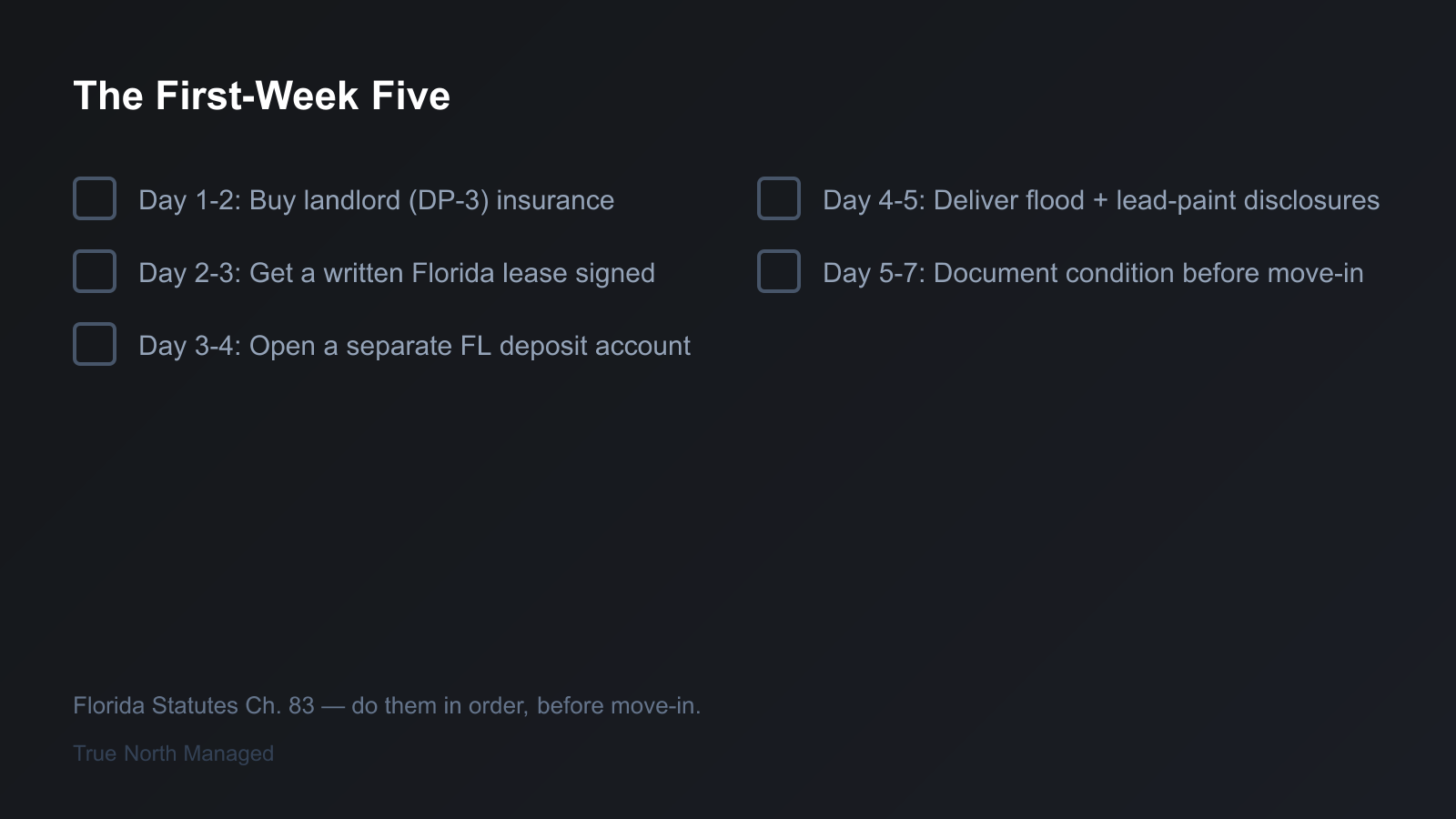
We call it "The First-Week Five." Let's walk through it, day by day.
What do you have to do in your first week as a Florida landlord?
In your first week as a Florida landlord, do five things in order: buy a landlord insurance policy, get a written lease signed, open a separate Florida bank account for the security deposit, deliver the required disclosures (flood and lead paint), and document the property's condition before move-in. Each carries a real deadline.
None of this is optional, and none of it is hard once you know the sequence. The trouble is that nobody hands a new landlord a checklist. You find out about the separate deposit account after you've already mixed the money into your checking account. You learn about the flood disclosure after the lease is signed.
So here's the week, mapped out. Two markets, one process — whether your rental sits in Orlando, Tampa, or anywhere else in Florida, the law in Chapter 83 of the Florida Statutes is the same.
Day 1-2: Do you need landlord insurance before the tenant moves in?
Yes. Before a tenant takes possession, swap your homeowners policy for a landlord policy — usually a DP-3 dwelling policy. A standard homeowners (HO-3) policy can be voided once the home is a rental, which means a claim could be denied when you need it most.
This is the first task because it protects everything else. If you inherited the house or moved out of it, your old policy was written for an owner-occupant. The moment a tenant has the keys, that policy may no longer apply. Call your agent and tell them plainly: "This is now a rental."
A landlord DP-3 policy covers the dwelling and lost rental income if the home becomes uninhabitable after a covered loss. Liability if someone is hurt on the property is critical too, and the standard DP-3 form doesn't include it — it's added as an endorsement or a separate policy, so confirm it's on your declarations page. Florida landlord insurance runs higher than the national average, mostly because of hurricane and reinsurance pressure. Inland Orlando properties tend to land lower; Tampa Bay homes in storm-surge zones run higher.
One thing the policy almost certainly won't cover: flood. Standard landlord policies exclude it. If your property sits in a FEMA flood zone — common across parts of Hillsborough, Pinellas, and Osceola counties — you'll want a separate flood policy. Check your address against the FEMA Flood Map Service Center before you decide.
Day 2-3: Why does Florida require a written lease?
Florida doesn't technically require a written lease — but renting without one is a mistake. Without a written agreement, your tenancy defaults to month-to-month under Florida law, which means either side can end it with 30 days' notice and you've lost your strongest tool for setting rules.
A written lease is where you put everything you'll wish you had in writing later: the rent amount and due date, the late fee, who handles lawn care and pest control, the pet policy, how maintenance requests get made. If it's not in the lease, it's a conversation you'll have to win without backup.
If you skip the written lease, Florida Statute 83.57 governs what happens. Since July 1, 2023, ending a month-to-month tenancy in Florida takes 30 days' written notice before the end of the monthly period — up from the old 15-day rule. That's fine if it's what you want. But most new landlords want a one-year lease for the stability, and that only exists if you write it down and both parties sign.
Use a Florida-specific lease, not a generic template you found online. A national form won't include the Florida disclosures we're about to cover, and it may include clauses Florida courts won't enforce. If you're already working with a property manager, this is one of the first things they handle.
For the deeper version of this, our guide to what belongs in a Florida lease agreement walks through the clauses that matter most.
Day 3-4: How should you handle the security deposit?
Put the security deposit in a separate Florida bank account — never your personal or business checking account — and within 30 days of receiving it, give the tenant written notice of where it's held (landlords with fewer than five units are exempt, but it costs nothing to send). The deadline that can cost you the deposit comes after the lease ends: return it within 15 days if you aren't claiming anything, or send written notice of your claim within 30 days. Miss that and you can't deduct — you return the deposit and sue for real damage instead.
This is the task new landlords get wrong most often, and the one with the sharpest teeth. Florida Statute 83.49 gives you three legal ways to hold a deposit. The simplest: a separate, non-interest-bearing account in a Florida banking institution, held for the tenant, not mixed with your own money. You can also use a separate interest-bearing Florida account — but then "the tenant shall receive and collect interest in an amount of at least 75 percent of the annualized average interest rate payable on such account or interest at the rate of 5 percent per year, simple interest, whichever the landlord elects," paid or credited against rent at least once a year — or post a surety bond, which also means paying the tenant 5 percent a year in simple interest.
Here's the part that bites. Within 30 days of receiving the deposit, you must give the tenant written notice — in the lease itself or as a separate written notice — stating the name and address of the bank holding the deposit and whether it earns interest, plus a disclosure whose wording the statute spells out. Section 83.49(2) then adds: "This subsection does not apply to any landlord who rents fewer than five individual dwelling units. Failure to give this notice is not a defense to the payment of rent when due." So with fewer than five units this notice isn't required, and missing it never lets a tenant withhold rent. The deadline that can actually cost you the deposit comes at move-out. Section 83.49(3)(a): "Upon the vacating of the premises for termination of the rental agreement, if the landlord does not intend to impose a claim on the security deposit, the landlord must return the security deposit, together with interest if otherwise required, within 15 days after the termination of the rental agreement. If the landlord intends to impose a claim on the deposit, the landlord must, within 30 days after the termination of the rental agreement, provide the tenant written notice by certified mail to the tenant's last known mailing address or by e-mail in accordance with s. 83.505 of his or her intention to impose a claim on the deposit and the reason for imposing the claim." In plain terms: 15 days to return it if you're keeping nothing, 30 days to tell the tenant in writing what you're keeping and why. Miss the 30 days and the same paragraph is specific: "If the landlord fails to give the required written notice within the 30-day period, he or she forfeits the right to impose a claim upon the security deposit and may not seek a setoff against the deposit but may file an action for damages after returning the security deposit to the tenant." Your tenant could trash a wall and you'd still have a legal path — but it's a lawsuit, after the whole deposit goes back.
So the move is simple. Open the separate account before the tenant pays. Deposit the money the day it arrives. Put the bank's name and address, whether it pays interest, and the statutory disclosure right in the lease — that satisfies the notice requirement and the clock at the same time. If you ever move the deposit to a different bank, you've got 30 days to tell the tenant about that too.
Think of the deposit like money you're holding in trust. It isn't income, and it isn't yours to spend. For the full picture on holding it, deducting from it, and returning it, see our Florida security deposit law guide.
Day 4-5: What disclosures must a Florida landlord give a new tenant?
Florida landlords must give two disclosures before or at lease signing: a flood disclosure on its own separate document for any lease of one year or longer, and — if the home was built before 1978 — a federal lead-based paint disclosure plus the EPA's lead pamphlet. Both go to the tenant before they sign.
The flood disclosure is the newer one, and plenty of landlords still don't know about it. Florida Statute 83.512, effective October 1, 2025, requires you to give a prospective tenant a flood disclosure — in a separate document, not buried in the lease — at or before signing a rental agreement of one year or more. It tells the tenant whether the home has flooded during your ownership, whether you've filed flood insurance claims (including with the National Flood Insurance Program), and whether you've received flood assistance. It also reminds the tenant that renters' insurance doesn't cover flood damage.
Skip it, and there's a consequence. If you fail to give the disclosure and a tenant suffers substantial loss to their personal property from flooding, they can terminate the lease within 30 days of the loss. In a state where storms are a given, that's not a risk worth taking.
The second disclosure is federal and only applies to older homes. If your rental was built before 1978, the EPA's Lead-Based Paint Disclosure Rule requires you to disclose any known lead-based paint or hazards, hand the tenant the EPA pamphlet "Protect Your Family From Lead in Your Home", provide any records or reports you have, and include a Lead Warning Statement in the lease. Most Orlando and Tampa rentals built in the last few decades are exempt — but if you inherited an older home in a place like College Park or Seminole Heights, this one applies to you.
Florida law also requires you to give the tenant your name and address (or your agent's) as the person authorized to receive notices. Put that in the lease and you've handled it.
Day 5-7: How do you make sure the property is move-in ready and legal?
Before the tenant takes possession, confirm the property meets Florida's habitability standard and document its exact condition. Florida Statute 83.51 requires you to comply with building, housing, and health codes and — for a single-family home or duplex — install working smoke detectors and reasonable screens at the start of the tenancy.
Habitability isn't a vague idea. It means the structural parts work — roof, windows, doors, floors, plumbing in reasonable order — and the home meets your county's codes. Walk through and check the basics: smoke detectors installed and tested, screens in place, no obvious code issues, every system functioning. For a single-family home or duplex, working smoke detectors at the start of the tenancy aren't a courtesy. They're the law.
Then document everything. Before the tenant gets the keys, do a written move-in inspection with dated photos of every room, every appliance, every existing scratch and stain. This is your evidence. When the tenant moves out and you need to separate normal wear from real damage, the move-in record is what makes a deposit deduction stick. Without it, it's your word against theirs. Our move-in inspection checklist for Florida landlords gives you a room-by-room version to work from.
If you're an out-of-state owner, this is the week the distance gets real. You can't photograph a property from another state. Hire a local inspector, a handyman, or a property manager to do the walkthrough and the condition record for you — and to be the set of eyes you don't have. Skipping it isn't an option just because you're far away.
The mistakes that cost new Florida landlords the most
Three errors show up again and again, and all three are avoidable in week one.
The first is mixing the security deposit into a personal account. It feels harmless — it's just one account. But it violates Florida Statute 83.49.
The second is renting without a written lease. A handshake deal with a tenant you trust still leaves you with no enforceable rules, no agreed late fee, and a tenancy that ends on 30 days' notice. Trust is good. A signed lease is better.
The third is skipping the move-in documentation. Landlords assume they'll remember the property's condition. Eleven months later, with a security deposit dispute in front of them, they don't — and neither does a judge. Photos with a date stamp settle it.
Your first week, handled
Five tasks. Insurance, lease, deposit account, disclosures, move-in check. Do them in that order before your tenant moves in, and you've covered the parts of Florida law that matter most — and bought yourself a calmer year.
If you're reading this and thinking you'd rather not learn property management on the fly, that's a reasonable call. Plenty of Florida owners have exactly one rental and no desire to manage it themselves. We manage single properties — not just portfolios — and the first week is the part we'd handle for you start to finish: the Florida lease, the deposit account and disclosure, the move-in inspection, all of it.
Not sure whether to manage it yourself or hand it off? Request a free rental analysis and we'll tell you what your property should rent for and what managing it actually involves. Once your first tenant is in, our first 30 days as a new Florida landlord guide picks up where this one leaves off.