

What Every Accidental Landlord in Florida Needs to Know
Relocated, inherited a property, or could not sell? Here is the crash course for Florida landlords who did not plan for this -- insurance, leases, FL 83 basics, when to hire a PM, and tax implications.

You didn't plan for this. Maybe you relocated for work and couldn't sell in time. Maybe you inherited a house from your parents. Maybe the market softened and renting felt like the only option. Now you're a landlord -- and you're Googling "Florida landlord requirements" at midnight, hoping you haven't already messed something up.
Here's the crash course. Everything an accidental landlord in Florida needs to get right from day one: insurance, lease basics, what Florida law actually requires, when it makes sense to hire help, and what the IRS Publication 527 expects.
Why Florida Is Different for Accidental Landlords
Florida's landlord-tenant law (Ch. 83) and lack of state income tax make it different for accidental landlords. You're dealing with FL Statute 83.49 on deposits, 83.56 on evictions, and no state return on rental income -- plus Orlando and Tampa markets that move fast. Inherited a property? You're not alone. Florida's landlord-tenant law lives in
Florida's landlord-tenant law (Ch. 83) and lack of state income tax make it different for accidental landlords. You're dealing with FL Statute 83.49 on deposits, 83.56 on evictions, and no state return on rental income -- plus Orlando and Tampa markets that move fast. Inherited a property? You're not alone.
Florida's landlord-tenant law lives in Florida Chapter 83 of the Florida Statutes, and it's strict. Miss a deadline on a security deposit and you lose the right to make claims against it. Skip the right notice before entering and you've given a tenant ammunition. The state also has no income tax, which helps your bottom line, but property insurance and property taxes can eat into cash flow faster than in most states.
What Insurance Do You Need?
In Florida, You need landlord insurance, not homeowner's. Standard HO-3 won't cover tenant-caused damage or loss of rent. In Orlando and Tampa, add flood coverage if you're in a zone -- many investors skip it and regret it when a storm hits. Your homeowner's policy doesn't cover a rental. You need a landlord policy (sometimes
You need landlord insurance, not homeowner's. Standard HO-3 won't cover tenant-caused damage or loss of rent. In Orlando and Tampa, add flood coverage if you're in a zone -- many investors skip it and regret it when a storm hits.
Your homeowner's policy doesn't cover a rental. You need a landlord policy (sometimes called a dwelling policy or DP-3) that includes liability coverage. In Florida, landlord insurance runs roughly $1,800-$2,500/year for a typical single-family home, depending on age, location, and wind mitigation. Older homes and coastal properties can run $4,000+. If you're still using the policy from when you lived there, you're exposed. Our guide to landlord insurance in Florida breaks down coverage types, what to look for, and how to avoid gaps.
What Goes in the Lease?
Your lease must cover security deposits, maintenance responsibilities, and eviction triggers. FL 83.49 requires you to specify where the deposit is held and notify the tenant within 30 days. Include AC responsibility -- in Florida, that's non-negotiable. Florida doesn't require a written lease for month-to-month tenancies, but you absolutely need one. Your lease should cover
Your lease must cover security deposits, maintenance responsibilities, and eviction triggers. FL 83.49 requires you to specify where the deposit is held and notify the tenant within 30 days. Include AC responsibility -- in Florida, that's non-negotiable.
Florida doesn't require a written lease for month-to-month tenancies, but you absolutely need one. Your lease should cover rent amount and due date, late fees, security deposit handling, maintenance responsibilities, pet policies, and what happens when someone breaks the rules. A handshake agreement leaves you exposed to disputes. Use a Florida lease agreement with the right clauses -- required notices, entry rules, and termination procedures.
What Does Florida Law Actually Require?
Security deposits. Under FL 83.49, you must hold deposits in a separate Florida-based account and notify the tenant in writing within 30 days. If you don't, you can't make claims against the deposit. Right of entry. You must give "reasonable notice" (typically 12-24 hours) before entering, except in emergencies. Habitable condition. You're responsible for working
Security deposits. Under FL 83.49, you must hold deposits in a separate Florida-based account and notify the tenant in writing within 30 days. If you don't, you can't make claims against the deposit.
Right of entry. You must give "reasonable notice" (typically 12-24 hours) before entering, except in emergencies.
Habitable condition. You're responsible for working heat (or AC in Florida), plumbing, and structural safety. A broken AC in July is a habitability issue.
Eviction process. You can't lock a tenant out or shut off utilities. You must follow the formal eviction process through the courts.
When Should You Hire a Property Manager?
In Florida, Hire a property manager when you're out of state, have 3+ doors, or can't respond to emergencies. Orlando and Tampa PMs typically charge 8-10% of rent. For accidental landlords juggling a day job, it's often worth every penny. If you're out of state, hire one. If you're juggling a full-time job and a
Hire a property manager when you're out of state, have 3+ doors, or can't respond to emergencies. Orlando and Tampa PMs typically charge 8-10% of rent. For accidental landlords juggling a day job, it's often worth every penny.
If you're out of state, hire one. If you're juggling a full-time job and a tenant who calls at 2 AM, you'll probably want one. If you're local, have time, and enjoy the work, self-managing can work for a single property. The rule of thumb: if the deal only works without a manager, it doesn't really work. Budget 8-10% of monthly rent for management. In Orlando, that's about $180-$220/month on a $2,000 rental.
What Are the Tax Implications?
Rental income goes on Schedule E; Florida has no state income tax. You'll still pay federal tax, but you can deduct mortgage interest, insurance, repairs, and depreciation (27.5 years for residential). Keep receipts -- the IRS loves documentation. Rental income is taxable. You report it on Schedule E. You can deduct mortgage interest, property taxes, insurance, repairs, maintenance, and management fees. Depreciation is a big one -- you're allowed to depreciate the building (not the land) over 27.5 years, which can reduce your taxable income even when you're cash-flow positive. If you're considering an LLC, our LLC for rental property in Florida guide walks through the pros, cons, and costs.
3 Mistakes Accidental Landlords Make
1. Treating it like a hobby. You're running a business. Track income and expenses, keep receipts, and separate your rental finances from your personal accounts. 2. Skipping the lease. You inherited a tenant who's been there for years. They seem fine. You never signed a lease. When something goes wrong, you've no written terms. Always get a lease in place. 3. Ignoring insurance. You kept the old homeowner's policy when you moved out. A tenant's guest gets hurt, and your insurer denies the claim because the property wasn't owner-occupied. Switch to landlord insurance before you list the property.
Next Step: Get the Numbers Right
Get a free rental analysis before you list. True North Managed runs comps for Orlando and Tampa properties so you know what you can realistically charge. No obligation -- just the numbers. if you're renting your old house or an inherited property, you need to know what it's worth as a rental. A free rental analysis gives you market rent, vacancy estimates, and a realistic picture of what to expect.
Next Steps
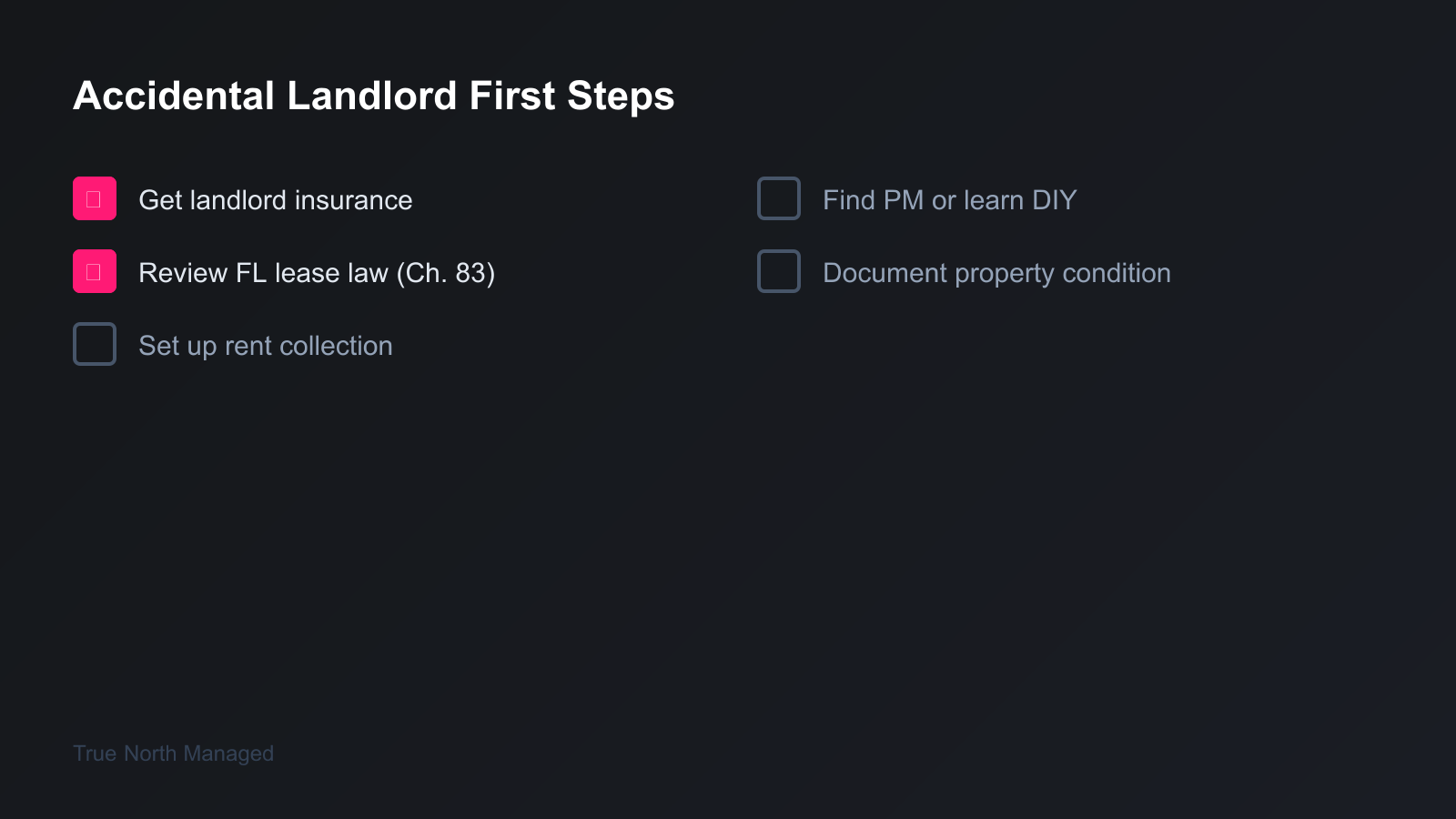
Next: run your numbers and decide if you're self-managing or hiring help. Either way, get your insurance, lease, and deposit handling right from day one. Florida doesn't cut accidental landlords slack. Document your property condition before tenants move in. Use our move-in inspection checklist . Set up systems for rent collection, maintenance requests, and lease renewals. Consider whether Orlando or Tampa property management fits your situation. The first-time landlord mistakes guide helps you avoid common pitfalls. For market-specific guidance, see the Orlando and Tampa hubs.
Next Steps
Your next steps: insurance, lease, and either a PM or a solid system. Don't skip the lease review -- a bad clause can cost you thousands in Orlando or Tampa eviction court.
Common Mistakes to Avoid
One of the biggest mistakes we see: skipping the written notice. Florida law is strict about documentation. If you don't have a paper trail—or email trail that meets SB 716's requirements—you can lose an eviction or deposit dispute. Document everything. Another mistake: underbudgeting for turnover. A typical Florida turnover runs $1,500–$3,000 when you include paint,
One of the biggest mistakes we see: skipping the written notice. Florida law is strict about documentation. If you don't have a paper trail—or email trail that meets SB 716's requirements—you can lose an eviction or deposit dispute. Document everything.
Another mistake: underbudgeting for turnover. A typical Florida turnover runs $1,500–$3,000 when you include paint, carpet, cleaning, and minor repairs. If you're only setting aside 5% of rent for maintenance, you're short. Plan for 8–12% in year one until you know your property.
Third: treating every tenant the same. A military family near MacDill has different needs than a UCF grad student. Screen for fit, not just credit score. The right tenant in the right property stays longer and costs you less.
Florida-Specific Considerations
Florida Statute 83 applies to residential tenancies. Know the notice requirements: 3 days for non-payment (soon 5 under SB 716), 7 days for cure or vacate for lease violations, 15 days for month-to-month termination. Wrong notice = delayed eviction.
Insurance is another Florida reality. Wind and flood can double your premium in certain zones. Run quotes before you buy. A $200/month insurance difference changes your cash flow by $2,400/year.
Finally, property taxes. Homestead doesn't apply to rentals. You'll pay non-homestead rates. In Florida County, that's typically 1.2–1.5% of assessed value. Appeal if your assessment seems high—many landlords overpay.
When to Get Help
If you're out of state, hire a local property manager. The 8–10% fee pays for itself in faster leasing, better screening, and someone who can show up when the AC dies at 10 PM. Self-managing from another state is a recipe for deferred maintenance and tenant frustration.
For legal issues—evictions, deposit disputes, lease breaks—consult a Florida-licensed attorney. Landlord-tenant law has traps. A $500 consult can save you $5,000 in a botched eviction. We've seen it.
Finally, for complex financial decisions—1031 exchanges, LLC structuring, depreciation—talk to a CPA who works with rental owners. The tax code rewards those who plan. Don't wing it.
Document your property condition before tenants move in. Use our move-in inspection checklist. Set up systems for rent collection, maintenance requests, and lease renewals. Consider whether Orlando or Tampa property management fits your situation. The first-time landlord mistakes guide helps you avoid common pitfalls. For market-specific guidance, see the Orlando and Tampa hubs. A free rental analysis gives you a market rent estimate based on your property.
Sources: Florida Statute 83.51, Florida Statute 83.201