

How Much Should You Charge for Rent in Orlando? A Pricing Guide
How to price your Orlando rental using real market data, neighborhood comps, and the pricing formula that fills vacancies faster.

You've got a rental property in Orlando. Maybe it's a house you inherited, a duplex you bought as an investment, or a condo you're holding while you decide what to do next. Either way, the same question keeps coming up: "How much should I charge for rent?"
Get it right and you fill the unit quickly while maximizing income. Get it wrong—too high or too low—and you're either staring at vacancy or leaving money on the table every month.
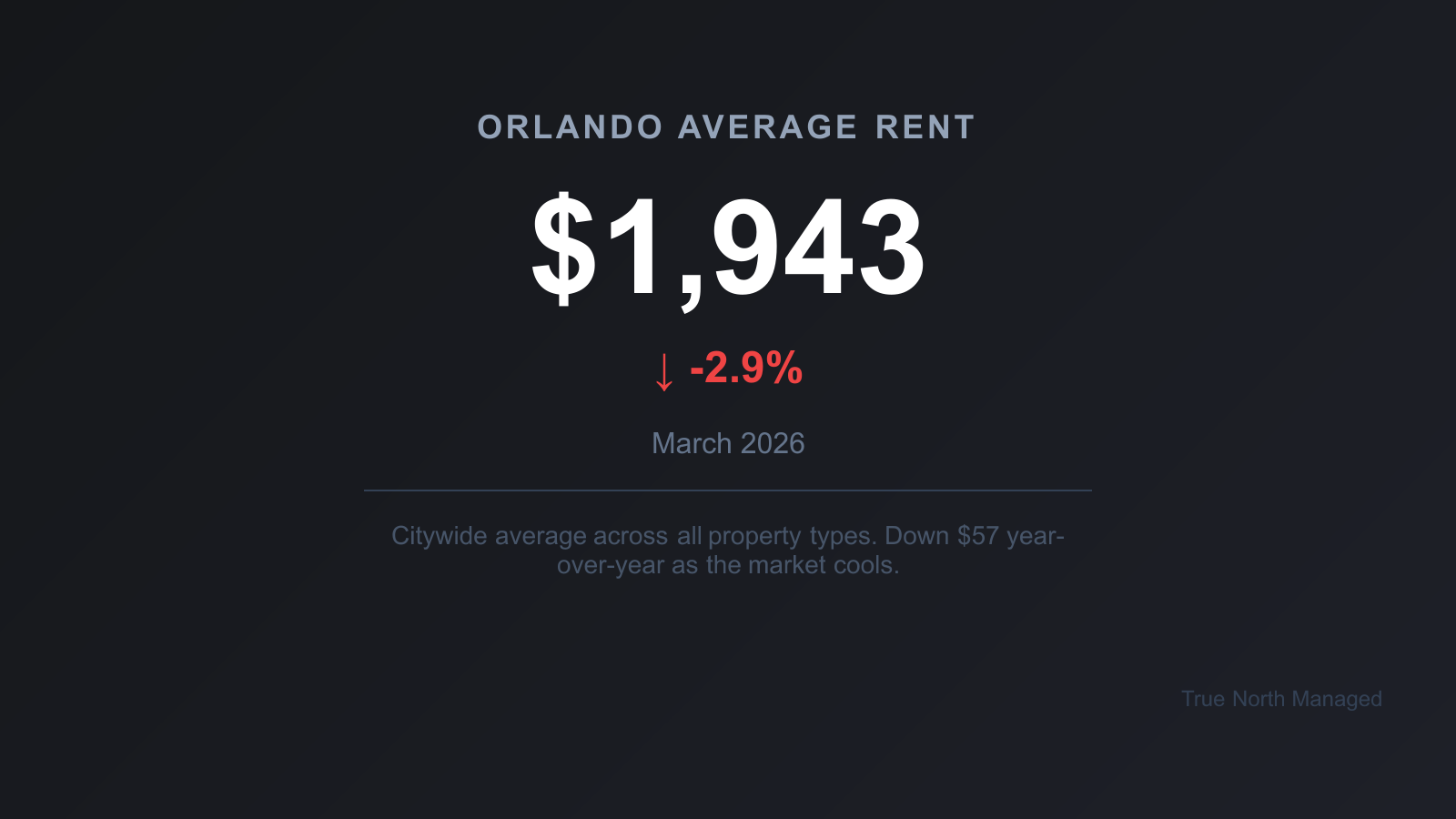
Here's the short answer: Orlando's average rent is about $1,943 right now, according to Zillow's Orlando market data, but that number varies by property type, bedroom count, and neighborhood. A 3-bedroom house in Lake Nona rents for roughly $2,500–$3,000; a 2-bedroom in Winter Park might go for $1,700–$1,900. The market has cooled in 2026—rents are down about 1.8% year-over-year—so you can't just set a price and assume it'll stick. You need to run comps, understand what drives pricing, and avoid the mistakes that cost landlords thousands. See our pricing Orlando rentals with market comps for more.
Let's break it down.
What Orlando Rents Look Like Right Now
Orlando's rental market is cooling after years of rapid growth. Median asking rent for 0–2 bedroom units fell 1.8% year-over-year as of late 2025, and the average rent across all property types sits around $1,943—down about $57 from the prior year. That doesn't mean you can't charge more; it means you need to know where your property fits.
By bedroom count (apartments/condos):
- 1 bedroom: ~$1,692/month
- 2 bedrooms: ~$2,048/month
- 3 bedrooms: ~$2,451/month
- 4 bedrooms: ~$2,752/month
By bedroom count (houses):
- 1 bedroom: ~$1,240/month
- 2 bedrooms: ~$1,879/month
- 3 bedrooms: ~$2,411/month
- 4 bedrooms: ~$3,074/month
By neighborhood: Lake Nona commands a premium—median rent there's around $2,800, with single-family homes averaging $2,925 and upscale homes in the $3,000–$4,500 range. Winter Park is more moderate: $1,487 for a 1-bedroom, $1,771 for a 2-bedroom, $2,076 for a 3-bedroom. Downtown Orlando averages about $2,092/month. On the lower end, neighborhoods like Lake Sunset, Lorna Doone, and Holden-Parramore run 30–45% below the city median.
Property type matters too. Houses generally rent for more than apartments for larger units (4-bedroom houses average $3,074 vs. $2,752 for apartments). The gap narrows for smaller units.
How to Run Rental Comps
Comps—comparable rentals—are the foundation of pricing. You're not guessing; you're looking at what similar properties actually rent for in your area.
Step 1: Define your search area. Stick to within 0.5–1 mile of your property. Closer is better. Same zip code or neighborhood is ideal.
Step 2: Match the basics. Find rentals that match your property on bedrooms, bathrooms, square footage, and property type (single-family, condo, townhome). If you've got a 3-bed, 2-bath house with 1,400 sq ft, your comps should be 3-bed, 2-bath houses in the same size range.
Step 3: Adjust for differences. If a comp has in-unit laundry and yours doesn't, subtract 6% or so from that comp's rent. If a comp has a garage and yours doesn't, subtract 8%. If a comp is older and less updated, add 5–10% for your property. Garage parking adds roughly 8% to rent; in-unit washer/dryer adds about 6%; yards and fitness access add around 5%. Use these as rough adjustments.
Step 4: Use multiple sources. Zillow's Orlando rental market trends, Realtor.com, Apartments.com, Redfin, and the MLS all have listing data. Tools like Zillow's Rent Zestimate and Rentometer can give you a starting point, but they rely on asking prices—not actual lease rates—so they can overstate true market rent. Use them as a starting point, then cross-check with live listings and recent leases if you have access.
Step 5: Pick 3–5 comps and average them. Don't cherry-pick the highest. If your comps range from $1,800 to $2,100, aim for the middle—maybe $1,950—and adjust up or down based on condition, amenities, and how quickly you need to fill the unit.
One more tip: price per square foot can help normalize size differences. If your 1,400 sq ft house comps at $2.10/sq ft and similar homes are renting at $2.00–$2.25, you've got a reasonable range. Use it as a sanity check, not the only number.
The Overpricing Trap: Why It Costs More Than You Think
Every $10 you add above market rate adds roughly 3 days to vacancy. A $50 overprice can mean a full month of avoidable vacancy. Properties priced within 3% of market lease 40% faster than those priced 10% above market, and most rental inquiries happen in the first 14 days of listing. If you're not getting bites, you're probably priced too high.
Here's the math: A month of vacancy on a $2,000 unit doesn't just cost you $2,000. It costs you closer to $4,000–$4,500 when you factor in lease-up incentives, turnover and make-ready expenses, marketing, utilities, and carrying costs. That's roughly 2 months of gross rent. So a property rented at $1,500/month but vacant 60 days generates $15,000 annual income—while the same property rented at $1,400/month and vacant only 30 days generates $15,400. Lower rent, faster fill, more money in your pocket.
Tenants are smart. They have access to the same listing data you do. They don't negotiate—they skip overpriced listings and move on.
The Underpricing Trap: Leaving Money on the Table
Underpricing feels safe. You're worried about vacancy, so you drop the rent $100 or $200. You'll fill it fast, right?
Maybe. But you're also leaving money on the table every single month. "Loss to lease" is the industry term for revenue you're not capturing because you're below market. If market rent is $2,000 and you're charging $1,700, you're 15% below market. That's $3,600 per year—every year—until you raise the rent at renewal.
Underpricing often comes from fear of vacancy, emotional attachment, or not doing enough market research. Don't assume you need to undercut to get tenants. If your comps are solid and your property is in good shape, price at market. You'll attract qualified tenants who expect to pay fair rent and are less likely to nickel-and-dime you on maintenance. Solid tenant screening helps you identify applicants who can afford your rent and will treat the property well.
What Actually Affects Your Rent Price?
Location matters most. Proximity to employment centers, schools, transit, and amenities drives demand. Lake Nona's Medical City and high-income tenant base justify higher rents. Winter Park's walkable downtown and strong schools do the same. Neighborhoods with lower crime, better schools, and easier commutes command premium rents.
Condition and upgrades. Fresh paint, updated appliances, and modern finishes justify higher rent. A renovated kitchen with quartz countertops and stainless appliances can add 10–15% over a dated unit. In-unit laundry adds roughly 6%; garage parking adds 8%. Hardwood or luxury vinyl plank flooring can return 100%+ on the investment. Smart home tech and energy-efficient features appeal to tenants and can support modest rent bumps.
Focus on upgrades tenants actually care about: kitchens, bathrooms, flooring, and laundry. Curb appeal matters for first impressions. Cosmetic fixes—fresh paint in neutral colors, updated hardware, clean landscaping—often deliver the best ROI per dollar spent. Skip luxury finishes that won't move the needle on rent.
Property features. Pet-friendly units can charge $20–$25 per pet per month in Orlando on top of base rent—plus a one-time pet fee of $300–$500. Furnished rentals can command 20–40% more than unfurnished—but they lease slower (about 34 days vs. 27 for unfurnished) and attract a smaller tenant pool. Most long-term renters already own furniture, so furnished works best for corporate relocations or short-term stays. If you're considering Section 8, the Orlando Housing Authority publishes payment standards by bedroom count and zip code; those caps will limit what you can charge for voucher holders.
Seasonality. May through August is peak rental season in Orlando. Families move before the school year; demand is high. December through February is slowest. Few people move during the holidays, and mid-school-year relocations are rare. If your lease expires in January, expect longer vacancy or consider offering a 12- or 18-month lease that aligns renewal with summer. Some Orlando property managers structure leases specifically to avoid winter gaps.
Market timing. Orlando's rental market has cooled in 2026. New construction has increased supply, and rent growth has slowed to roughly 1.2% projected for the year. That means you can't rely on automatic annual bumps—you need to price right from the start and stay competitive at renewal. The days of double-digit rent increases are over; measured, data-driven pricing wins.
When to Raise Rent
Florida has no statewide rent control. Landlords can raise rent by any amount they choose as long as proper notice is given. Florida's rent increase laws require 15 days' written notice for month-to-month leases and 60 days for fixed-term annual leases. You can't raise rent during the lease term unless the lease explicitly allows it.
Practical timing: Raise rent at lease renewal. Give tenants a clear heads-up—60 days before the end of their term—and explain the increase in context (market rates, property improvements, increased costs). If you've been under market for a year or two, a 5–8% increase might be justified. If you're already at market, a 3–5% bump aligned with inflation is typical. Don't overdo it: tenants who feel gouged are more likely to leave, and turnover costs more than a modest rent increase.
Rent-to-income ratio: Most landlords screen for tenants whose rent is no more than 30% of gross income. That's the standard HUD and most lenders use: rent shouldn't exceed 30% of gross monthly income. A $2,000 rent requires about $6,000 monthly income—$72,000 annual. Orlando's median household income is around $77,600, so a $2,000 rent is right at the edge for typical renters. If you're pricing above that, you're targeting higher-income tenants—make sure your property and location justify it. Tenants spending more than 50% of income on rent are considered severely rent-burdened and are higher default risks.
Get Your Free Rental Analysis
Pricing isn't guesswork. It's comps, condition, location, and timing. If you're not sure where your property sits in the market—or you want a second opinion before you list—we can help. Our Orlando market guide covers the full picture for rental investors, including what property management costs and how to run the numbers.
We'll analyze your property against comparable rentals in your neighborhood, factor in your upgrades and amenities, and give you a data-backed rent range. No obligation. Just a clear picture of what you can charge.