

How to Screen Tenants in Florida Without Breaking Fair Housing Law
How to screen tenants in Florida without violating fair housing law — the criteria you can use and the questions that'll get you sued.

Your best tenant and your worst tenant look the same on day one
Everybody smiles at the showing. Everybody says they'll take great care of the place. And if you've been a landlord long enough in Orlando, you know that the person who seemed perfect at the walkthrough can be the same person who stops paying rent four months later. See ourOrlando-specific tenant screeningfor more.
Screening is the difference. But screening wrong -- asking the wrong questions, rejecting someone for the wrong reasons, or running background checks without proper authorization -- can put you on the wrong side of a Fair Housing complaint faster than a bad tenant can trash your property. And those complaints start at$16,000 in penaltiesfor first-time violations. Sixty-eight percent of all housing discrimination complaints originate from the screening process.
The Short Answer
Florida lets you check five things: credit history, income and employment, rental history, eviction records, and criminal background. You must get written permission before pulling any consumer report. And you can't ask about -- or make decisions based on -- race, color, national origin, religion, sex, disability, or familial status. Period.
Why This Matters in Orlando
Orlando is one of the most diverse metro areas in the country. Your applicant pool includes families, students from UCF and Valencia, military personnel, remote workers who relocated during the pandemic, and international professionals working in hospitality and tech. That diversity is great for demand -- it also means you need a screening process that's consistent, documented, and legally defensible.
If you're renting near MacDill AFB in Tampa, military tenants havedifferent screening documentation— LES statements instead of pay stubs, and federal SCRA lease protections that override standard lease terms. See ourTampa and Hillsborough County screeningfor more.

Here's something Orlando landlords should know: unlike Miami-Dade and Palm Beach counties, Orange County doesn't have a local "source of income" protection ordinance. That means you're not required to accept Section 8 vouchers or other housing assistance programs in Orlando. Some landlords choose to -- and there are good business reasons to consider it -- but it's not mandated here. If you're managing properties in both Orlando and South Florida, the rules are different depending on which county you're in. See our Section 8 pros and cons for Florida landlords for details.
Fair Housing complaints filed with HUD aren't rare. They're not even uncommon. And they don't require the tenant to prove you intentionally discriminated -- they only need to show a pattern or a policy that's a discriminatory effect. A solid written screening policy protects you from that.
The math makes the case on its own: a bad tenant placement costs $7,500-$15,000 when you add up the eviction filing, lost rent during the process, turnover costs, and potential property damage. A proper screening costs $50-$75 per applicant. That's a ratio worth paying attention to.
What can you legally check?
Here are the five pillars of a legal screening process in Florida. Use all five. Skip none.
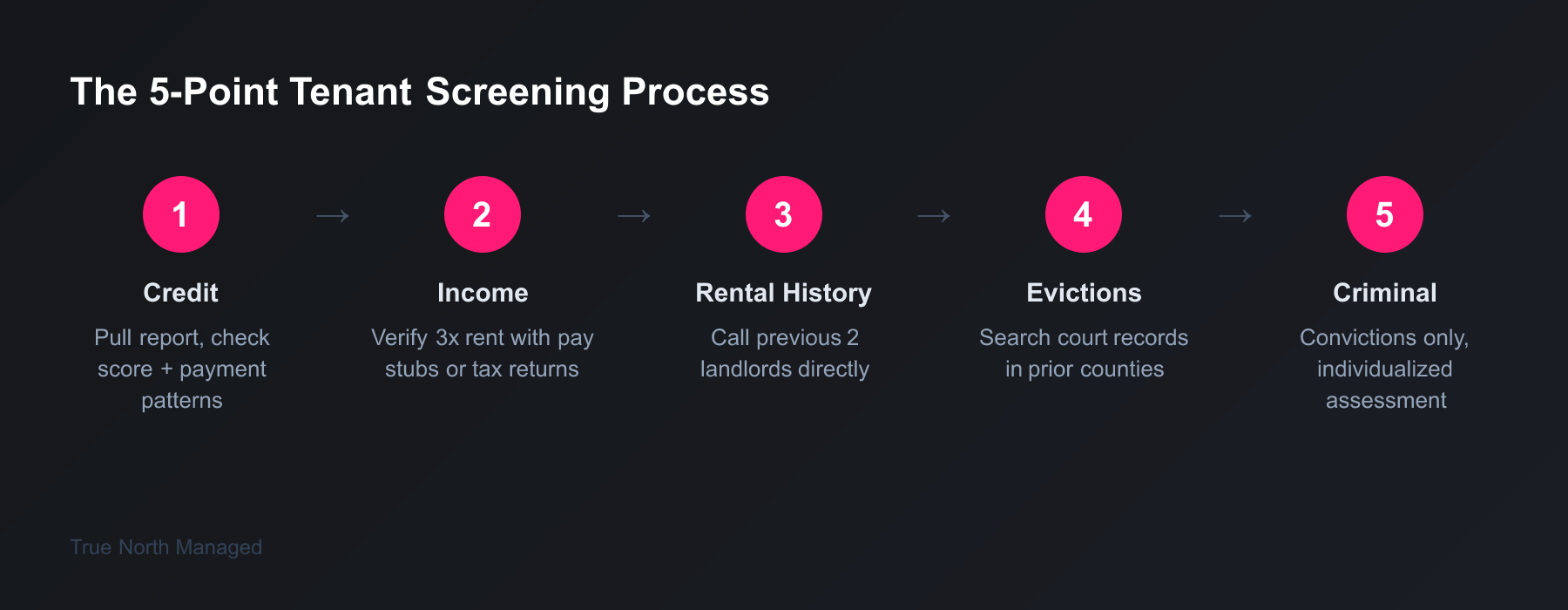
1. Credit history.Pull a full credit report through a screening service that complies with the Fair Credit Reporting Act. You're looking for payment patterns, outstanding collections, and debt-to-income ratios. A credit score below 580 is a red flag for most Orlando rentals. Between 620-680 is workable depending on the rest of the application. Above 700 and you're in good shape.
But don't use credit score alone. Someone with a 640 credit score and a perfect rental history for seven years is a safer bet than someone with a 720 and two prior evictions. Context matters.
2. Income and employment.The standard benchmark is 3x the monthly rent in gross income. For an Orlando rental at $1,850/month, that's $5,550/month or roughly $66,600 annually. Verify with recent pay stubs (at least two months), a bank statement, or an employment verification letter.
Self-employed applicants need extra documentation: two years of tax returns or a CPA letter confirming income. Don't skip this because verification feels awkward. The awkward conversation now prevents the missed-rent conversation later.
3. Rental history.Call the previous two landlords. Not just the current one -- the current landlord might give a glowing reference because they want the problem tenant gone. Ask specific questions: Did they pay on time? Did they give proper notice? Any lease violations? Would you rent to them again?
If someone can't provide landlord references -- maybe they're moving out of a family home or breaking from a roommate situation -- that's not automatic disqualification. But it means the rest of the application needs to be stronger.
4. Eviction records.Search Orange County court records for any prior eviction filings. In Florida, eviction cases are public record. You're looking at the county where they previously lived, not just Orange County. A single eviction from eight years ago with clean history since is different from two filings in the last three years.
5. Criminal background.You can check, but you can't apply a blanket ban. HUD's 2016 guidance (still in effect) says landlords can't automatically reject every applicant with any criminal record. Instead, you're supposed to evaluate three things: the nature and severity of the offense, how long ago it happened, and whether it's directly related to the safety of other tenants or the property.
A marijuana possession charge from 2018 doesn't justify denial. A conviction for arson six months ago probably does. The key is individualized assessment -- not a checkbox policy that rejects everyone with a record.
One more thing: you can only consider convictions. Not arrests. An arrest without a conviction means nothing happened in the eyes of the law, and using it against an applicant is a liability.
A note on AI screening tools:If you're using an online screening service that scores applicants automatically, be aware that HUD issued guidance in 2024 clarifying that the Fair Housing Act applies to AI-driven screening tools the same way it applies to manual decisions. If the algorithm produces a discriminatory pattern -- even unintentionally -- the landlord using it's liable. Know what your screening service actually checks and how it weights factors.
What questions are off limits?
The Fair Housing Act protects seven classes. You can't ask about any of them, directly or indirectly:
- Race or color.Obvious. But "what country are you from?" slides into this territory fast.
- National origin.You can verify legal right to work. You can't ask where someone was born or what language they speak at home.
- Religion.Don't ask. Don't comment on religious items visible during a showing. Don't ask about church, holidays, or dietary restrictions.
- Sex.Includes gender identity and sexual orientation under HUD's current interpretation.
- Disability.You can't ask if someone has a disability. You can't ask what medications they take. You can't refuse a reasonable accommodation request (like a service animal in a no-pets unit) without a valid reason. This one catches landlords off guard more than any other.
- Familial status.You can't refuse to rent to someone because they've kids. You can't advertise a property as "ideal for professionals" or "quiet building" if the intent is to exclude families. You can't limit children to certain units or floors.
Here's a rule that keeps it simple: if the question doesn't appear on your written screening criteria, don't ask it. Small talk at showings is where most Fair Housing violations happen. "So, do you've kids?" sounds friendly. It's also illegal as a screening question.
How do you build a written screening policy?
Write it down. Apply it the same way to every applicant. Keep it on file.
Your written policy should include:
- Minimum credit score or credit criteria (and what compensating factors you'll accept)
- Income requirement (3x rent, documented)
- Rental history standards (number of years, what constitutes disqualifying history)
- Eviction policy (how recent, how many, how you evaluate context)
- Criminal background criteria (types of offenses, lookback period, individualized assessment)
- Application fee amount and what it covers
- Timeline for decision-making (how many business days after application)
On application fees:Florida has no statutory cap on what you can charge, but most Orlando landlords charge between $50 and $100 per adult applicant. That should cover the cost of a credit report, criminal background check, and eviction search. Charging $200+ per applicant without a clear justification is going to raise eyebrows -- and in a market with 3,400+ competing listings, it'll shrink your applicant pool.
Apply it identically to every applicant. Document every decision. If you reject someone, send an adverse action notice that includes the screening company's name and contact information -- that's an FCRA requirement, not optional.
A written policy does two things: it keeps you consistent (which is your best legal protection), and it speeds up your process (because you're not making judgment calls from scratch on every application).
What about reusable screening reports?
This is new. Florida passed Section 83.471 in 2025, creating a framework forreusable tenant screening reports. The idea is straightforward: a tenant pays a consumer reporting agency to prepare a screening report, and then presents that same report to multiple landlords instead of paying separate application fees at every property.
You're not required to accept reusable reports. But if you do, you can't charge the applicant a separate screening fee for the same information the report already covers. The report has to be less than 30 days old and prepared by a recognized consumer reporting agency.
For landlords, the practical impact is small right now -- most tenants don't know about this option yet. But it's worth understanding because it's likely to become more common, especially among applicants who are shopping multiple rentals at once in a competitive market likeOrlando's.
Common Mistakes Orlando Landlords Make
- Screening by gut feeling."They seemed nice" isn't a screening criteria. Neither is "I got a bad vibe." Document everything. Decide based on your written policy.
- Not getting written permission for the background check.The FCRA requires written authorization from the applicant before you pull any consumer report -- credit, criminal, or eviction. Skipping this step exposes you to federal liability, not just state.
- Asking illegal questions during showings."Are you married?" "Do you go to church nearby?" "That's a big family -- will everyone fit?" Each of these is a Fair Housing violation waiting to happen. Stick to the application. Let the paperwork do the talking.
- Applying a blanket criminal history ban."No criminal record" as a policy is a lawsuit waiting to happen. HUD's guidance is clear: you need individualized assessment. If you can't articulate why a specific conviction is relevant to tenancy, you can't use it to deny an applicant.
- Skipping the adverse action notice.When you reject an applicant based on information in a consumer report (credit, criminal, eviction), you're legally required to send a written adverse action notice. it's to include the name and contact information of the screening company. Most self-managing Orlando landlords skip this step entirely -- and that's a federal violation under the Fair Credit Reporting Act.
Next Steps
Screening is the single highest-use activity in property management. Get it right and you'll fill your Orlando rental with a tenant who pays on time, follows the lease, and renews. Get it wrong and you're looking at asecurity deposit disputethat spirals into an eviction that costs $3,000-8,000 and takes two to three months in Orange County.
We've seen what bad screening looks like up close -- landlords who end up withvacant properties and months of lost rentbecause they rushed the process or skipped steps. The screening system we use on every property we manage follows this exact five-point process, applied consistently, documented every time.
If you want help building a screening system that's legally sound and actually works in the Orlando market, start with a free rental analysis. We'll look at your property and your current process and tell you what's working and what isn't.