
Tenant Retention in a Softening Market: What's Working in Orlando and Tampa
Turnover costs $3,500–$7,000 per unit in Florida. In a market with 10%+ vacancy, keeping a good tenant is worth more than chasing a higher rent. Here's what's working for Orlando and Tampa landlords right now.
Tenant Retention in a Softening Market: What's Working in Orlando and Tampa
When vacancy rates sit above 10% in Tampa and around 9.5% in Orlando, the economics of tenant retention shift dramatically. In a tight market, you can lose a tenant and fill the unit in 14 days. In a soft market, that timeline stretches to 30–45 days — and every vacant day costs you $55–$85 on a $2,000/month rental.
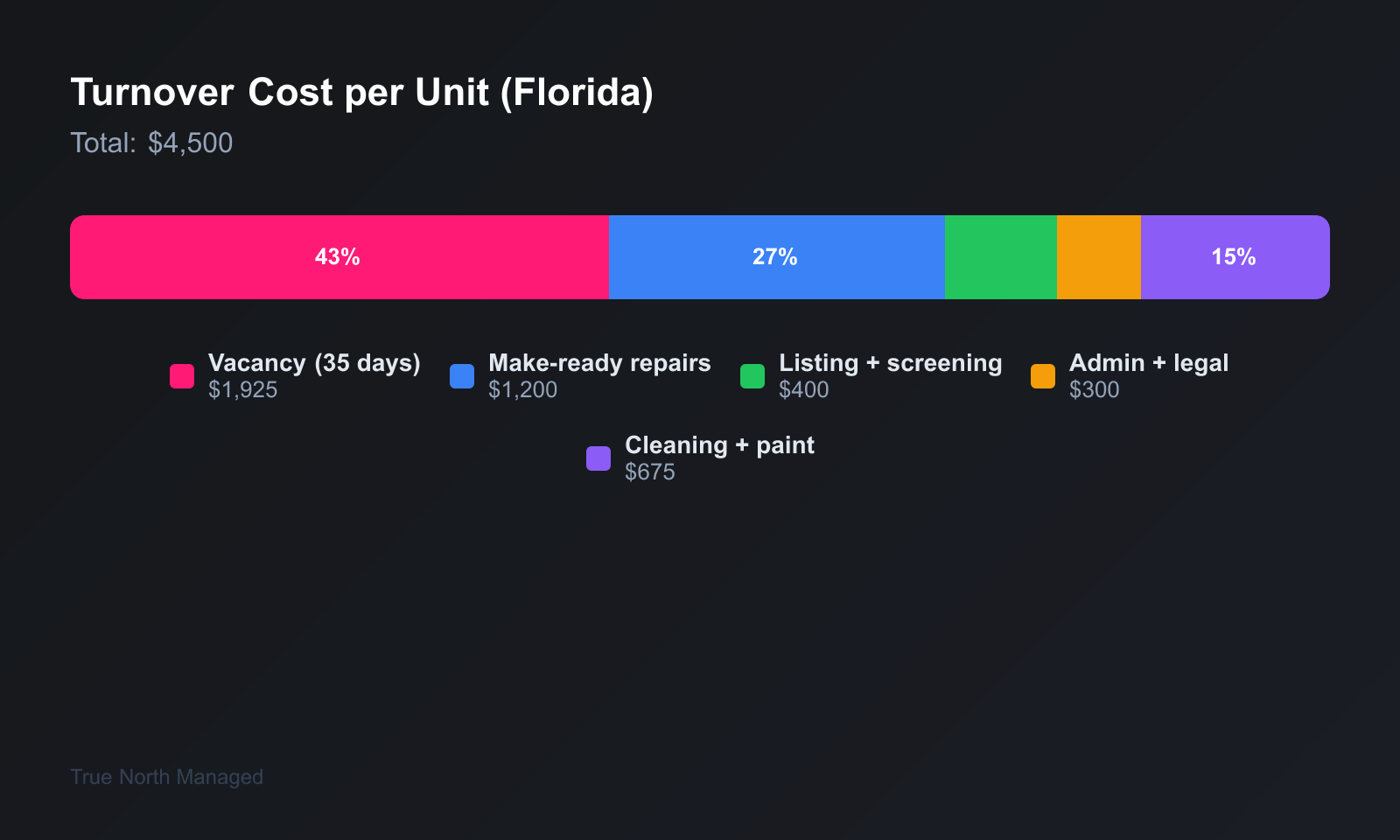
The math is simple: turnover costs $3,500–$7,000 per unit in Florida when you factor in vacancy, make-ready repairs, listing costs, and screening expenses. A $50/month rent concession on a 12-month renewal costs $600. Retention beats replacement every time — especially now.
Here's what's actually working for Central Florida landlords in the current market.
Start Renewal Conversations 90 Days Out
The biggest retention mistake landlords make: waiting until 30 days before lease expiration to bring up renewal. By then, the tenant has already been browsing listings. They've seen what's available. They've done the math.
At 90 days out, the tenant hasn't started looking yet. That's your window. A simple message — "We'd love to keep you. Here's our renewal offer" — initiates the conversation while you still have the upper hand.
The 90-day renewal framework:
- Day 90: Send renewal offer with proposed terms. Include a small incentive for early commitment (waived admin fee, carpet cleaning credit, or a rent freeze).
- Day 60: Follow up if no response. Ask if there's anything about the property they'd like addressed before renewing.
- Day 45: Final offer window. If the tenant declines, you now have 45 days to market the unit — enough time to avoid a vacancy gap even in a slower market.
Properties that implement 90-day renewal programs see 15–20% higher renewal rates than those that wait until 30 days. That's 1–2 fewer turnovers per year on a 10-unit portfolio — saving $7,000–$14,000 annually.
Price Renewals Against the Market, Not Against Last Year
The standard approach — "raise rent 3–5% at renewal" — works in a landlord's market. In a soft market, it pushes good tenants out the door.
Here's the 2026 reality in Central Florida:
- Orlando median asking rent: ~$1,650/month (flat year-over-year)
- Tampa median asking rent: ~$2,600/month for SFR (up 4% YoY, but apartment rents are declining)
- Average days on market for new listings: 30–47 days (up significantly from 2024)
If your current tenant is paying $1,800/month and comparable units are listing at $1,750, a 3% increase to $1,854 sends them to a cheaper unit down the street — and you eat 30+ days of vacancy to backfill at $1,750.
The retention pricing strategy:
- Pull comps within a 2-mile radius. What are similar units actually leasing for (not asking — leasing)?
- If your current rent is at or above market, offer a renewal at the same rate. A zero-increase renewal is a retention tool, not a surrender.
- If your current rent is below market, increase modestly (2–3%). Position it as a "loyalty rate" that's still below what a new tenant would pay.
- If the tenant is excellent (pays on time, maintains the property, no complaints), the math justifies absorbing a below-market renewal to avoid $5,000+ in turnover costs.
Fix the Small Things Before They Become Move-Out Reasons
Tenants rarely leave because of one big problem. They leave because of five small problems that accumulate into frustration. The dripping faucet they reported twice. The garage door opener that sometimes doesn't work. The landscaping that looks neglected.
These are $50–$200 fixes that prevent $5,000 turnovers. The ROI is absurd.
The pre-renewal maintenance blitz: Schedule a property walkthrough 100 days before lease expiration (10 days before your renewal offer). Fix everything you find — paint touch-ups, caulking, hardware replacements, filter changes, cosmetic repairs. Then send the renewal offer.
The psychology here matters. The tenant receives a renewal offer from a landlord who just fixed three things they'd been tolerating. The message is: "We notice. We care. We want you to stay." That's retention.
Communicate Like a Professional, Not a Stranger
The landlords with the highest retention rates share one habit: they communicate proactively, not just reactively. They don't only reach out when rent is late or when it's time to renew. They reach out because there's something worth communicating.
High-retention communication patterns:
- Seasonal reminders: AC filter replacement in spring, hurricane prep in May, freeze prep in December (rare but relevant in North Florida)
- Maintenance scheduling: "We're sending someone to check the HVAC system next Tuesday. No action needed from you."
- Market updates: A brief note about neighborhood developments, road construction, or community events
- Appreciation: A $25 gift card at renewal or during the holidays costs nothing relative to turnover costs
This doesn't mean being a nuisance. One communication per month is plenty. The point is that the tenant perceives a relationship, not a transaction.
Create Friction Against Leaving
Not manipulative friction — structural friction that makes staying easier than leaving.
Flexible lease terms. Offer 6-month, 12-month, or 18-month renewal options. Some tenants want flexibility; some want stability. Giving them the choice reduces the impulse to leave for a property that offers what you don't.
Move-in anniversary acknowledgment. A brief message — "It's been a year since you moved in. Thanks for being a great tenant." — costs nothing and creates a moment of positive association with staying. Small gestures compound. The tenant who receives regular acknowledgment is 2x less likely to shop for alternatives at renewal time.
Maintenance request responsiveness. The #1 complaint tenants cite when leaving: slow maintenance response. Properties that respond to maintenance requests within 24 hours and complete repairs within 72 hours have measurably higher retention rates than properties that take a week.
The Retention Math for 2026
Here's a worked example for an Orlando landlord with a 5-unit portfolio:
Without retention focus:
- 2 turnovers per year (40% annual turnover rate — typical for self-managing landlords)
- Average vacancy per turnover: 35 days at $55/day = $1,925
- Make-ready cost per turnover: $1,200 (cleaning, paint, minor repairs)
- Listing/screening cost per turnover: $400
- Total annual turnover cost: $7,050
With retention focus (90-day program + competitive pricing + maintenance blitz):
- 0.5 turnovers per year (10% turnover rate — achievable with professional management)
- Average vacancy per turnover: 21 days at $55/day = $1,155
- Make-ready cost: $800 (lighter touch after a maintained tenancy)
- Listing/screening cost: $400
- Total annual turnover cost: $1,178
Annual savings: $5,872. Over 5 years, that's nearly $30,000 — on a 5-unit portfolio. Scale that to 10 or 20 units and retention strategy becomes the single highest-ROI investment a landlord can make.
Frequently Asked Questions
Should I match a competitor's lower price to keep a tenant? Only if the total cost (lower rent × remaining lease months) is less than the turnover cost. On a 12-month renewal, matching a $100/month price cut costs $1,200 — still less than the $5,000+ turnover cost.
What if the tenant asks for improvements as a condition of renewal? Evaluate each request on ROI. New carpet ($800) that prevents a $5,000 turnover? Absolutely. A full kitchen remodel ($15,000)? Probably not. Counter with the improvements that are defensible for any future tenant.
When should I let a problem tenant leave? Retention applies to good tenants only. If a tenant consistently pays late, damages the property, or generates neighbor complaints, a turnover is an investment in your portfolio's health — not a cost to avoid.
Does retention strategy differ between Orlando and Tampa right now? Slightly. Orlando's market is tightening faster, so you have marginally more pricing power on renewals — 2–3% increases are realistic for well-maintained properties. Tampa's higher vacancy means flat renewals are often the right call through Q3 2026. In both markets, the retention fundamentals are the same: start early, price against comps, fix the small stuff, and communicate consistently.
What's the ideal tenant turnover rate? Industry benchmarks for well-managed single-family portfolios are 20–30% annual turnover. Self-managing landlords average closer to 40%. Professional management with a dedicated retention program targets 10–15%. Each 10-percentage-point reduction in turnover rate saves approximately $2,000–$4,000 per unit annually.
In a soft market, retention isn't a nice-to-have — it's the highest-return investment in your portfolio. Start 90 days before expiration, price against the market, fix the small stuff, and communicate like a professional.
If you want tenant retention handled by a team that does this at scale across Orlando and Tampa, get a free rental analysis to see the difference.