

Short-Term vs. Long-Term Rentals in Florida: Which Makes More Money?
STR or LTR? The answer depends on your property, your market, and how much time you're willing to invest. Here's the Florida-specific math, licensing, taxes, and management reality for both models.

Short-Term vs. Long-Term Rentals in Florida: Which Makes More Money?
Every Florida investor asks this question eventually: should I Airbnb this property or put a long-term tenant in it?
The honest answer: it depends. And the variables that matter aren't the ones most investors focus on. Everyone looks at the nightly rate. Few people calculate the actual operating costs, factor in the regulatory risk, or account for the time they'll spend managing turnovers.
Here's the Florida-specific framework for deciding between short-term (STR) and long-term (LTR) rental strategies.
What Does Each Model Actually Produce?
Short-term rental revenue is higher on paper. A property that rents for $2,000/month long-term can generate $150–$250/night as an STR during peak season. At 70% occupancy, that's $3,150–$5,250/month.
But occupancy isn't 70% everywhere, and it isn't 70% year-round. Florida STR occupancy ranges from 40% in off-season (September��November) to 85%+ during peak season (December–April for snowbirds, June–August for families). Your annualized effective occupancy is probably closer to 55–65%.
Long-term rental revenue is steady. On a 12-month lease, you're collecting $2,000/month at 95%+ occupancy (accounting for the occasional turnover). Annual gross: $22,800–$24,000.
STR annual gross at 60% average occupancy and $200/night average: $43,800. Looks great — until you subtract the expenses.
What Does Each Model Cost to Run?
This is where the comparison shifts dramatically.
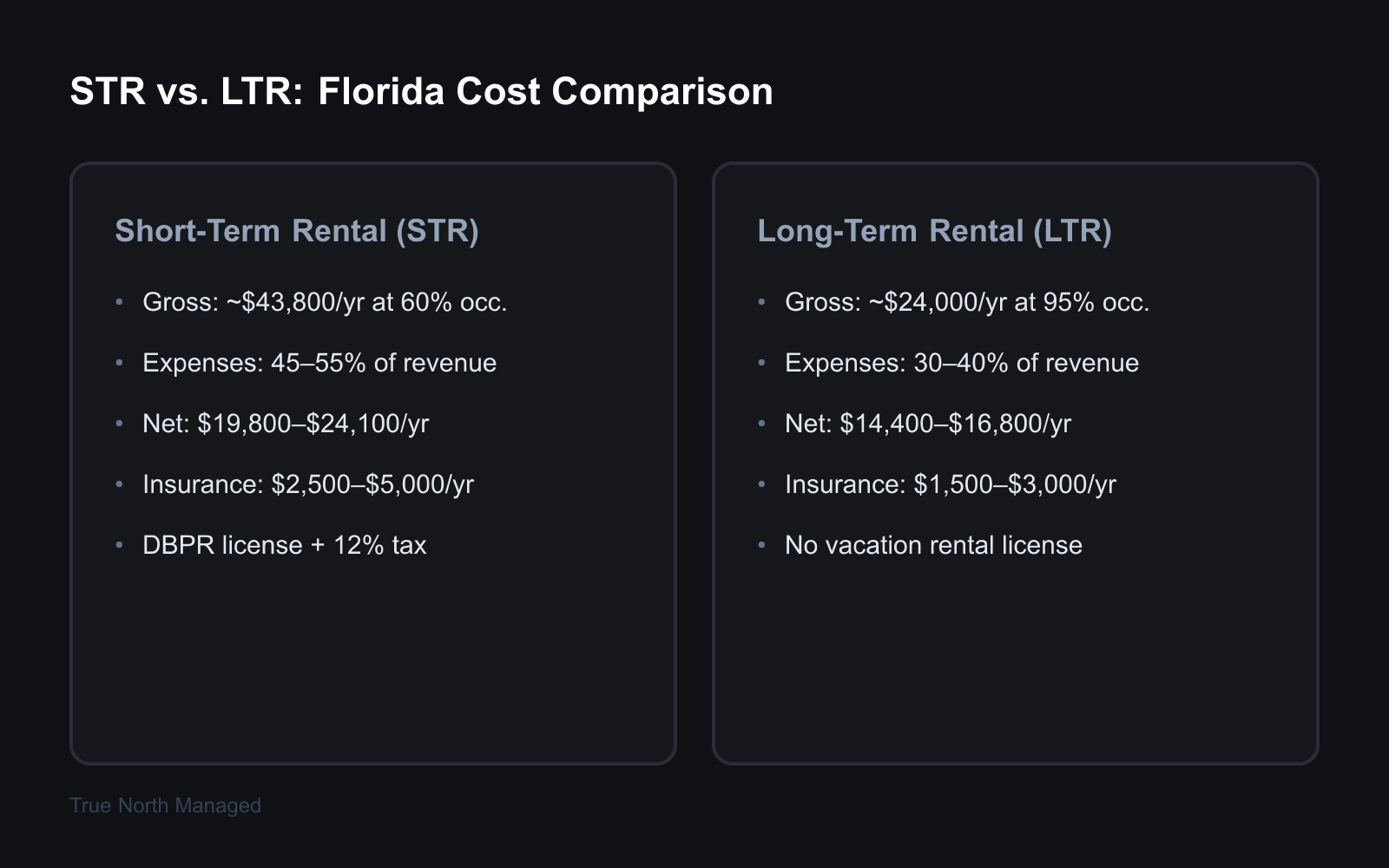
STR operating costs run 45–55% of revenue. That includes:
- Cleaning between guests: $100–$175 per turnover (at 60% occupancy with average 3-night stays, that's ~6 turnovers/month = $600–$1,050/month)
- Platform commissions: Airbnb takes 3% from hosts (plus 14% from guests), VRBO takes 5–8%
- Furnishings and replacements: Budget $3,000–$5,000 upfront, $1,000–$2,000/year for wear
- Utilities: You pay them all — electric, water, internet, streaming. Budget $300–$500/month in Florida.
- Supplies: Linens, towels, toiletries, coffee, kitchen consumables. $200–$400/month.
- Marketing photography and listing optimization: $500–$1,000 upfront, periodic refreshes
- Dynamic pricing software: $20–$50/month
LTR operating costs run 30–40% of revenue. That includes:
- Property management (if applicable): 8–12% of rent
- Maintenance: 1–3% of property value annually
- Insurance: Landlord policy ($1,500–$3,000/year)
- Property taxes (tenant doesn't pay these)
- Vacancy cost: ~5% of annual rent (one turnover every 2 years)
On the $2,000/month LTR: annual expenses of roughly $7,200–$9,600. Net income: $14,400–$16,800.
On the STR at $43,800 gross: annual expenses of roughly $19,700–$24,000. Net income: $19,800–$24,100.
The STR nets more — but the margin is thinner than the gross revenue suggests. And that's before we talk about licensing, taxes, and the management reality.
What Are Florida's STR Licensing and Tax Requirements?
This is where a lot of investors get surprised.
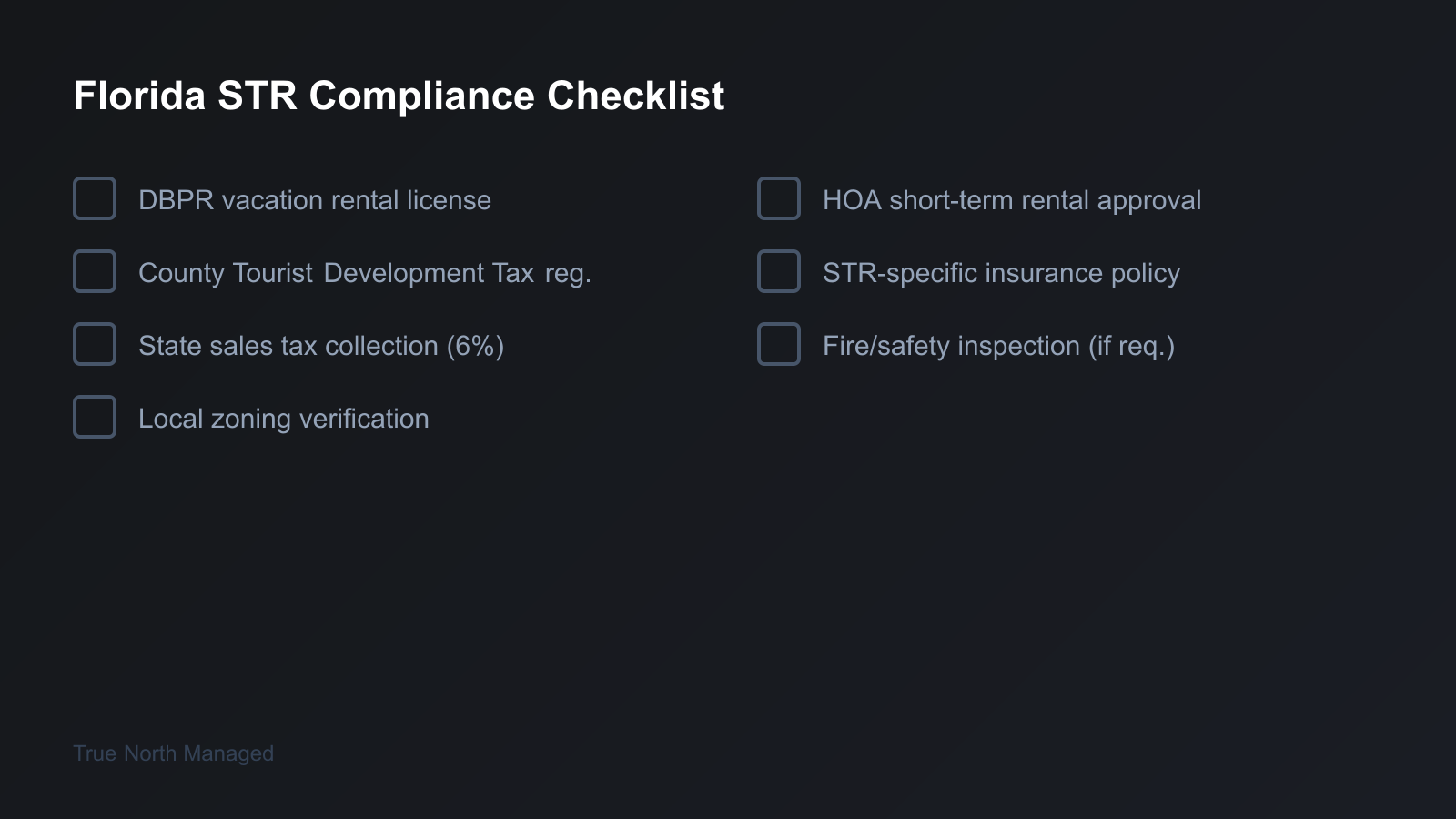
DBPR licensing. Florida defines a vacation rental as any dwelling unit rented for periods of less than 30 days (or one calendar month), three or more times per year. All vacation rentals must be licensed through the Department of Business and Professional Regulation (DBPR). The license application includes an inspection, and annual renewal runs $50–$170 depending on unit count.
Tourist Development Tax. In addition to Florida's 6% state sales tax, counties levy a Tourist Development Tax on all short-term rentals:
- Orange County (Orlando): 6% TDT → 12% total tax on gross rental receipts
- Hillsborough County (Tampa): 6% TDT → 12% total tax
- Osceola County (Kissimmee): 6% TDT → 12% total tax
You're responsible for collecting and remitting these taxes. Airbnb collects and remits state sales tax automatically, but some platforms don't handle the county TDT — you may need to register directly with the county tax collector.
Local regulations. This is the biggest variable. Some Florida municipalities welcome STRs. Others restrict or ban them:
- Certain Orlando neighborhoods restrict vacation rentals in residential zones
- Tampa has STR registration requirements
- HOAs can (and do) prohibit short-term rentals entirely
Before investing in an STR, verify the local zoning, HOA rules, and any pending regulatory changes. A city council vote can turn your STR into an LTR overnight.
How Different Is the Insurance?
Very different. And more expensive.
STR insurance requires a commercial or short-term rental policy. Standard landlord insurance doesn't cover properties rented to guests for less than 30 days. STR-specific policies run $2,500–$5,000/year in Florida — roughly double a standard landlord policy.
LTR insurance is a standard landlord/dwelling fire policy. Coverage is more straightforward, and premiums in Florida run $1,500–$3,000/year for a single-family home (flood insurance additional if required).
Some landlords try to use their homeowner's policy for STRs and don't disclose the rental activity. This is a claim-denial waiting to happen. If a guest is injured and your insurer discovers you're running an unlicensed, uninsured STR, they'll deny the claim and potentially cancel your policy.
When Does STR Win?
STR makes more money when:
- Your property is in a high-demand tourism zone (near Disney, near beaches, near downtown areas with nightlife)
- You can achieve 65%+ average occupancy year-round
- You enjoy or can outsource the operational intensity (guest communication, turnovers, dynamic pricing)
- Local regulations are STR-friendly with no pending restrictions
- The property is well-suited for guests (pool, updated finishes, proximity to attractions)
When Does LTR Win?
LTR makes more money on a risk-adjusted, time-adjusted basis when:
- Your property is in a residential neighborhood without strong tourist demand
- You value stable, predictable cash flow over volatile higher-gross income
- You don't want to manage (or pay for) weekly turnovers, guest communication, and supply restocking
- The HOA restricts short-term rentals
- Local regulations are tightening or uncertain
- You want truly passive income (LTR with a PM = nearly passive; STR is never passive)
What About the Middle Ground?
Mid-term rentals (30–90 day stays) are growing in Florida. Traveling nurses, corporate relocations, snowbirds who don't want a full-season commitment, and insurance displacement tenants (people displaced by hurricane or fire damage) create steady demand for furnished rentals at 30+ day terms.
Mid-term rentals avoid DBPR licensing and tourist taxes (stays of 30+ days aren't "vacation rentals" under Florida law), while generating 30–60% more revenue than standard LTR. They do require furnishing the unit and higher turnover than LTR, but far less than STR.
For many Florida investors, this is the sweet spot — higher returns than LTR without the regulatory and operational burden of STR.
How Does Property Type Affect the Decision?
Not every property works for both strategies. The physical asset matters.
Condos near attractions (Disney area, International Drive, Tampa Convention Center) lean STR. They're easy to furnish, guests expect them, and the location drives demand. But watch the HOA — many condo associations in Orange and Hillsborough counties now restrict or ban rentals under 30 days. Verify the HOA rules before closing.
Single-family homes in residential neighborhoods lean LTR. Families want 12-month leases, good schools, and quiet streets. Trying to run an STR in a subdivision with deed restrictions is a recipe for complaints, fines, and forced conversion to LTR anyway.
Duplexes and small multifamily almost always make more sense as LTR. The math on furnishing and turning over 2–4 units weekly rarely pencils out compared to steady monthly rent from stable tenants. The exception: purpose-built furnished units in urban cores targeting travel nurses and corporate relocators (mid-term strategy).
Lakefront or waterfront properties can swing either way. Waterfront commands a premium in both models, but the STR premium is often steeper — $300–$400/night for a lakefront home near Disney vs. $2,500/month LTR for the same property. Do the occupancy math honestly.
Frequently Asked Questions
Can I switch from STR to LTR mid-year? Yes, but it's not free. You'll lose your Airbnb ranking and reviews (which took months to build), need to defurnish or find a tenant who wants a furnished unit, and may face a gap between your last guest checkout and your first lease start. Budget 30–60 days of vacancy for the transition.
Do I need a property manager for an STR? Not technically, but practically — yes, unless you live nearby and have flexible time. STR management companies charge 15–25% of gross revenue (significantly more than LTR management at 8–12%). The management cost is one reason STR net margins are thinner than the gross numbers suggest.
What's the biggest mistake new STR investors make? Projecting peak-season revenue across 12 months. A property that generates $5,000/month from January through April might generate $1,500/month in September and October. Run your numbers on conservative annual averages, not peak months.
Does having an STR affect my property insurance claim history? It can. Claims on STR policies may affect your insurability for future properties. Frequent guest-related claims (theft, damage, liability incidents) can increase premiums or make you uninsurable with certain carriers. This is another hidden cost of the STR model that rarely shows up in the initial projections.
The STR vs. LTR decision isn't about which model generates more gross revenue. It's about which model generates more net income for your time, risk tolerance, and specific property.
If you're trying to figure out which strategy maximizes your return for a specific Florida property, get a free rental analysis — we'll model both scenarios with real market data.