

Application Fraud Is Rising: How to Spot Fake Pay Stubs and Landlord References
93% of landlords reported encountering application fraud in the past year. The new wave isn't just fake pay stubs — it's fake employers with real websites, real phone numbers, and AI-generated employment histories.

Application Fraud Is Rising: How to Spot Fake Pay Stubs and Landlord References
Snappt's 2026 Multifamily Fraud Report found that 5.1% of the 1.46 million rental applications they analyzed contained edited or fabricated documents — that's 86,000 fraudulent submissions in a single year. And 93% of property managers reported encountering application fraud in the past 12 months. And the methods are getting more sophisticated.
A decade ago, fake pay stubs were obvious — bad fonts, round numbers, missing employer details. Today, "template farms" — operations that mass-produce fake document templates for reuse across applicants — accounted for over 42,600 fraud cases in 2025 alone. And individual fraudsters build entire fake companies around their applications. They register domains, create professional websites, set up LinkedIn profiles, and forward phone numbers to accomplices who'll confirm employment. The total cost of this infrastructure: under $50 and 30 minutes of setup time.
If your screening process hasn't been updated since 2024, it's likely missing the current generation of fraud.
The Five Most Common Types of Application Fraud
1. Fabricated pay stubs. Online generators produce documents that look identical to ADP, Paychex, and Gusto output — complete with correct tax calculations, proper formatting, and realistic YTD totals. They cost $5–$20 and are available on dozens of websites. You can't detect them by visual inspection alone.
2. Fake employer verification. The applicant lists an employer that doesn't exist or is a shell. They provide a phone number that routes to an accomplice who confirms employment. They create a professional website, a LinkedIn page with fabricated employees, and sometimes even a Google Business listing. Traditional verification — calling the provided number — is now useless against prepared fraud.
3. Forged landlord references. A friend or associate poses as the "previous landlord" using a Google Voice number. They'll confirm on-time rent payment, no damages, and a glowing rental history. Some services even specialize in providing fake landlord references for a fee.
4. Altered bank statements. PDF editing tools let applicants change account balances, remove overdraft fees, and add fictional deposits. The document looks like an authentic bank statement because it is — just with modified numbers.
5. Identity fraud. Stolen Social Security numbers, manipulated driver's licenses, and AI-generated headshots that pass visual inspection. This is the most serious category because it means the person on the lease isn't who they claim to be.
Verification Methods That Still Work
Traditional screening — pulling a credit report, calling the employer's listed number, and checking the references they provided — catches only the most unsophisticated fraud. Here are the methods that work against the current threat.
WHOIS domain lookup. Check when the employer's domain was registered at who.is or lookup.icann.org. Legitimate companies have domains registered years before an employee applies for an apartment. If the domain was registered 3 months ago, that's a red flag.
State business registry search. Every legitimate Florida business is registered with the Division of Corporations. Search the exact business name the applicant provides. If it doesn't appear — or was incorporated very recently — investigate further.
LinkedIn company verification. Check the employer's LinkedIn page for employee count, creation date, and activity history. Fake pages show few employees, no activity before the current year, and generic descriptions.
Direct bank verification. Instead of accepting uploaded bank statements, use services that connect directly to the applicant's bank via Plaid or similar APIs. This pulls real-time data from the bank's servers — no PDF to manipulate.
Cross-reference income against tax returns. Request the most recent tax return (1040 or W-2). Compare reported income to the pay stub figures. A pay stub showing $6,000/month with a W-2 showing $42,000 annual income doesn't add up.
Call the employer's main line — not the number on the application. Look up the company's phone number independently through their website or directory listing. Call the main line and ask for HR. If the company doesn't have a main line, or the number on their website doesn't match the application, that's a flag.
Property ownership records for landlord references. Check the county property appraiser's website to verify that the "previous landlord" actually owns the property the applicant claims they rented. In Orange County, that's ocpafl.org. In Hillsborough County, it's hcpafl.org.
What Does Florida Law Allow (and Prohibit) in Screening?
Florida's fair housing laws set boundaries on what you can ask and how you can use the information.
You can: Require employment verification, income documentation, credit reports, criminal background checks (with limitations), and rental history verification. You can charge a reasonable application fee to cover these costs — typically $50–$75 in the Orlando and Tampa markets.
You cannot: Discriminate based on race, color, national origin, religion, sex, familial status, or disability (federal Fair Housing Act). You also cannot use blanket criminal record disqualifications without individualized assessment — HUD guidance requires you to consider the nature of the offense, time since conviction, and relevance to housing.
Document everything. If you deny an application based on screening findings, document the specific reason. "Application denied due to unverifiable employment" is defensible. "Something seemed off" is not.
Building a Fraud-Resistant Screening Process
A screening process that catches modern fraud needs multiple independent verification channels. No single check catches everything — but layering catches most.
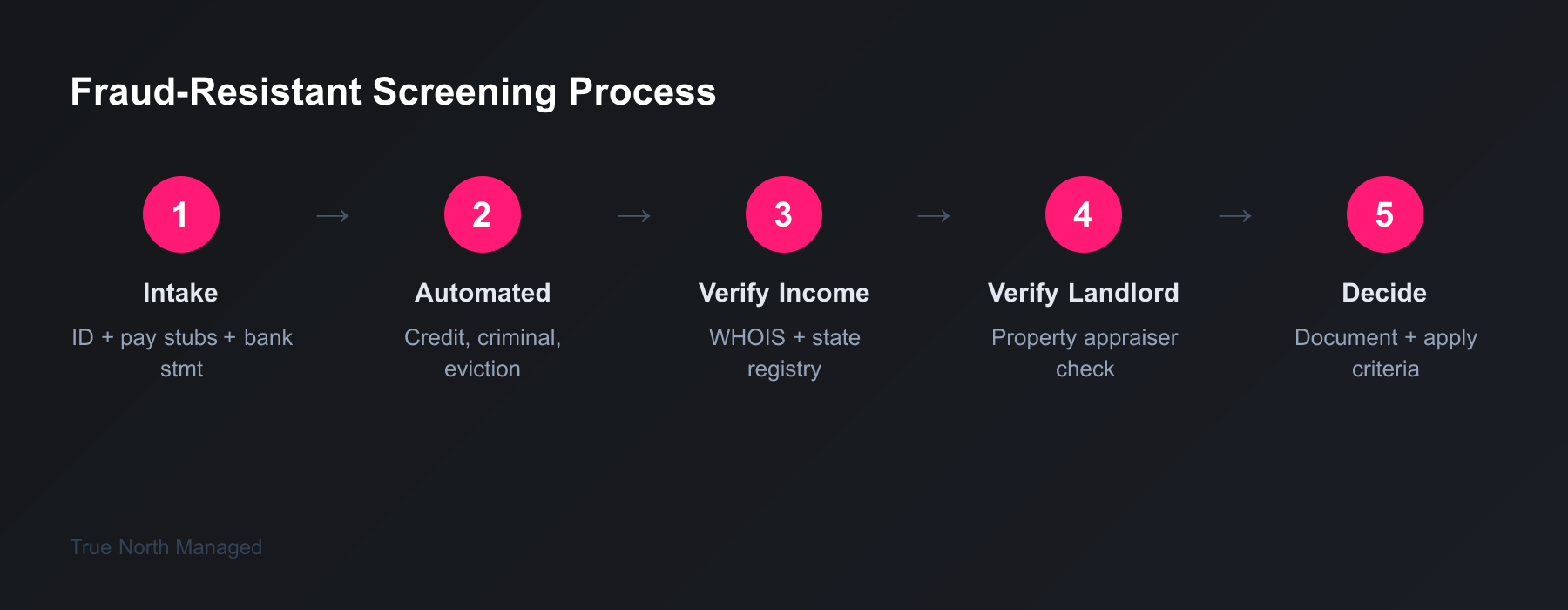
Step 1: Application intake. Require government-issued ID, two recent pay stubs, most recent bank statement, and prior landlord contact information. Require the applicant to sign an authorization allowing you to verify all information provided.
Step 2: Automated screening. Run credit report, criminal background, and eviction history through a screening service (TransUnion SmartMove, RentPrep, or similar). This catches the obvious disqualifiers — evictions, bankruptcies, serious criminal history.
Step 3: Income verification — the hard way. Don't just look at the pay stub. Cross-reference against the state business registry, WHOIS lookup, and independent phone number. If anything doesn't match, ask the applicant to explain. Honest applicants can. Fraudsters get vague.
Step 4: Landlord verification — with ownership check. Before calling the "previous landlord," verify they actually own the property via the county property appraiser. Then call the number listed on the property records, not the number the applicant provided.
Step 5: Decision and documentation. Apply your screening criteria consistently across all applicants. Document the verification steps you took and the results. Consistent, documented screening protects you against fair housing complaints — you can demonstrate that every applicant received the same process.
Can You Press Charges for Application Fraud in Florida?
Yes — and the penalties are real. Under Florida Statute 817.03, making false statements to obtain property or credit is a criminal offense. If the applicant submitted falsified financial documents — fake pay stubs, altered bank statements, forged W-2s — that falls under FL §817.2341, which classifies filing materially false financial statements with intent to deceive as a third-degree felony.
In practice, most landlords don't pursue criminal charges. The eviction process is painful enough without adding a criminal case on top. But knowing the law exists gives you leverage. If you discover fraud mid-application, deny the application and document the specific discrepancy. If you discover fraud after the lease is signed, consult with a Florida real estate attorney — the fraud may constitute a lease violation, and in identity theft cases, it's a matter for law enforcement.
The real protection isn't prosecution — it's prevention. A 30-minute verification process costs you nothing but time. A fraudulent tenant who slips through your screening costs $8,000-$15,000 before the eviction is complete.
Frequently Asked Questions
How much does thorough screening cost? Basic credit and background checks run $25–$40 per applicant through services like TransUnion SmartMove or RentPrep. Most Florida landlords charge a $50–$75 application fee that covers these costs. The manual verification steps (WHOIS, business registry, property records) are free — they just take time.
Can I reject an applicant who provided fake documents? Yes. Providing falsified information on a rental application is grounds for denial in every jurisdiction. Document the specific discrepancy you found.
What if my current tenant provided fraudulent information? If you discover fraud after lease execution, consult with a Florida real estate attorney. Depending on the nature of the fraud, it may constitute a lease violation. In extreme cases (identity fraud), it could be a criminal matter.
Should I use AI-powered screening tools? They're worth considering. Snappt claims 99.8% accuracy by analyzing 10,000+ document features against templates from 2,000+ financial institutions. VERO offers similar forensic analysis. These tools catch things the human eye can't — pixel-level font mismatches, metadata inconsistencies, mathematical errors in tax calculations. They're a strong supplement to manual verification, not a replacement for it.
What's the most reliable single verification step? County property appraiser lookup for landlord references. It's free, takes 2 minutes, and definitively confirms whether the person claiming to be a "previous landlord" actually owns the property. If they don't show up as the owner, the reference is fabricated — no further investigation needed.
The Cost of Not Catching Fraud
A fraudulent tenant who passes screening typically generates $8,000–$15,000 in losses before the eviction is complete. According to the National Multifamily Housing Council, 24% of all eviction filings over a three-year period stemmed from fraudulent applications — and only 17% of eviction judgments result in any financial recovery. That breaks down as:
- 2–3 months of unpaid rent: $4,000–$7,500
- Property damage beyond normal wear: $1,500–$4,000
- Eviction filing and legal costs: $1,500–$2,500
- Vacancy during and after eviction: $1,000–$2,000
In the Orlando and Tampa markets, where average rents run $1,800-$2,200/month, even a two-month eviction timeline means $3,600-$4,400 in lost rent alone. Add court costs ($185 filing fee in Orange County, $90 for the writ of possession), attorney time, and the turnover — painting, cleaning, re-listing — and a single fraudulent tenant can wipe out an entire year's profit on a rental property.
Compare that to the cost of thorough screening: $25–$40 for automated reports plus 30–45 minutes of manual verification per applicant. The ROI on proper screening is measured in thousands of dollars per fraudulent application caught.
Application fraud isn't going away — it's getting cheaper and easier to execute. The landlords who update their verification process now will catch what basic screening misses. The ones who rely on a credit check and a phone call will keep getting fooled.
If you want screening handled by professionals who verify every application against multiple data sources, get a free rental analysis to see how our process works.