

Property Tax Appeals in Florida: Step-by-Step for Landlords
FL property tax appeal process: Value Adjustment Board, deadlines, evidence needed, comparable sales, income approach. Success rates and cost.

When NOT to Appeal
File even if you're not sure you'll win.In Florida, The process is straightforward in most counties. The worst case is no change; the best case is a lower assessment for years. FL landlords in Orlando and Tampa should check local requirements.
File even if you're not sure you'll win. The process is straightforward in most counties. The worst case is no change; the best case is a lower assessment for years.
Skip an appeal if your assessment is already below recent sales of comparable properties. If the cost of an attorney or specialist exceeds likely savings, it may not pencil. Appealing every year without new evidence can hurt credibility. One strong appeal with solid comps beats repeated weak filings.
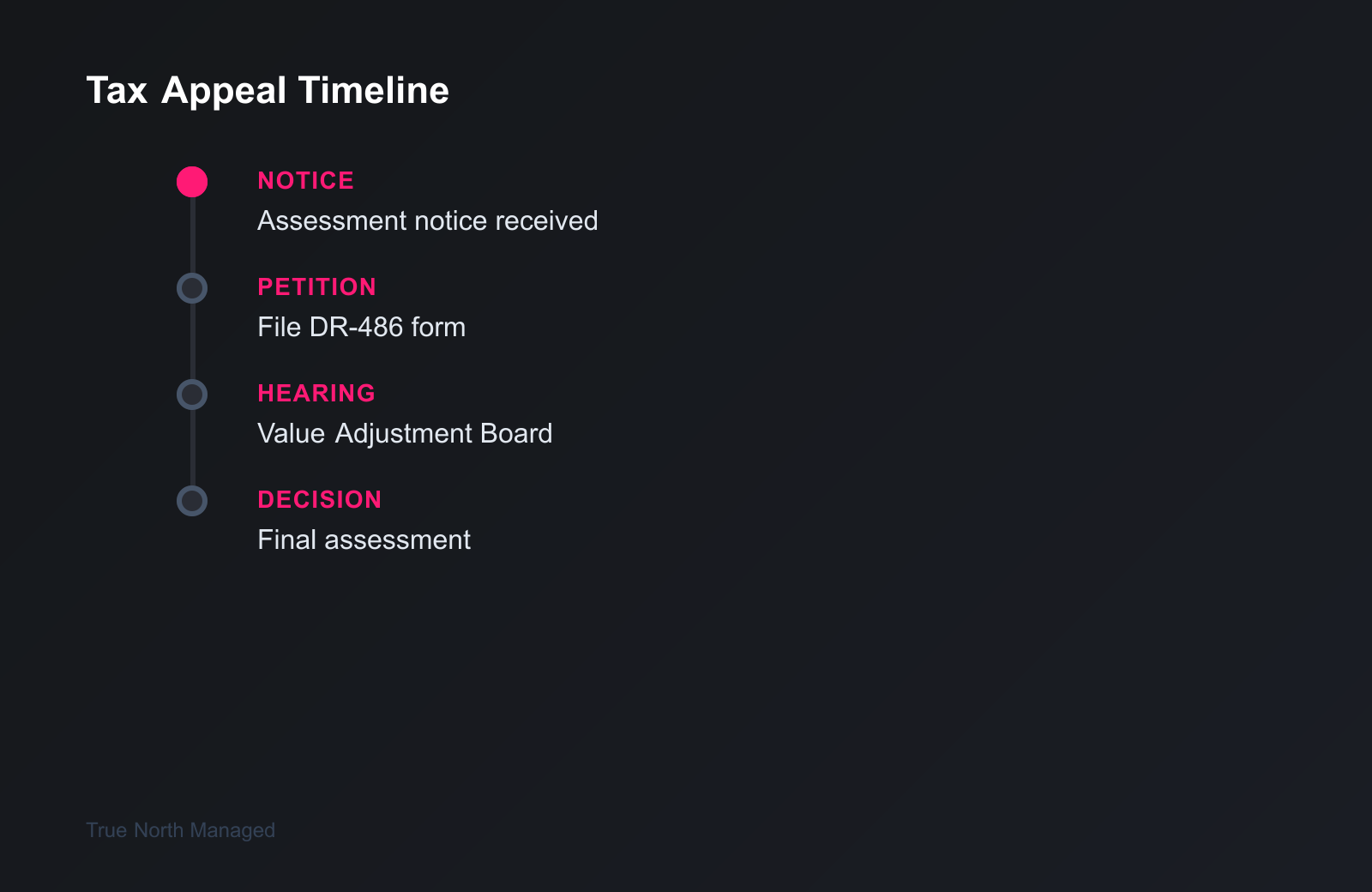
Florida property taxes are based on assessed value. If your assessment is too high, you can appeal. The process runs through the county Value Adjustment Board (VAB). Here's how it works for landlords.
How Florida Assessments Work
County property appraisers value property annually.The assessed value is capped by the "Save Our Homes" cap for homesteads, but rental property has no cap. Assessed value × millage rate = your tax bill. FL landlords in Orlando and Tampa should check local requirements.
County property appraisers value property annually. The assessed value is capped by the "Save Our Homes" cap for homesteads, but rental property has no cap. Assessed value × millage rate = your tax bill. If the assessment is wrong, your bill is wrong.Florida Statute 193.011sets the valuation criteria. See ourFlorida rental property tax guidefor the basics.
Value Adjustment Board (VAB)
Each county has a VAB that hears assessment appeals.You file a petition, pay a filing fee (usually $15--$30), and present evidence. The appraiser reviews your case and may adjust before the hearing. FL landlords in Orlando and Tampa should check local requirements.
Each county has a VAB that hears assessment appeals. You file a petition, pay a filing fee (usually $15–$30), and present evidence. The appraiser reviews your case and may adjust before the hearing. If not, you argue before the board. See your county property appraiser site for VAB deadlines and forms. Orange County:ocpafl.org. Hillsborough:hcpafl.org.
Deadlines
Petitions are typically due within 25 days from the TRIM notice mailing (seeOrange CountyandHillsboroughfor local deadlines) of the TRIM (Truth in Millage) notice, which usually arrives in August.In Florida, Miss the deadline and you wait until next year. Mark the date when you receive the notice.
Petitions are typically due within 25 days of the TRIM (Truth in Millage) notice, which usually arrives in August. Miss the deadline and you wait until next year. Mark the date when you receive the notice.
Evidence You Need
Comparable sales:Recent sales of similar properties in your area at lower prices. The appraiser uses comparable sales; you can challenge with better comps.
Income approach:For rentals, the income approach can support a lower value. If your property generates $24,000/year in NOI and typical cap rates are 5%, the value is $480,000. If the appraiser assessed at $550,000, you've an argument.
Condition issues:Deferred maintenance, needed repairs, or functional obsolescence can reduce value. Document with photos and estimates.
Cost to Appeal
Filing fee is minimal.In Florida, Doing it yourself is free beyond the fee. Hiring an attorney or appraiser costs $500--$2,000 or a contingency fee (often 30--50% of first-year savings). FL landlords in Orlando and Tampa should check local requirements.
Filing fee is minimal. Doing it yourself is free beyond the fee. Hiring an attorney or appraiser costs $500–$2,000 or a contingency fee (often 30–50% of first-year savings). For a $5,000 annual tax bill, a 10% reduction saves $500. A contingency fee might be $150–$250 of that.
Success Rates
VABs vary by county.In Florida, Some grant reductions more readily than others. Evidence matters. FL landlords in Orlando and Tampa should check local requirements.
VABs vary by county. Some grant reductions more readily than others. Evidence matters. Weak cases get dismissed. Strong cases with good comps or income data often settle before the hearing.
Property tax is a real cost for Florida landlords. If you're in Orlando or Tampa and want help understanding your tax exposure,get a free rental analysisand we can walk through the numbers.
Deadlines and Process
County property appraisers mail notices of proposed value in August.you've 25 days to file a petition with the Value Adjustment Board (VAB) . The process varies by county. FL landlords in Orlando and Tampa should check local requirements.
County property appraisers mail notices of proposed value in August. you've 25 days to file a petition with theValue Adjustment Board (VAB). The process varies by county. Orange and Hillsborough have online filing. Gather comps: recent sales of similar properties in your area. If your assessed value is above market, you've a case.
When to Appeal
If your assessment rose more than 10% year-over-year.If comparable sales suggest a lower value. If the appraiser has incorrect data (wrong square footage, bedroom count, or condition). FL landlords in Orlando and Tampa should check local requirements.
If your assessment rose more than 10% year-over-year. If comparable sales suggest a lower value. If the appraiser has incorrect data (wrong square footage, bedroom count, or condition). Don't appeal every year. One successful appeal can lock in a lower value for years. ForFlorida rental property taxes, see our guide.
Hiring an Attorney
For properties under $300,000, a DIY appeal often works.Above that, or if you've multiple properties, a tax attorney or specialist may be worth it. They typically work on contingency: 25--50% of first-year savings. FL landlords in Orlando and Tampa should check local requirements.
For properties under $300,000, a DIY appeal often works. Above that, or if you've multiple properties, a tax attorney or specialist may be worth it. They typically work on contingency: 25–50% of first-year savings. No savings, no fee. SeeOrlandoandTampaproperty tax specifics.
Bottom line: you've 25 days after the notice to file. Gather comps. DIY works for properties under $300k. Above that, a contingency attorney may be worth it. One successful appeal can lock in savings for years. SeeFlorida rental property taxesfor context.
File even if you're not sure you'll win. The process is straightforward in most counties. The worst case is no change. The best case is a lower assessment for years. Comps are your evidence—recent sales of similar properties in your area. The appraiser may have outdated or incorrect data.
When an Appeal Makes Sense
Not every assessment is worth contesting.In Florida, If the appraised value is within 5% of comparable sales, the cost of gathering evidence likely outweighs the savings. Focus your appeal efforts on years when the assessor increases value by 10% or more above actual market comps, or -- when they've clearly miscategorized the property type or condition.
Not every assessment is worth contesting. If the appraised value is within 5% of comparable sales, the cost of gathering evidence likely outweighs the savings. Focus your appeal efforts on years when the assessor increases value by 10% or more above actual market comps, or -- when they've clearly miscategorized the property type or condition.
When an Appeal Makes Sense
Appeal when your assessed value is higher than what comparable properties sold for in the last 12 months. In Orlando and Tampa, that happens when the market softens. Pull 3–5 comps from your neighborhood and compare them to your assessment.
The deadline is usually 25 days after the TRIM notice arrives—around late August. Don't miss it. You can hire a tax consultant who works on contingency—they take 25–50% of the first year's savings. For a $300,000 property, that's often $500–$1,000 in savings.
Hiring a Tax Consultant
Tax consultants work on contingency—they take 25-50% of first-year savings. No savings, no fee. For a $300,000 property, a 10% reduction saves $600-800 per year. The consultant might take $200-400 of that.
They handle the paperwork and hearing. You sign the forms and show up if needed. For busy landlords, it's worth it. Shop around—fees vary. Some charge a flat fee instead of contingency.
Bottom Line
Appeal when the numbers support it. Use comps from the last 12 months. Hire a consultant on contingency if you don't want to DIY.
The VAB hearing is informal. Bring your comps. The appraiser may settle before the hearing. Many appeals resolve within 60 days.
When in doubt, document it. Florida landlords who follow the process and keep a paper trail protect themselves when disputes arise. A few minutes of documentation can save months of headaches.
Florida's landlord-tenant statutes—particularly Chapter 83—govern most of what you'll encounter. Familiarize yourself with the notice requirements, timelines, and documentation rules. A well-documented process protects you when disputes arise. In Orlando and Tampa, local ordinances can add layers; check your county and city rules before you act.
Attend the VAB hearing if you file. Some counties allow written submissions only; others expect you to present. A 15-minute hearing can save thousands. Bring your comps, photos if condition is an issue, and a clear summary of why the assessment is wrong. Preparation matters.