

Florida Late Fees: What Landlords Can Charge and How to Enforce
FL late fee rules: no statutory cap but must be reasonable. Lease clause requirements, grace period best practices, and enforcement.

Florida doesn't cap late fees by statute. But they must be reasonable, and they must be in the lease. Here's what landlords need to know.
No Statutory Cap
Unlike some states, Florida has no dollar limit on late fees.Florida Statute 83. 46 governs landlord obligations. FL landlords in Orlando and Tampa should check local requirements.
Unlike some states, Florida has no dollar limit on late fees.Florida Statute 83.46governs landlord obligations. It doesn't set a late fee cap. But courts can strike down unreasonable fees. A $500 late fee on $1,500 rent would likely be rejected. Courts generally accept 5–10% of monthly rent as reasonable. A $50 or $75 fee on $1,500 rent is usually upheld.
Reasonableness
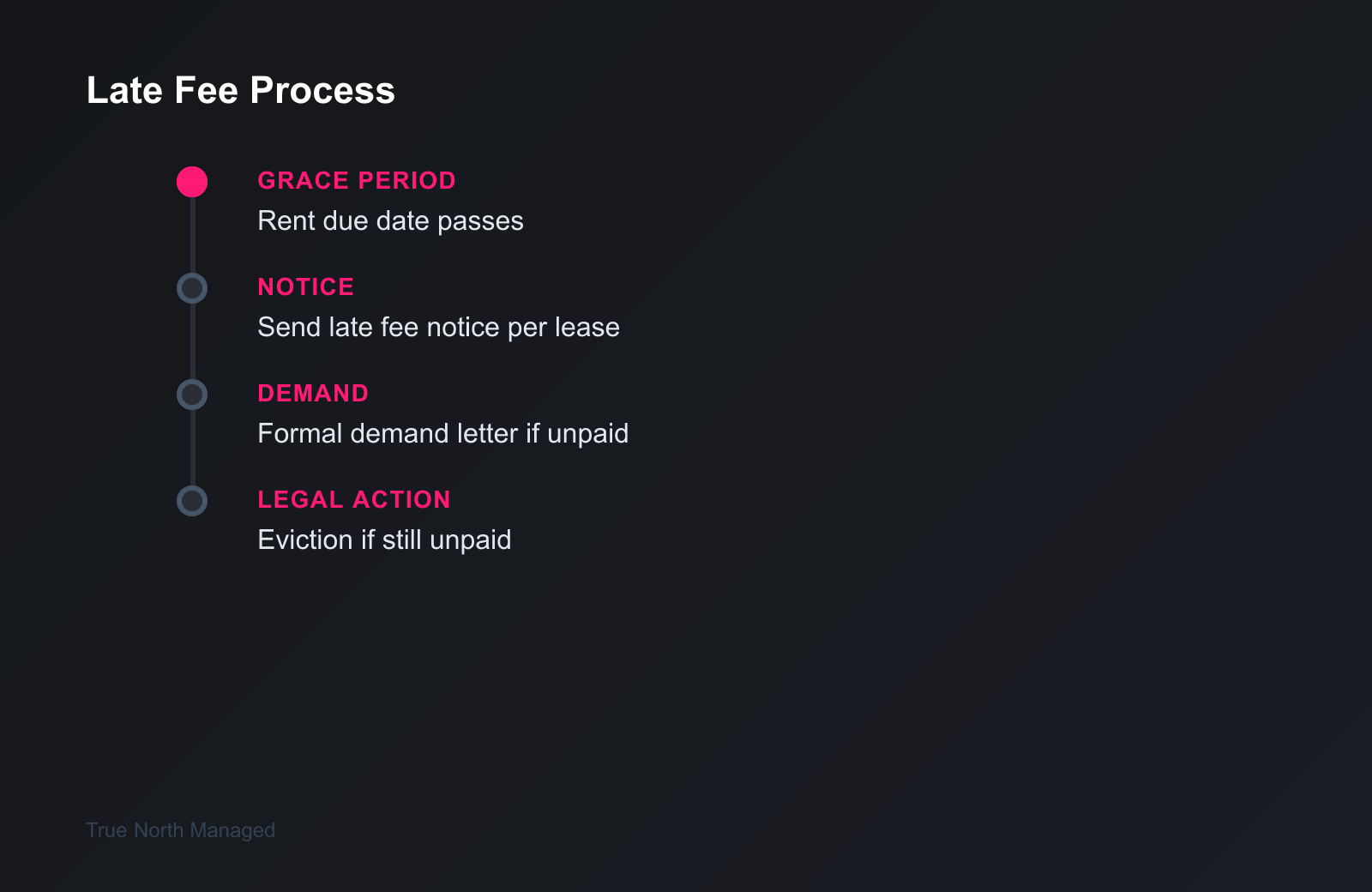
Fees should bear some relation to actual costs: administrative time, processing, and the risk of delayed payment.In Florida, A flat fee of 5% of rent or a fixed amount like $50–$100 is common. Some landlords use a tier: $50 for 1–5 days late, $100 for 6–15 days.
Fees should bear some relation to actual costs: administrative time, processing, and the risk of delayed payment. A flat fee of 5% of rent or a fixed amount like $50–$100 is common. Some landlords use a tier: $50 for 1–5 days late, $100 for 6–15 days. The key is that it's defensible if challenged.
Lease Clause Requirements
The late fee must be in the lease.In Florida, Specify the amount, when it applies (e. g. FL landlords in Orlando and Tampa should check local requirements.
The late fee must be in the lease. Specify the amount, when it applies (e.g., after a 5-day grace period), and when it's due. Vague language ("late fees may apply") can cause problems. A clear clause: "Rent is due on the 1st. A grace period of 5 days applies. If rent isn't received by the 6th, a late fee of $75 will be charged."
Grace Period Best Practices
Many landlords offer a 5-day grace period.In Florida, It reduces conflict and gives tenants who pay on the 2nd or 3rd a buffer. It also signals that you're reasonable. FL landlords in Orlando and Tampa should check local requirements.
Many landlords offer a 5-day grace period. It reduces conflict and gives tenants who pay on the 2nd or 3rd a buffer. It also signals that you're reasonable. A grace period doesn't change the due date; it just delays when the late fee kicks in. See ourrent collection guidefor systems that reduce late payments.
Enforcement
Add the late fee to the next rent payment.In Florida, If the tenant doesn't pay it, it becomes part of the balance due. For eviction, you must include all amounts owed in the 3-day notice.
Add the late fee to the next rent payment. If the tenant doesn't pay it, it becomes part of the balance due. For eviction, you must include all amounts owed in the 3-day notice. Unpaid late fees can be included. But don't evict solely for late fees without a lease clause that allows it; eviction for non-payment of rent requires rent to be the primary amount.
When Late Fees Become Unenforceable
If the fee is unreasonably high, a court may refuse to enforce it.In Florida, If it wasn't in the lease, you can't charge it. If you've waived it repeatedly, you may have established a pattern that undermines enforcement.
If the fee is unreasonably high, a court may refuse to enforce it. If it wasn't in the lease, you can't charge it. If you've waived it repeatedly, you may have established a pattern that undermines enforcement. Be consistent.
Late fees are a tool, not a profit center. The goal is on-time rent. For help with rent collection and lease management in Orlando or Tampa,get a free rental analysisand we can walk through best practices.
Enforcement and Collection
Charge the fee only when the lease allows it and only after the grace period has passed.In Florida, Include the late fee in the next rent demand or send a separate notice. If you file for eviction, you can include unpaid late fees in the amount demanded.
Charge the fee only when the lease allows it and only after the grace period has passed. Include the late fee in the next rent demand or send a separate notice. If you file for eviction, you can include unpaid late fees in the amount demanded.FL 83.46doesn't address late fees directly, but courts expect clear lease terms and consistent application.
Grace Periods
Many leases specify a 5-day grace period before late fees apply.In Florida, That gives tenants a buffer for processing delays. A grace period doesn't extend the 3-day pay-or-vacate notice for eviction--rent is still due on the first.
Many leases specify a 5-day grace period before late fees apply. That gives tenants a buffer for processing delays. A grace period doesn't extend the 3-day pay-or-vacate notice for eviction--rent is still due on the first. The late fee applies after the grace period; the eviction notice can be served after rent is 3 days late. Don't conflate the two.
Common Mistakes
Vague lease language, charging fees not in the lease, or applying different standards to different tenants can create problems.Use a clear clause and apply it consistently. For tenants who pay late repeatedly, see our chronic late rent guide .
Vague lease language, charging fees not in the lease, or applying different standards to different tenants can create problems. Use a clear clause and apply it consistently. For tenants who pay late repeatedly, see ourchronic late rent guide. For the full rent collection process, seerent collection for Florida landlords.
Sample Lease Clause
Your lease must state the late fee amount and when it applies.Florida doesn't cap late fees, but they must be reasonable. Document the late payment in your records -- date received, amount, and any partial payments.
Documentation Requirements
Your lease must state the late fee amount and when it applies.Florida doesn't cap late fees, but they must be reasonable. Document the late payment in your records -- date received, amount, and any partial payments.
Your lease must state the late fee amount and when it applies. Florida doesn't cap late fees, but they must be reasonable. Document the late payment in your records -- date received, amount, and any partial payments. If you end up in eviction court, you'll need to show the rent ledger and when fees were assessed.
Electronic Payment Setup
ACH and online payments reduce late payments.In Florida, Tenants who pay automatically tend to pay on time. Offer a grace period if your lease allows -- 3-5 days is common. FL landlords in Orlando and Tampa should check local requirements.
ACH and online payments reduce late payments. Tenants who pay automatically tend to pay on time. Offer a grace period if your lease allows -- 3-5 days is common. After that, the late fee applies. Some landlords waive the first late fee as a goodwill gesture; document it so it doesn't become an expectation.
Setting Up Electronic Payment to Reduce Late Payments
The simplest way to reduce late rent is removing friction from the payment process.In Florida, Offer ACH autopay through your property management software or a service like Zelle, and watch your late payment rate drop. Most tenants who pay late aren't doing it on purpose -- they forget, or the process is inconvenient.
The simplest way to reduce late rent is removing friction from the payment process. Offer ACH autopay through your property management software or a service like Zelle, and watch your late payment rate drop. Most tenants who pay late aren't doing it on purpose -- they forget, or the process is inconvenient. Electronic payment with automatic reminders 3 days before the due date solves both problems and costs you nothing to set up.
A clear clause might read: "Rent is due on the first of each month. A late fee of $75 applies if rent isn't received by the fifth. Late fees are due with the next rent payment." Specify the amount, the trigger date, and that it's non-negotiable. Avoid "late fees may apply" or "reasonable late fees." OurFlorida lease agreement guidecovers essential clauses.
Florida doesn't cap late fees, but your lease must specify the amount and when it's due. We use a 5-day grace period and then 5% of rent or $50, whichever is less—it's defensible and common in Orlando and Tampa. Anything over 10% can draw scrutiny in small claims.
Enforcing Late Fees Without Losing the Tenant
Florida doesn't cap late fees. Your lease can specify whatever you want—$50, $75, 5% of rent, or a daily rate. The key is clarity. "Late fee of $75 if rent not received by 5th" is enforceable. "Reasonable late fee" is not.
We've seen landlords lose in small claims because the fee wasn't in the lease or was applied inconsistently. If you charge a late fee for one tenant but waive it for another in the same situation, you're inviting a fair housing complaint. Apply the policy uniformly.