

Emergency Maintenance Protocol for Florida Rental Properties
What counts as an emergency in Florida? AC failure, water leaks, gas—and how to respond within 24 hours.
What Counts as an Emergency in Florida?
In Florida, an emergency is no AC, no heat, water intrusion, gas leak, security failure, or anything that threatens health or safety. AC failure in July is non-negotiable -- Florida tenants expect it in the lease. Orlando and Tampa landlords who delay risk liability. Florida law doesn't spell out "emergency" in black and white, but
In Florida, an emergency is no AC, no heat, water intrusion, gas leak, security failure, or anything that threatens health or safety. AC failure in July is non-negotiable -- Florida tenants expect it in the lease. Orlando and Tampa landlords who delay risk liability.
Florida law doesn't spell out "emergency" in black and white, but habitability does. Under Florida Statute 83.51, you must maintain a fit and habitable dwelling. When something makes the unit uninhabitable or dangerous, that's an emergency.
AC failure in summer. No heat in winter (rare in Florida, but it counts). Major water leak or flood. Gas leak. No power. Broken locks (tenant can't secure the unit). Fire or smoke damage. Sewage backup. These are emergencies. A dripping faucet, a slow drain, a burned-out bulb—those aren't.
Response Times: What's Reasonable?
In Florida, Reasonable response: 30-60 minutes to acknowledge, 2-4 hours to dispatch a contractor for true emergencies. A burst pipe can't wait until Monday. Document your response times. For emergencies, you need to respond quickly. Same-day or next-day is the standard. For AC in July, tenants can't wait a week. For a water leak, every
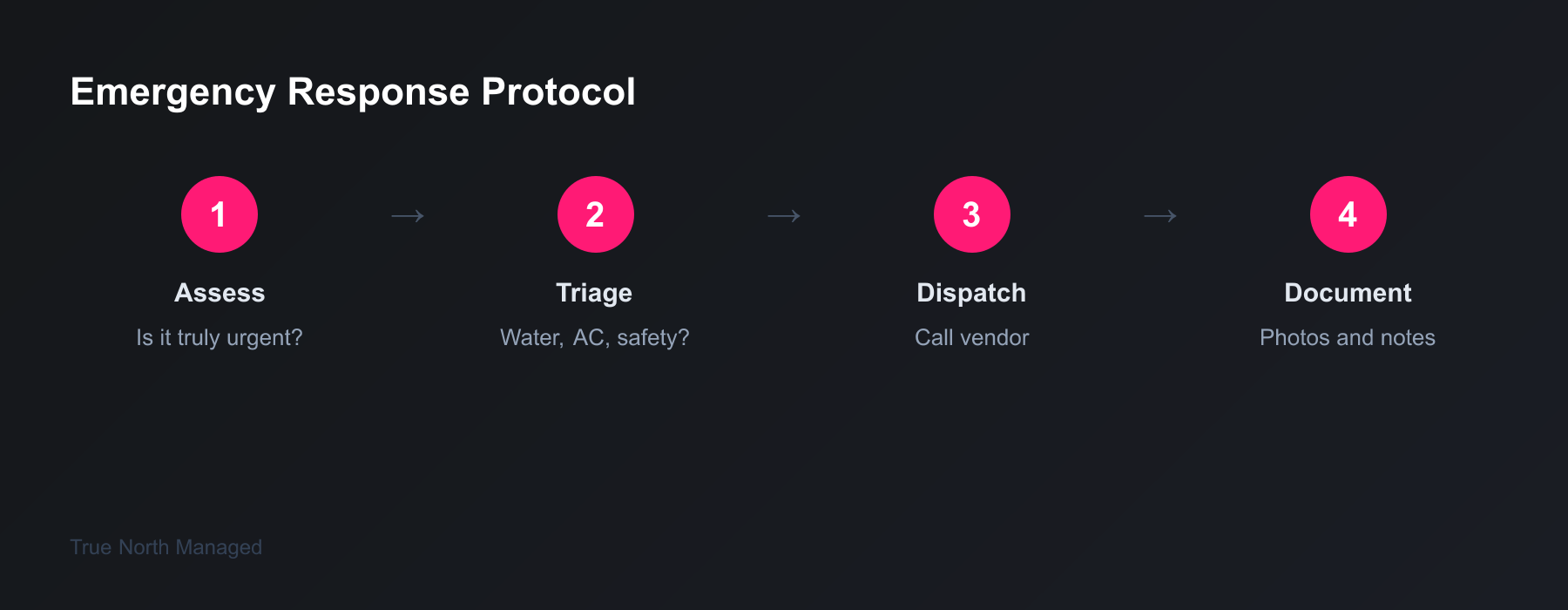
Reasonable response: 30-60 minutes to acknowledge, 2-4 hours to dispatch a contractor for true emergencies. A burst pipe can't wait until Monday. Document your response times.
For emergencies, you need to respond quickly. Same-day or next-day is the standard. For AC in July, tenants can't wait a week. For a water leak, every hour increases damage. Have contractors on call who can respond within 24 hours. Document your response—when you were notified, when you dispatched someone, when the repair was completed.
AC Failure: Your Specific Obligation
AC failure is a specific Florida obligation. Many leases explicitly require working AC. In summer, it's a health and safety issue. Have an HVAC vendor on speed dial. In Florida, AC isn't optional in summer. Heat can make a unit uninhabitable. We cover the full picture—timing, tenant rights, and what "reasonable" means—in our guide on AC repair obligations for Florida landlords .
Having Contractors on Call
Have contractors on call before you need them. HVAC, plumber, electrician, locksmith. Orlando and Tampa have plenty -- vet them in advance. Build a roster. You need an HVAC company, a plumber, and an electrician who take after-hours calls. Build these relationships before you need them. Test the process: call at 8 p.m. and see what happens. If no one answers, find someone who does.
After-Hours Procedures
In Florida, After-hours procedures: someone answers within 30-60 minutes and dispatches within 2-4 hours for emergencies. Put it in writing. Give tenants the number. Give tenants a single number to call for emergencies. That is your phone, an answering service, or a property manager's line. Make sure whoever answers knows the difference between emergency and
After-hours procedures: someone answers within 30-60 minutes and dispatches within 2-4 hours for emergencies. Put it in writing. Give tenants the number.
Give tenants a single number to call for emergencies. That is your phone, an answering service, or a property manager's line. Make sure whoever answers knows the difference between emergency and non-emergency—and -- can dispatch the right help.
Your Broader Responsibilities
Your broader responsibilities: habitability, security, and responding to emergencies. Florida law doesn't require a specific response time, but courts look at reasonableness. Document everything. Emergency response is one piece of Florida landlord responsibilities . Maintenance, habitability, and timely repairs all tie together. When you respond quickly to emergencies, you protect the prop
Your broader responsibilities: habitability, security, and responding to emergencies. Florida law doesn't require a specific response time, but courts look at reasonableness. Document everything.
Emergency response is one piece of Florida landlord responsibilities. Maintenance, habitability, and timely repairs all tie together. When you respond quickly to emergencies, you protect the property, satisfy the law, and keep tenants from escalating to code enforcement or legal action.
Know what's urgent. Have contractors ready. Document everything. That's the emergency protocol. Want someone else to handle the 2 a.m. calls? Get a free rental analysis and see how full-service management handles emergencies.
Define Emergency in Your Lease
Define emergency in your lease so tenants know what qualifies. No AC in July, burst pipe, gas leak, broken lock -- spell it out. Reduces "it's urgent" calls for non-emergencies. Put it in writing. "Emergency means no AC when outdoor temp exceeds 85, no water, no heat when below 50, gas odor, active water leak, broken exterior lock, or no electrical power." Tenants who call at midnight for a dripping faucet need a clear definition. Reference this in your lease and tenant handbook.
Response Time Expectations
In Florida, Response time expectations: 30-60 min callback, 2-4 hours for contractor dispatch. Set expectations in the lease. Tenant communication matters. For true emergencies, respond within 30–60 minutes. That doesn't mean the repair is done; it means you've acknowledged the call and dispatched help. Document every step. If a vendor doesn't answer, try the next
Response time expectations: 30-60 min callback, 2-4 hours for contractor dispatch. Set expectations in the lease. Tenant communication matters.
For true emergencies, respond within 30–60 minutes. That doesn't mean the repair is done; it means you've acknowledged the call and dispatched help. Document every step. If a vendor doesn't answer, try the next one. Good faith effort protects you if a tenant later claims you failed to act. Florida courts consider whether you made reasonable attempts.
Cost Tracking and Budgeting
Cost tracking: budget 1-2% of rent for emergency repairs. Florida AC and plumbing is expensive. Track by property so you see patterns. After-hours repairs cost 1.5–2x normal rates. Budget 1–2% of annual rent for emergency repairs. A $2,000/month rental might see $240–480 in emergency costs per year. Track by category: HVAC, plumbing, electrical. Patterns reveal properties that need preventive work. For more on preventive maintenance , see our calendar. Bottom line: put the definition in the lease, respond within 30–60 minutes for true emergencies, and document everything. Good faith effort matters in Florida courts. Budget for 1.5–2x normal rates on after-hours calls. Keep a list of backup vendors. If your primary HVAC company doesn't answer, you need a second number. Build these relationships in the off-season. A vendor who knows your properties responds faster when you've a real emergency. Train tenants on what to do. Include instructions in the lease: "For emergencies, call this number. For non-emergencies, submit via portal or email." Some landlords laminate a small card with the emergency number and what qualifies. Clarity reduces inappropriate after-hours calls.
Common Emergency Protocol Mistakes
In Florida, Common mistakes: no vendor list, no after-hours protocol, and unclear definitions. Orlando and Tampa landlords who document and prepare avoid 2 a.m. panic. Not defining "emergency" in the lease. Tenants who call at midnight for a dripping faucet need a clear definition. Failing to document vendor attempts. If you can't reach anyone, document
Common mistakes: no vendor list, no after-hours protocol, and unclear definitions. Orlando and Tampa landlords who document and prepare avoid 2 a.m. panic.
Not defining "emergency" in the lease. Tenants who call at midnight for a dripping faucet need a clear definition. Failing to document vendor attempts. If you can't reach anyone, document the calls and times. Courts look for good faith. Not having backup vendors. If your primary HVAC company doesn't answer, you need a second number. Finally, delaying response. For true emergencies, acknowledge within 30-60 minutes. Our after-hours maintenance guide covers vendor networks and response times.
Common Emergency Protocol Mistakes
Don't skip the protocol. One missed emergency can cost more than a year of management fees. Not defining "emergency" in the lease. Tenants who call at midnight for a dripping faucet need a clear definition. Failing to document vendor attempts. If you can't reach anyone, document the calls and times. Courts look for good faith. Not having backup vendors. If your primary HVAC company doesn't answer, you need a second number. Finally, delaying response. For true emergencies, acknowledge within 30-60 minutes. Our after-hours maintenance guide covers vendor networks and response times.
Vendor Backup List
Vendor backup list: at least 2 HVAC, 2 plumbers, 1 electrician, 1 locksmith. When one doesn't answer, you've a backup. Orlando and Tampa have plenty -- build the list. Keep a list of backup vendors. If your primary HVAC company doesn't answer, you need a second number. Build these relationships in the off-season. A vendor who knows your properties responds faster when you've a real emergency. Document every call: time, issue, vendor, cost. Our after-hours maintenance guide covers building the network. Good faith effort protects you if a tenant later claims you failed to act.
What Counts as an Emergency in Florida
AC failure in July qualifies. Florida law doesn't require landlords to provide AC, but if your lease promises it, you're on the hook. No AC in 90°+ weather is a habitability issue in practice—tenants can withhold rent or break the lease if you don't respond within 24 hours. Water intrusion is the other big one.
AC failure in July qualifies. Florida law doesn't require landlords to provide AC, but if your lease promises it, you're on the hook. No AC in 90°+ weather is a habitability issue in practice—tenants can withhold rent or break the lease if you don't respond within 24 hours.
Water intrusion is the other big one. A burst pipe, roof leak, or sewage backup needs same-day or next-day response. Document every call, the time you were notified, and when the contractor arrived. That paper trail protects you if a tenant later claims you were negligent.
After-Hours Vendor Relationships
In Florida, Build your emergency vendor list before you need it. HVAC, plumbing, and electrical—you need 24/7 contacts for each. In Orlando and Tampa, that's a short list. Most contractors don't do emergency calls. The ones who do charge premium rates—$150-300 for after-hours service calls. Pay them fairly. If you nickel-and-dime your emergency vendors, they
Build your emergency vendor list before you need it. HVAC, plumbing, and electrical—you need 24/7 contacts for each. In Orlando and Tampa, that's a short list. Most contractors don't do emergency calls. The ones who do charge premium rates—$150-300 for after-hours service calls.
Pay them fairly. If you nickel-and-dime your emergency vendors, they won't prioritize you when you call at 2 a.m. on a holiday. We maintain relationships with 2-3 vendors per trade. When one is booked, we've backups.
Bottom Line
Define emergencies in your lease. Build 24/7 vendor relationships before you need them. Document every call. When a dispute arises, your paper trail protects you.
Florida's heat makes AC failure a habitability issue in practice. Tenants can withhold rent if you don't respond within 24 hours in summer.
When in doubt, document it. Florida landlords who follow the process and keep a paper trail protect themselves when disputes arise. A few minutes of documentation can save months of headaches.
Florida's landlord-tenant statutes—particularly Chapter 83—govern most of what you'll encounter. Familiarize yourself with the notice requirements, timelines, and documentation rules. A well-documented process protects you when disputes arise. In Orlando and Tampa, local ordinances can add layers; check your county and city rules before you act.
True North Managed helps Orlando and Tampa landlords handle these issues every day. When you need local expertise, we're here.