

How to Handle After-Hours Maintenance Emergencies in Florida
What qualifies as an emergency? After-hours protocol, contractor relationships, liability, and documentation. Be ready before the 2 a.m. call.
What Qualifies as an Emergency?
In Florida, an emergency is anything that threatens health, safety, or property. No AC in July, no heat in winter, burst pipe, gas leak, broken lock, sewage backup -- these can't wait until Monday. Orlando and Tampa landlords who delay risk liability.
What Your Emergency Protocol Document Should Include
In Florida, Your protocol doc should define emergencies, list on-call vendors, and spell out response times. Put it in writing and give tenants a copy at move-in. When 2 a.m. hits, you'll be glad you did. Keep a list of backup vendors. If your primary HVAC company doesn't answer, you need a second number. Build
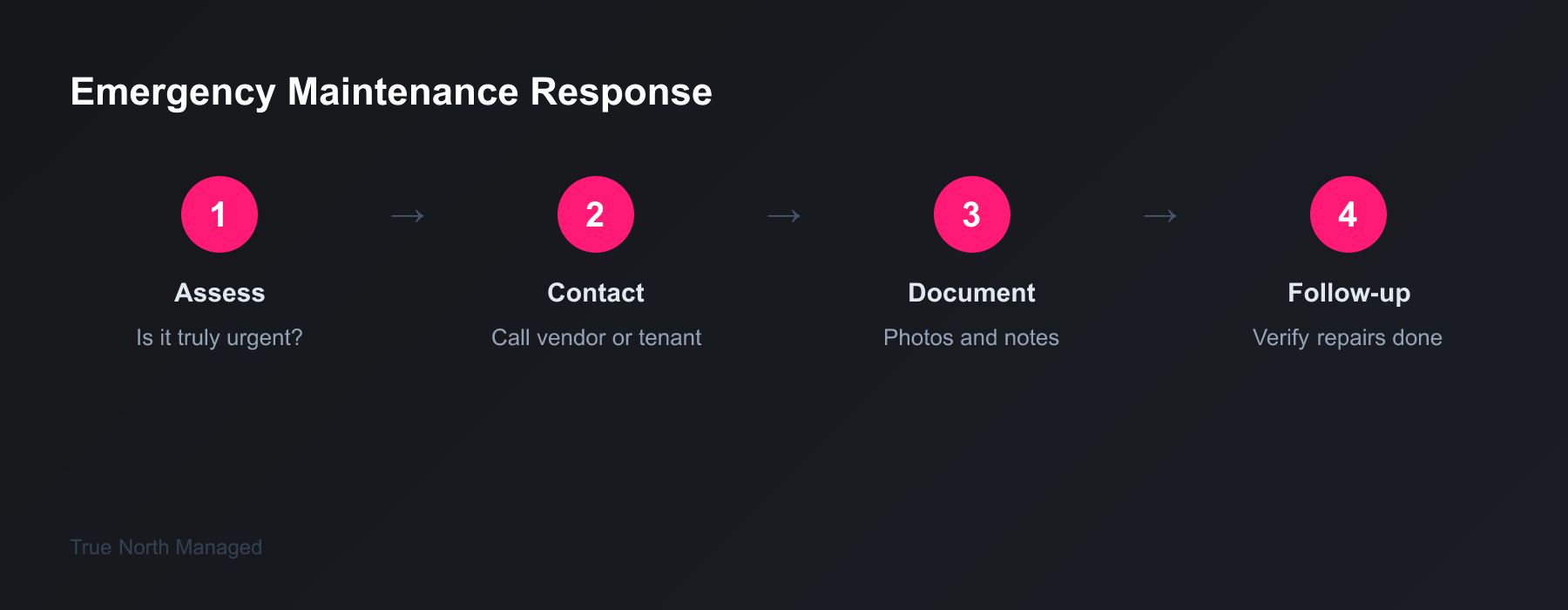
Your protocol doc should define emergencies, list on-call vendors, and spell out response times. Put it in writing and give tenants a copy at move-in. When 2 a.m. hits, you'll be glad you did.
Keep a list of backup vendors. If your primary HVAC company doesn't answer, you need a second number. Build these relationships in the off-season.
Define "emergency" in writing. List your 24/7 vendors with phone numbers and after-hours rates. Specify tenant contact instructions and your response-time commitment. Include backup vendor contacts if the primary doesn't answer. Document every call. Our emergency maintenance protocol guide covers the full checklist.
Not every maintenance request is urgent. A dripping faucet can wait. A burst pipe can't. Florida law doesn't define "emergency" in black and white, but habitability does. Under Florida Statute 83.51, you must maintain a fit and habitable dwelling. When something makes the unit uninhabitable or dangerous, that's an emergency.
AC failure in summer. No heat in winter. Major water leak or flood. Gas leak. No power. Broken locks. Fire or smoke damage. Sewage backup. These are emergencies. A slow drain, a burned-out bulb, a squeaky door—those aren't.
After-Hours Response Protocol
In Florida, After-hours means someone answers within 30-60 minutes and a contractor is dispatched within 2-4 hours for true emergencies. AC out in July? That's same-day. Leaking faucet? Next business day is fine. Give tenants a single number to call for emergencies. That is your phone, an answering service, or a property manager's line. Whoever
After-hours means someone answers within 30-60 minutes and a contractor is dispatched within 2-4 hours for true emergencies. AC out in July? That's same-day. Leaking faucet? Next business day is fine.
Give tenants a single number to call for emergencies. That is your phone, an answering service, or a property manager's line. Whoever answers must know the difference between emergency and non-emergency—and be able to dispatch help. Document every call: when you were notified, when you dispatched someone, -- when the repair was completed.
contractor-relationshipscontractor-relationships">contractor-relationships">Contractor Relationships
Contractor relationships matter more at 2 a.m. than at 2 p.m. Build a roster of HVAC, plumbing, and electric vendors who take after-hours calls. Orlando and Tampa have plenty -- find them before you need them. You need an HVAC company, a plumber, and an electrician who take after-hours calls. Build these relationships before you need them. Test the process: call at 8 p.m. and see what happens. If no one answers, find someone who does. See our guide on vetting contractors for how to build a reliable network.
Liability and Documentation
Document every call: time, tenant, issue, and what you did. If a tenant claims you ignored an emergency, your log is your defense. Florida courts look at whether you acted reasonably. If you're slow to respond to an emergency, you can face liability. Document your response times. A tenant who claims you ignored a water leak will have a harder case if you've records -- showing you dispatched a plumber within 4 hours.
Full Emergency Protocol
A full protocol covers definition, response times, vendor list, and tenant communication. Keep it in your lease addendum and property management software. Update it when vendors change. For the complete picture—what counts as urgent, response times, and contractor setup —see our emergency maintenance protocol for Florida renta
A full protocol covers definition, response times, vendor list, and tenant communication. Keep it in your lease addendum and property management software. Update it when vendors change.
For the complete picture—what counts as urgent, response times, and contractor setup—see our emergency maintenance protocol for Florida rentals. It covers AC obligations, water damage, and Florida landlord responsibilities.
When to Hand Off
Hand off to a property manager when you can't guarantee 24/7 response. PMs in Orlando and Tampa have established vendor networks and after-hours rotations. One missed emergency can cost more than a year of management fees. If you can't reliably respond to after-hours emergencies, consider hiring a property manager. they've 24/7 coverage and contractors on call. See our when to hire a property manager guide for the decision framework. Know what's urgent. Have contractors ready. Document everything. That's the after-hours protocol. Want someone else to handle the 2 a.m. calls? Get a free rental analysis and see how full-service management handles emergencies.
What Qualifies as an Emergency
In Florida, Emergencies are no AC, no heat, water intrusion, gas leak, security failure, or anything that threatens health or safety. A dripping faucet isn't an emergency. A flooded bathroom is. No AC when it's 95 degrees, no water, no heat when it's below 50, gas smell, active leak, broken lock, or no power. These
Emergencies are no AC, no heat, water intrusion, gas leak, security failure, or anything that threatens health or safety. A dripping faucet isn't an emergency. A flooded bathroom is.
No AC when it's 95 degrees, no water, no heat when it's below 50, gas smell, active leak, broken lock, or no power. These affect habitability. Florida law requires landlords to maintain habitable conditions. A clogged drain or broken dishwasher isn't an emergency. Tell tenants to call only for true emergencies; everything else goes -- to your normal maintenance line.
Build Your Vendor Network Before You Need It
Build your vendor list before the first 2 a.m. call. HVAC, plumber, electrician, locksmith -- get them on speed dial. Orlando and Tampa have solid contractor pools; vet them in advance. Find an HVAC company, plumber, and electrician that offer 24/7 service. Get their after-hours rates in writing. Expect 1.5–2x normal rates for nights and weekends. A $200 daytime AC repair can run $400 at 2 a.m. Document every call: time, issue, vendor, cost. For more on vetting contractors in Florida , see our guide.
Tenant Communication Protocol
Tell tenants how to report emergencies and what to expect. Put the number in the lease. Set expectations: "We'll call back within 30 minutes; a contractor within 2-4 hours for true emergencies." Put your emergency number in the lease. Specify that non-emergency calls go to email or your property management portal. Some landlords use a dedicated Google Voice number for after-hours that forwards to their phone. Respond within 30 minutes for true emergencies. If you can't reach a vendor, document your attempts. Good faith effort matters if a tenant later claims you failed to act. Managing emergencies remotely? Orlando and Tampa property managers handle 24/7 maintenance so you don't. Bottom line: define "emergency" in writing, build your vendor list before you need it, and document every call. Budget 1–2% of annual rent for after-hours repairs. A responsive landlord keeps tenants longer and avoids habitability claims. Some landlords use an answering service that triages calls and pages only for true emergencies. Cost runs $50–100/month. It filters out "the dishwasher is making a noise" at 11 p.m. and ensures real emergencies get through. Document your vendor attempts; courts look for good faith.
Training Tenants on What Qualifies
Train tenants on what qualifies so they don't cry wolf. A clogged toilet isn't an emergency; raw sewage backing up is. Clear definitions reduce after-hours noise and keep real emergencies prioritized. Half of after-hours calls aren't true emergencies. Include a one-page emergency guide in your move-in packet that clearly defines what qualifies: water main breaks, gas leaks, no heat in winter, sewage backups, and security breaches. Everything else goes through your standard maintenance request process during business hours. A clear guide reduces unnecessary calls by 30% or more. Define "emergency" in writing and stick to it. A tenant who calls for a non-emergency at 2 a.m. should get a polite redirect to the normal line. Repeat offenders may need a lease reminder. Consistency prevents abuse and keeps your phone quiet when it's not a real crisis.
Building a Reliable After-Hours Vendor List
In Florida, You need 24/7 contacts for HVAC, plumbing, and electrical. In Orlando and Tampa, that's a short list—most contractors don't do emergency calls. Build relationships with 2–3 vendors per trade before you need them. Pay them fairly for after-hours work; they'll prioritize you when you call at 2 a.m. Define "emergency" in your lease.
You need 24/7 contacts for HVAC, plumbing, and electrical. In Orlando and Tampa, that's a short list—most contractors don't do emergency calls. Build relationships with 2–3 vendors per trade before you need them. Pay them fairly for after-hours work; they'll prioritize you when you call at 2 a.m.
Define "emergency" in your lease. A clogged toilet is tenant-caused and often fixable with a plunger. A burst pipe is your problem. A broken AC in August is your problem. Put it in writing so tenants know when to call and when to wait until morning.
Setting Tenant Expectations
In Florida, Put "emergency" in writing in your lease. Define it: no AC when it's over 85°F, no heat when it's under 55°F, no water, gas leak, fire, sewage backup. Everything else can wait until the next business day. Give tenants a phone number or portal for emergencies. Don't give them your personal cell for
Put "emergency" in writing in your lease. Define it: no AC when it's over 85°F, no heat when it's under 55°F, no water, gas leak, fire, sewage backup. Everything else can wait until the next business day.
Give tenants a phone number or portal for emergencies. Don't give them your personal cell for routine requests. A dedicated line or app filters the noise. We use a maintenance request system—tenants log the issue, we triage, we dispatch. Non-emergencies get scheduled for the next day.
Bottom Line
Define emergencies in writing. Build a vendor list. Use a portal so tenants know when to call. Most "emergencies" can wait until morning.
A 24/7 answering service can triage calls. They distinguish emergencies from "the toilet is slow." Worth the $50–100/month for peace of mind.
When in doubt, document it. Florida landlords who follow the process and keep a paper trail protect themselves when disputes arise. A few minutes of documentation can save months of headaches.
Florida's landlord-tenant statutes—particularly Chapter 83—govern most of what you'll encounter. Familiarize yourself with the notice requirements, timelines, and documentation rules. A well-documented process protects you when disputes arise. In Orlando and Tampa, local ordinances can add layers; check your county and city rules before you act.
Sources: Florida Statute 83.53, Florida Statute 83.51