

Short-Term vs. Long-Term Rentals in Orlando: ROI Comparison
Orlando STR vs LTR: tourist zone proximity, Orange County regulations, occupancy rates, and when each strategy wins. A practical ROI comparison.

Hybrid Strategy
Run the numbers for your specific property. HOA fees, management costs, and occupancy assumptions vary. Our Orlando rent pricing guide helps you calibrate. FL landlords in Orlando and Tampa should check local requirements. Run the numbers for your specific property. HOA fees, management costs, and occupancy assumptions vary. Our Orlando rent pricing guide helps you
Run the numbers for your specific property. HOA fees, management costs, and occupancy assumptions vary. Our Orlando rent pricing guide helps you calibrate. FL landlords in Orlando and Tampa should check local requirements.
Run the numbers for your specific property. HOA fees, management costs, and occupancy assumptions vary. Our Orlando rent pricing guide helps you calibrate.
Some Orlando investors use a hybrid approach: LTR during slower seasons, STR during peak tourism. HOA and local rules may restrict this. If allowed, the added complexity requires strong systems. Our Florida STR laws guide covers compliance. The Orlando hub links to market-specific resources.
Orlando's tourism economy creates a real choice: run a short-term rental near Disney or I-Drive, or go long-term for the workers and families who need a place to live. The answer depends on location, regulations, and how much hands-on management you want. Here's a practical ROI comparison for Orange County.
Tourist Zone Proximity: Where STR Wins
In Orlando, Properties within 15--20 minutes of Disney, Universal, or the Convention Center command premium STR rates. A 3/2 SFH in Kissimmee or south Orange County can gross $3,500--5,000/month as a short-term rental in peak season--versus $1,800--2,200 as a long-term lease. The gap narrows in winter and widens in summer. Properties within 15–20 minutes of
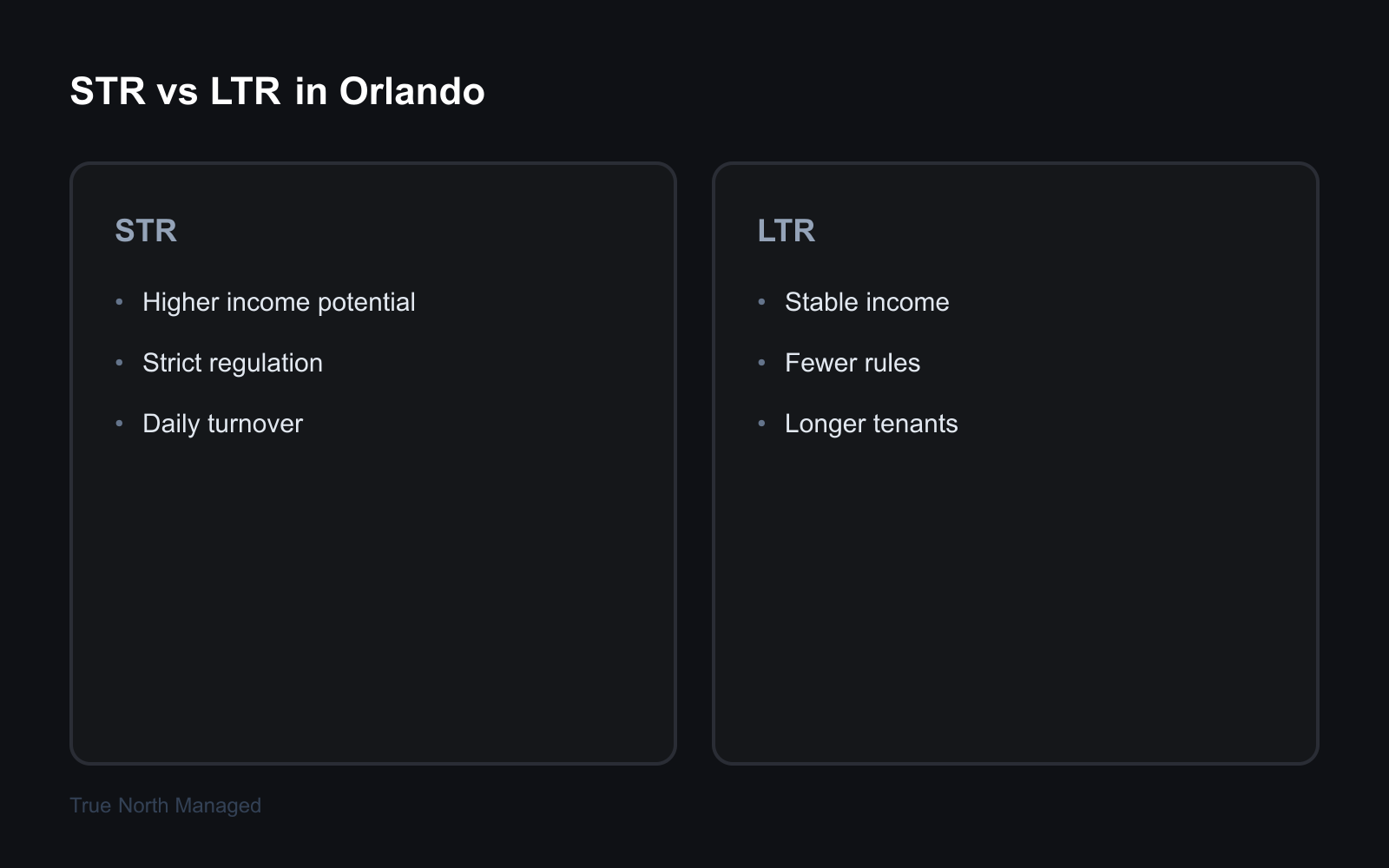
Properties within 15--20 minutes of Disney, Universal, or the Convention Center command premium STR rates. A 3/2 SFH in Kissimmee or south Orange County can gross $3,500--5,000/month as a short-term rental in peak season--versus $1,800--2,200 as a long-term lease. The gap narrows in winter and widens in summer.
Properties within 15–20 minutes of Disney, Universal, or the Convention Center command premium STR rates. A 3/2 SFH in Kissimmee or south Orange County can gross $3,500–5,000/month as a short-term rental in peak season—versus $1,800–2,200 as a long-term lease. The gap narrows in winter and widens in summer. Visit Orlando tourism data shows strong convention and leisure demand year-round, but occupancy fluctuates. STR revenue is lumpy; LTR is steady.
Orange County STR Regulations
Orange County has short-term rental rules: registration, occupancy limits, and sometimes zoning overlays. The City of Orlando has its own requirements. Before you assume STR is allowed, check the zoning and any overlay districts. FL landlords in Orlando and Tampa should check local requirements. Orange County has short-term rental rules: registration, occupancy limits, and sometimes
Orange County has short-term rental rules: registration, occupancy limits, and sometimes zoning overlays. The City of Orlando has its own requirements. Before you assume STR is allowed, check the zoning and any overlay districts. FL landlords in Orlando and Tampa should check local requirements.
Orange County has short-term rental rules: registration, occupancy limits, and sometimes zoning overlays. The City of Orlando has its own requirements. Before you assume STR is allowed, check the zoning and any overlay districts. Some HOAs ban STR entirely. Our Orlando market guide covers neighborhood-level considerations; for statewide STR law context, see our Orlando vs Tampa rental comparison.
Occupancy Rates and Revenue Reality
STR occupancy in Orlando's tourist corridor often runs 60--75% annually--higher in summer, lower in January and September. At 65% occupancy and $200/night average, a 3/2 grosses about $47,450/year. The same property as LTR at $2,000/month grosses $24,000. STR occupancy in Orlando's tourist corridor often runs 60–75% annually—higher in summer, lower in January and September. At
STR occupancy in Orlando's tourist corridor often runs 60--75% annually--higher in summer, lower in January and September. At 65% occupancy and $200/night average, a 3/2 grosses about $47,450/year. The same property as LTR at $2,000/month grosses $24,000.
STR occupancy in Orlando's tourist corridor often runs 60–75% annually—higher in summer, lower in January and September. At 65% occupancy and $200/night average, a 3/2 grosses about $47,450/year. The same property as LTR at $2,000/month grosses $24,000. STR wins on gross revenue—but expenses are higher. Cleaning, turnover, utilities, management fees (20–30% for STR vs 8–10% for LTR), and higher insurance eat into the gap. Net cash flow can favor either strategy depending on your numbers.
Expense Differences: STR vs LTR
STR costs more to operate: professional cleaning between guests, higher utilities (AC running full. Management fees for STR run 20--35%; LTR management is typically 8--10%. Property taxes and HOA fees are the same. FL landlords in Orlando and Tampa should check local requirements. STR costs more to operate: professional cleaning between guests, higher utilities (AC
STR costs more to operate: professional cleaning between guests, higher utilities (AC running full. Management fees for STR run 20--35%; LTR management is typically 8--10%. Property taxes and HOA fees are the same. FL landlords in Orlando and Tampa should check local requirements.
STR costs more to operate: professional cleaning between guests, higher utilities (AC running full blast for vacationers), more wear and tear, and STR-specific insurance. Management fees for STR run 20–35%; LTR management is typically 8–10%. Property taxes and HOA fees are the same. The break-even occupancy for STR vs LTR in Orlando is often 55–65%—if you can't hit that, LTR may net more.
When Each Strategy Wins
Florida law and local practice set specific timelines for this. LTR works when: you want passive income, you're outside the tourist zone, or your HOA/zoned area restricts STR. Many Orlando investors split the portfolio--STR near the parks, LTR in suburban submarkets like Avalon Park or Horizon West. STR works best when: you're in a tourist
Florida law and local practice set specific timelines for this. LTR works when: you want passive income, you're outside the tourist zone, or your HOA/zoned area restricts STR. Many Orlando investors split the portfolio--STR near the parks, LTR in suburban submarkets like Avalon Park or Horizon West.
STR works best when: you're in a tourist hotspot, you can self-manage or afford premium management, and you're okay with vacancy risk and regulation changes. LTR works when: you want passive income, you're outside the tourist zone, or your HOA/zoned area restricts STR. Many Orlando investors split the portfolio—STR near the parks, LTR in suburban submarkets like Avalon Park or Horizon West.
Next Step
Curious what your Orlando property could generate as STR or LTR? Get a free rental analysis . We manage Orlando rentals and can walk you through the numbers for your specific location. FL landlords in Orlando and Tampa should check local requirements. Curious what your Orlando property could generate as STR or LTR? Get a
Curious what your Orlando property could generate as STR or LTR? Get a free rental analysis . We manage Orlando rentals and can walk you through the numbers for your specific location. FL landlords in Orlando and Tampa should check local requirements.
Curious what your Orlando property could generate as STR or LTR? Get a free rental analysis. We manage Orlando rentals and can walk you through the numbers for your specific location.
Orlando STR Market
Orlando's tourism drives STR demand. Theme park proximity commands premium rates. But HOA restrictions, local ordinances, and tax obligations add complexity. FL landlords in Orlando and Tampa should check local requirements. Orlando's tourism drives STR demand. Theme park proximity commands premium rates. But HOA restrictions, local ordinances, and tax obligations add complexity. Many communities ban
Orlando's tourism drives STR demand. Theme park proximity commands premium rates. But HOA restrictions, local ordinances, and tax obligations add complexity. FL landlords in Orlando and Tampa should check local requirements.
Orlando's tourism drives STR demand. Theme park proximity commands premium rates. But HOA restrictions, local ordinances, and tax obligations add complexity. Many communities ban or limit STRs. Check FL 509.032 and local rules before listing. See our Florida STR laws guide.
LTR Stability
LTR offers predictable income, less turnover, and simpler compliance. Orlando's job growth supports strong rental demand. Median rents in core submarkets have held. FL landlords in Orlando and Tampa should check local requirements. LTR offers predictable income, less turnover, and simpler compliance. Orlando's job growth supports strong rental demand. Median rents in core submarkets have
LTR offers predictable income, less turnover, and simpler compliance. Orlando's job growth supports strong rental demand. Median rents in core submarkets have held. FL landlords in Orlando and Tampa should check local requirements.
LTR offers predictable income, less turnover, and simpler compliance. Orlando's job growth supports strong rental demand. Median rents in core submarkets have held. Vacancy remains tight. For investors who want hands-off ownership, LTR is often the better fit. Our Orlando rent pricing guide covers market rates.
Tax Comparison
STR income faces sales tax and tourist development tax. LTR income doesn't. Both report on Schedule E. FL landlords in Orlando and Tampa should check local requirements. STR income faces sales tax and tourist development tax. LTR income doesn't. Both report on Schedule E. See our STR vs LTR tax guide . Our Orlando hub
STR income faces sales tax and tourist development tax. LTR income doesn't. Both report on Schedule E. FL landlords in Orlando and Tampa should check local requirements.
STR income faces sales tax and tourist development tax. LTR income doesn't. Both report on Schedule E. See our STR vs LTR tax guide. Our Orlando hub links to neighborhood guides and case studies.
Orlando STR Market
Orlando's tourism drives STR demand. Theme park proximity commands premium rates. But HOA restrictions, local ordinances, and tax obligations add complexity. FL landlords in Orlando and Tampa should check local requirements. Orlando's tourism drives STR demand. Theme park proximity commands premium rates. But HOA restrictions, local ordinances, and tax obligations add complexity. Many communities ban
Orlando's tourism drives STR demand. Theme park proximity commands premium rates. But HOA restrictions, local ordinances, and tax obligations add complexity. FL landlords in Orlando and Tampa should check local requirements.
Orlando's tourism drives STR demand. Theme park proximity commands premium rates. But HOA restrictions, local ordinances, and tax obligations add complexity. Many communities ban or limit STRs. Check FL 509.032 and local rules before listing. See our Florida STR laws guide.
LTR Stability
LTR offers predictable income, less turnover, and simpler compliance. Orlando's job growth supports strong rental demand. Median rents in core submarkets have held. FL landlords in Orlando and Tampa should check local requirements. LTR offers predictable income, less turnover, and simpler compliance. Orlando's job growth supports strong rental demand. Median rents in core submarkets have
LTR offers predictable income, less turnover, and simpler compliance. Orlando's job growth supports strong rental demand. Median rents in core submarkets have held. FL landlords in Orlando and Tampa should check local requirements.
LTR offers predictable income, less turnover, and simpler compliance. Orlando's job growth supports strong rental demand. Median rents in core submarkets have held. Vacancy remains tight. For investors who want hands-off ownership, LTR is often the better fit. Our Orlando rent pricing guide covers market rates.
Tax Comparison
Some Orlando landlords run a hybrid model: long-term lease most of the year, then. This requires a flexible lease structure and a property in an STR-permitted zone. The math works in specific locations -- particularly those near theme parks or downtown -- but the management complexity doubles. The Hybrid Approach Some Orlando landlords run a
Some Orlando landlords run a hybrid model: long-term lease most of the year, then. This requires a flexible lease structure and a property in an STR-permitted zone. The math works in specific locations -- particularly those near theme parks or downtown -- but the management complexity doubles.
The Hybrid Approach
Some Orlando landlords run a hybrid model: long-term lease most of the year, then. This requires a flexible lease structure and a property in an STR-permitted zone. The math works in specific locations -- particularly those near theme parks or downtown -- but the management complexity doubles. Some Orlando landlords run a hybrid model: long-term
Some Orlando landlords run a hybrid model: long-term lease most of the year, then. This requires a flexible lease structure and a property in an STR-permitted zone. The math works in specific locations -- particularly those near theme parks or downtown -- but the management complexity doubles.
Some Orlando landlords run a hybrid model: long-term lease most of the year, then short-term during peak tourism months when the lease renews. This requires a flexible lease structure and a property in an STR-permitted zone. The math works in specific locations -- particularly those near theme parks or downtown -- but the management complexity doubles. Run the numbers on both scenarios before committing to either strategy.
STR income faces sales tax and tourist development tax. LTR income doesn't. Both report on Schedule E. See our STR vs LTR tax guide. Our Orlando hub links to neighborhood guides and case studies.
If you're in an HOA that allows short-term rentals, check the occupancy limits. Orlando-area HOAs often cap STR guests at 8–10 regardless of bedroom count. That can kill your group-family bookings. A 4-bed LTR can sleep 8–10; an STR cap might cap you at 6.
Sources: Orlando Home Sharing, MyFloridaLicense.com
Cash Flow vs. Appreciation
STR in Orlando can gross 2–3x long-term rent in tourist zones. But vacancy rates swing 30–50% depending on season. A 3/2 in Dr. Phillips might rent for $2,800/month long-term or $4,500/month STR—but you'll have months at 60% occupancy. Long-term gives you predictability. STR gives you flexibility to sell furnished or convert to primary. We've seen
STR in Orlando can gross 2–3x long-term rent in tourist zones. But vacancy rates swing 30–50% depending on season. A 3/2 in Dr. Phillips might rent for $2,800/month long-term or $4,500/month STR—but you'll have months at 60% occupancy.
Long-term gives you predictability. STR gives you flexibility to sell furnished or convert to primary. We've seen investors do both—STR for 2–3 years to build equity, then convert to LTR when they want less hands-on management.