

Orlando Rental Property Zoning: What You Can and Can't Rent
Orange County and City of Orlando zoning rules for rentals: which zones allow LTR, STR overlay districts, conditional use, and grandfathering.

Zoning determines whether you can legally rent your Orlando property—and whether that rental is short-term or long-term. Orange County and the City of Orlando have different rules, and overlay districts add another layer. Here's what investors need to verify before buying or converting.
Residential Zones That Allow Rentals
In Orlando, Most Orange County residential zones (R-1, R-2, R-3) allow long-term rentals by right. You don't need a special permit to lease a single-family home or duplex on a lot zoned residential. The Orange County zoning code defines use categories; standard residential leasing falls under "single-family dwelling" or "multi-family" depending on unit count. Most
Most Orange County residential zones (R-1, R-2, R-3) allow long-term rentals by right. You don't need a special permit to lease a single-family home or duplex on a lot zoned residential. The Orange County zoning code defines use categories; standard residential leasing falls under "single-family dwelling" or "multi-family" depending on unit count.
Most Orange County residential zones (R-1, R-2, R-3) allow long-term rentals by right. You don't need a special permit to lease a single-family home or duplex on a lot zoned residential. The Orange County zoning code defines use categories; standard residential leasing falls under "single-family dwelling" or "multi-family" depending on unit count. The City of Orlando has its own zoning map—properties inside city limits follow city rules, not county.
STR Overlay Districts and Conditional Use
Short-term rentals are more restricted. Orange County and Orlando have adopted STR overlay districts and conditional use requirements in certain areas. Some zones allow STR by right; others require a conditional use permit (CUP) or special exception. Short-term rentals are more restricted. Orange County and Orlando have adopted STR overlay districts and conditional use requirements
Short-term rentals are more restricted. Orange County and Orlando have adopted STR overlay districts and conditional use requirements in certain areas. Some zones allow STR by right; others require a conditional use permit (CUP) or special exception.
Short-term rentals are more restricted. Orange County and Orlando have adopted STR overlay districts and conditional use requirements in certain areas. Some zones allow STR by right; others require a conditional use permit (CUP) or special exception. The permit process can take months and isn't guaranteed. Check the City of Orlando zoning map and Orange County's GIS for your parcel. "Tourist" or "resort" zoning often allows STR; standard residential may not.
Orange County vs City of Orlando
If your property is in unincorporated Orange County, county rules apply. If it's inside Orlando city limits--College Park, Thornton Park, Parramore, etc. --city rules apply. FL landlords in Orlando and Tampa should check local requirements. If your property is in unincorporated Orange County, county rules apply. If it's inside Orlando city limits—College Park, Thornton Park,
If your property is in unincorporated Orange County, county rules apply. If it's inside Orlando city limits--College Park, Thornton Park, Parramore, etc. --city rules apply. FL landlords in Orlando and Tampa should check local requirements.
If your property is in unincorporated Orange County, county rules apply. If it's inside Orlando city limits—College Park, Thornton Park, Parramore, etc.—city rules apply. The boundary matters. Some Orlando neighborhoods are county islands; others are fully within the city. Your property appraiser record and a quick GIS check will tell you which jurisdiction you're in.
Grandfathering and Enforcement
In Orlando, Properties that were legally operating as STR before new rules took effect is grandfathered. Grandfathering typically requires proof of prior use--license records, tax receipts, or booking history. Enforcement has increased: code compliance responds to complaints, and unpermitted STRs face fines and cease-and-desist orders. Properties that were legally operating as STR before new rules
Properties that were legally operating as STR before new rules took effect is grandfathered. Grandfathering typically requires proof of prior use--license records, tax receipts, or booking history. Enforcement has increased: code compliance responds to complaints, and unpermitted STRs face fines and cease-and-desist orders.
Properties that were legally operating as STR before new rules took effect is grandfathered. Grandfathering typically requires proof of prior use—license records, tax receipts, or booking history. Enforcement has increased: code compliance responds to complaints, and unpermitted STRs face fines and cease-and-desist orders. Don't assume you're grandfathered; get documentation. Our Florida landlord responsibilities guide covers compliance basics; zoning is one of the first checks.
Next Step
Zoning is one of the first things we verify when evaluating an Orlando rental. Get a free rental analysis and we'll factor in zoning constraints. We manage Orlando rentals across Orange County and the city. Zoning is one of the first things we verify when evaluating an Orlando rental. Get a free rental analysis and
Zoning is one of the first things we verify when evaluating an Orlando rental. Get a free rental analysis and we'll factor in zoning constraints. We manage Orlando rentals across Orange County and the city.
Zoning is one of the first things we verify when evaluating an Orlando rental. Get a free rental analysis and we'll factor in zoning constraints. We manage Orlando rentals across Orange County and the city.
Orange County and City of Orlando
Orange County and the City of Orlando have separate zoning codes. Unincorporated Orange County uses the county code; properties within city limits use the city code. Multi-family, single-family, and mixed-use designations affect what you can do. Orange County and the City of Orlando have separate zoning codes. Unincorporated Orange County uses the county code; properties
Orange County and the City of Orlando have separate zoning codes. Unincorporated Orange County uses the county code; properties within city limits use the city code. Multi-family, single-family, and mixed-use designations affect what you can do.
Orange County and the City of Orlando have separate zoning codes. Unincorporated Orange County uses the county code; properties within city limits use the city code. Multi-family, single-family, and mixed-use designations affect what you can do. Some zones allow accessory dwelling units; others don't. Check the Orange County and City of Orlando planning departments for maps and ordinances.
Common Zones
R-1 single-family, R-2 and R-3 multi-family, and mixed-use designations each have different rules. Short-term rentals is restricted in certain zones. Long-term rentals are generally permitted in residential zones. FL landlords in Orlando and Tampa should check local requirements. R-1 single-family, R-2 and R-3 multi-family, and mixed-use designations each have different rules. Short-term rentals is restricted
R-1 single-family, R-2 and R-3 multi-family, and mixed-use designations each have different rules. Short-term rentals is restricted in certain zones. Long-term rentals are generally permitted in residential zones. FL landlords in Orlando and Tampa should check local requirements.
R-1 single-family, R-2 and R-3 multi-family, and mixed-use designations each have different rules. Short-term rentals is restricted in certain zones. Long-term rentals are generally permitted in residential zones. Verify before purchasing. Our Orlando STR vs LTR guide covers STR-specific rules. See Orlando HOA restrictions for community-level limits.
Comparison
Tampa and Hillsborough have different zoning structures. See our Tampa rental zoning guide. Our Orlando market hub links to local resources. FL landlords in Orlando and Tampa should check local requirements. Tampa and Hillsborough have different zoning structures. See our Tampa rental zoning guide. Our Orlando market hub links to local resource
Tampa and Hillsborough have different zoning structures. See our Tampa rental zoning guide. Our Orlando market hub links to local resources. FL landlords in Orlando and Tampa should check local requirements.
Tampa and Hillsborough have different zoning structures. See our Tampa rental zoning guide. Our Orlando market hub links to local resources.
What to Watch in Orlando Zoning
Zoning designations can change. Check the Orange County and City of Orlando planning departments for proposed changes. Short-term rental rules differ by zone. FL landlords in Orlando and Tampa should check local requirements. Zoning designations can change. Check the Orange County and City of Orlando planning departments for proposed changes. Short-term ren
Zoning designations can change. Check the Orange County and City of Orlando planning departments for proposed changes. Short-term rental rules differ by zone. FL landlords in Orlando and Tampa should check local requirements.
Zoning designations can change. Check the Orange County and City of Orlando planning departments for proposed changes. Short-term rental rules differ by zone. HOA restrictions apply on top of zoning--many communities prohibit or limit rentals. Verify before you buy. Our Orlando HOA guide and Orlando STR permits guide cover community and STR rules. The Orlando hub has neighborhood guides.
Verification Before Purchase
Orlando allows accessory dwelling units in some single-family zones. Rules vary by overlay; lot size, setbacks, and parking apply. An ADU can add $800-$1,500/month in rent. FL landlords in Orlando and Tampa should check local requirements. ADU Regulations Orlando allows accessory dwelling units in some single-family zones. Rules vary by overlay; lot size, setbacks, and
Orlando allows accessory dwelling units in some single-family zones. Rules vary by overlay; lot size, setbacks, and parking apply. An ADU can add $800-$1,500/month in rent. FL landlords in Orlando and Tampa should check local requirements.
ADU Regulations
Orlando allows accessory dwelling units in some single-family zones. Rules vary by overlay; lot size, setbacks, and parking apply. An ADU can add $800-$1,500/month in rent. FL landlords in Orlando and Tampa should check local requirements. Orlando allows accessory dwelling units in some single-family zones. Rules vary by overlay; lot size, setbacks, and parking apply.
Orlando allows accessory dwelling units in some single-family zones. Rules vary by overlay; lot size, setbacks, and parking apply. An ADU can add $800-$1,500/month in rent. FL landlords in Orlando and Tampa should check local requirements.
Orlando allows accessory dwelling units in some single-family zones. Rules vary by overlay; lot size, setbacks, and parking apply. An ADU can add $800-$1,500/month in rent. Check the current code -- the city has updated ADU rules in recent years. Permits take 4-8 weeks.
Mixed-Use Zones
Downtown and corridor plans allow mixed-use. In Florida, That can mean live-work, apartments above retail, or townhomes in commercial areas. Density and height limits apply. FL landlords in Orlando and Tampa should check local requirements. Downtown and corridor plans allow mixed-use. That can mean live-work, apartments above retail, or townhomes in commercial areas. Density and
Downtown and corridor plans allow mixed-use. In Florida, That can mean live-work, apartments above retail, or townhomes in commercial areas. Density and height limits apply. FL landlords in Orlando and Tampa should check local requirements.
Downtown and corridor plans allow mixed-use. That can mean live-work, apartments above retail, or townhomes in commercial areas. Density and height limits apply. These zones often have faster appreciation but more complex entitlements.
Code Enforcement
Orlando code enforcement responds to complaints and does periodic sweeps. Unpermitted units, overcrowding, and zoning violations can trigger fines. Fix-it tickets usually give 30 days to comply. FL landlords in Orlando and Tampa should check local requirements. Orlando code enforcement responds to complaints and does periodic sweeps. Unpermitted units, overcrowding, and zoning violations can trigger
Orlando code enforcement responds to complaints and does periodic sweeps. Unpermitted units, overcrowding, and zoning violations can trigger fines. Fix-it tickets usually give 30 days to comply. FL landlords in Orlando and Tampa should check local requirements.
Orlando code enforcement responds to complaints and does periodic sweeps. Unpermitted units, overcrowding, and zoning violations can trigger fines. Fix-it tickets usually give 30 days to comply. Repeat violations escalate. Stay on the right side of the code.
Code Enforcement: What Triggers an Inspection
In Orlando, Orange County code enforcement operates primarily on a complaint basis -- they're not. But one tenant complaint or one angry neighbor call can trigger an inspection that uncovers unpermitted work, occupancy violations, or maintenance code issues. The most common triggers for rental properties: overgrown landscaping, visible exterior damage, noise complaints, and parking on
Orange County code enforcement operates primarily on a complaint basis -- they're not. But one tenant complaint or one angry neighbor call can trigger an inspection that uncovers unpermitted work, occupancy violations, or maintenance code issues. The most common triggers for rental properties: overgrown landscaping, visible exterior damage, noise complaints, and parking on unpaved surfaces.
Orange County code enforcement operates primarily on a complaint basis -- they're not driving neighborhoods looking for violations. But one tenant complaint or one angry neighbor call can trigger an inspection that uncovers unpermitted work, occupancy violations, or maintenance code issues. The most common triggers for rental properties: overgrown landscaping, visible exterior damage, noise complaints, and parking on unpaved surfaces. Staying on top of basic exterior maintenance is your best defense against code enforcement surprises.
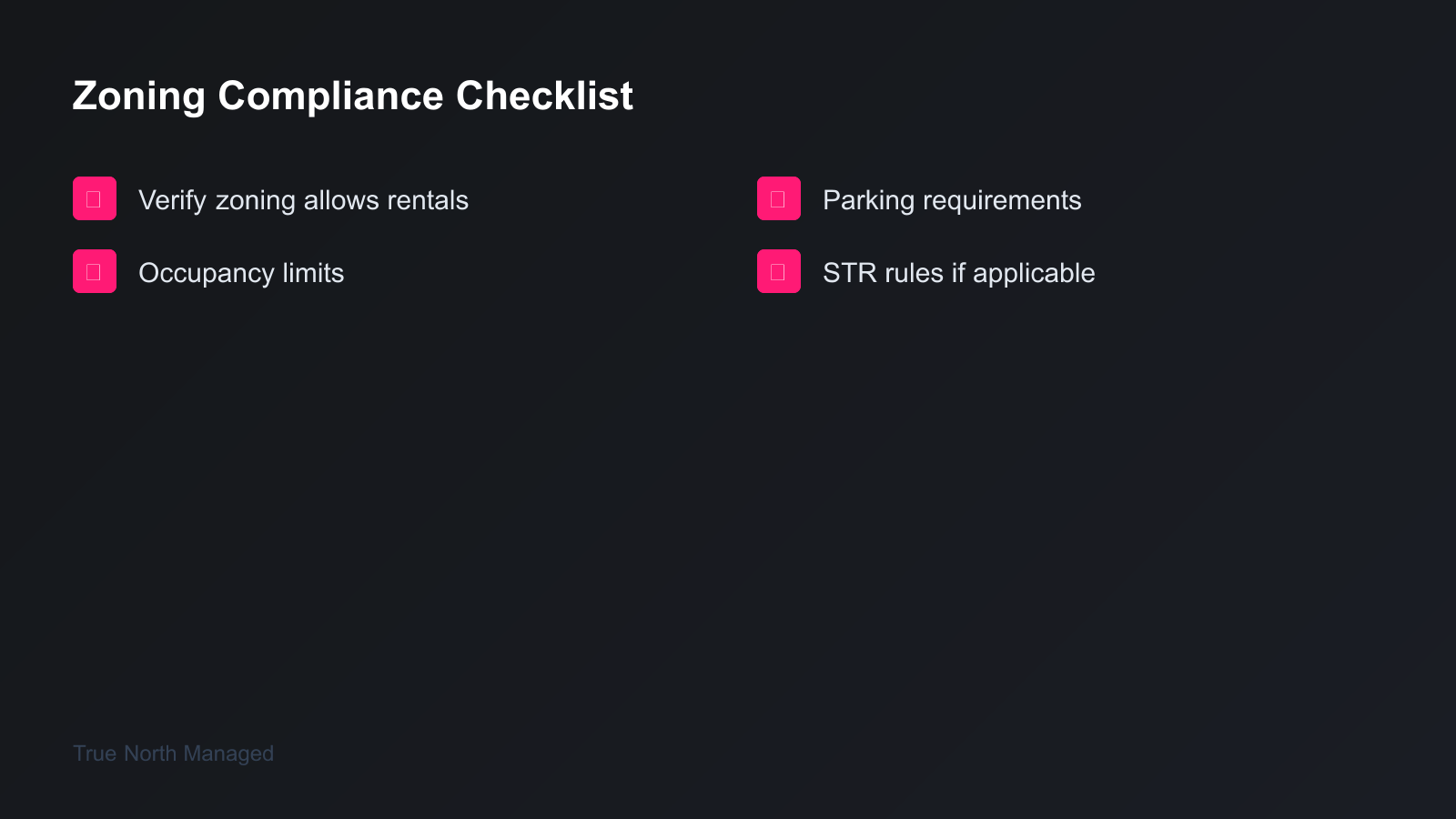
Pull the property's zoning from the county or city before you make an offer. Confirm that your intended use is permitted. Short-term rentals face additional restrictions. Our Orlando STR permits guide covers short-term rules. HOA restrictions apply on top of zoning. The Orlando hub has neighborhood guides. A free rental analysis helps you evaluate a property before committing.
Orange County's zoning map is online—search by address before you buy. We've seen investors assume a single-family is rented by the room; some zones allow it, others don't. A 10-minute lookup can save you from a code violation and a $500/day fine.
STR Restrictions by Zone
Orlando's zoning code treats short-term rentals differently by district. Some zones allow STRs by right; others require a conditional use permit. Downtown zones have different rules than suburban single-family. Before you buy for STR, pull the zoning map. Orange County (unincorporated) has its own rules—often stricter than the city. HOA restrictions can override zoning. A
Orlando's zoning code treats short-term rentals differently by district. Some zones allow STRs by right; others require a conditional use permit. Downtown zones have different rules than suburban single-family. Before you buy for STR, pull the zoning map. Orange County (unincorporated) has its own rules—often stricter than the city.
HOA restrictions can override zoning. A zone that allows STRs means nothing if the HOA bans them. We've seen investors close on a property only to discover the HOA amended the docs last year. Read the HOA docs before you offer.