
Smart Home Technology for Florida Rental Properties
Smart locks, leak detectors, thermostats, and video doorbells can reduce vacancy and cut costs. Here's how to deploy them without breaking Florida law.
Why Smart Landlords Are Adding Tech
Start with a smart thermostat and leak detectors. In Florida, Add a smart lock at turnover if key handoffs are a pain. Disclose everything in the lease. FL landlords in Orlando and Tampa should check local requirements.
What Tenants Actually Want
Start with a smart thermostat and leak detectors. In Florida, Add a smart lock at turnover if key handoffs are a pain. Disclose everything in the lease. FL landlords in Orlando and Tampa should check local requirements. Start with a smart thermostat and leak detectors. Add a smart lock at turnover if key handoffs are
Start with a smart thermostat and leak detectors. In Florida, Add a smart lock at turnover if key handoffs are a pain. Disclose everything in the lease. FL landlords in Orlando and Tampa should check local requirements.
Start with a smart thermostat and leak detectors. Add a smart lock at turnover if key handoffs are a pain. Disclose everything in the lease.
Keyless entry and programmable thermostats top the list. Tenants value convenience over flashy features. Reliable AC control matters more than voice assistants. Smart leak detectors that alert before damage are appreciated. Avoid devices that feel invasive. Our landlord responsibilities guide covers habitability standards.
Smart locks, leak detectors, thermostats, and video doorbells can reduce vacancy, improve tenant satisfaction, and cut maintenance costs. But they also raise privacy questions and legal concerns. Florida landlords need to know how to deploy tech without breaking the law or alienating tenants.
Smart Locks: Keyless Entry and Access Control
Smart locks eliminate the need for physical key handoffs. In Florida, You can grant temporary codes for contractors, revoke access remotely when a tenant moves out, and avoid rekeying costs. Tenant turnover is faster. FL landlords in Orlando and Tampa should check local requirements. Smart locks eliminate the need for physical key handoffs. You can grant temporary codes for contractors, revoke access remotely when a tenant moves out, and avoid rekeying costs. Tenant turnover is faster. Some tenants prefer keyless entry—no fumbling with keys.
Leak Detectors: Water Damage Prevention
Place detectors under sinks, behind toilets, and near water heaters. In Florida, When a leak starts, you get an alert before it becomes a flood. Water damage is one of the costliest rental issues. FL landlords in Orlando and Tampa should check local requirements. Place detectors under sinks, behind toilets, and near water heaters. When a leak starts, you get an alert before it becomes a flood. Water damage is one of the costliest rental issues. A $50 detector can save thousands in repairs.
Smart Thermostats: Energy Savings
Programmable thermostats let you set schedules and limit temperature extremes. In Florida, Some tenants set AC to 68 in summer--that drives costs up. A smart thermostat can cap the range while still allowing comfort. FL landlords in Orlando and Tampa should check local requirements. Programmable thermostats let you set schedules and limit temperature extremes. Some tenants set AC to 68 in summer—that drives costs up. A smart thermostat can cap the range while still allowing comfort. Disclose the limits in the lease.
Video Doorbells: Security and Surveillance
Doorbell cameras can deter package theft and document who visits. But Florida law restricts recording. Under Florida Statute 934. FL landlords in Orlando and Tampa should check local requirements. Doorbell cameras can deter package theft and document who visits. But Florida law restricts recording. Under Florida Statute 934.03, you generally can't record audio where someone has a reasonable expectation of privacy. Video-only doorbells in common areas are typically fine. Disclose in the lease that you use video surveillance.
ROI and Tenant Privacy
Weigh ROI against tenant privacy. In Florida, A leak detector is invisible to tenants. A smart thermostat is visible but acceptable if disclosed. FL landlords in Orlando and Tampa should check local requirements. Weigh ROI against tenant privacy. A leak detector is invisible to tenants. A smart thermostat is visible but acceptable if disclosed. Cameras
Weigh ROI against tenant privacy. In Florida, A leak detector is invisible to tenants. A smart thermostat is visible but acceptable if disclosed. FL landlords in Orlando and Tampa should check local requirements.
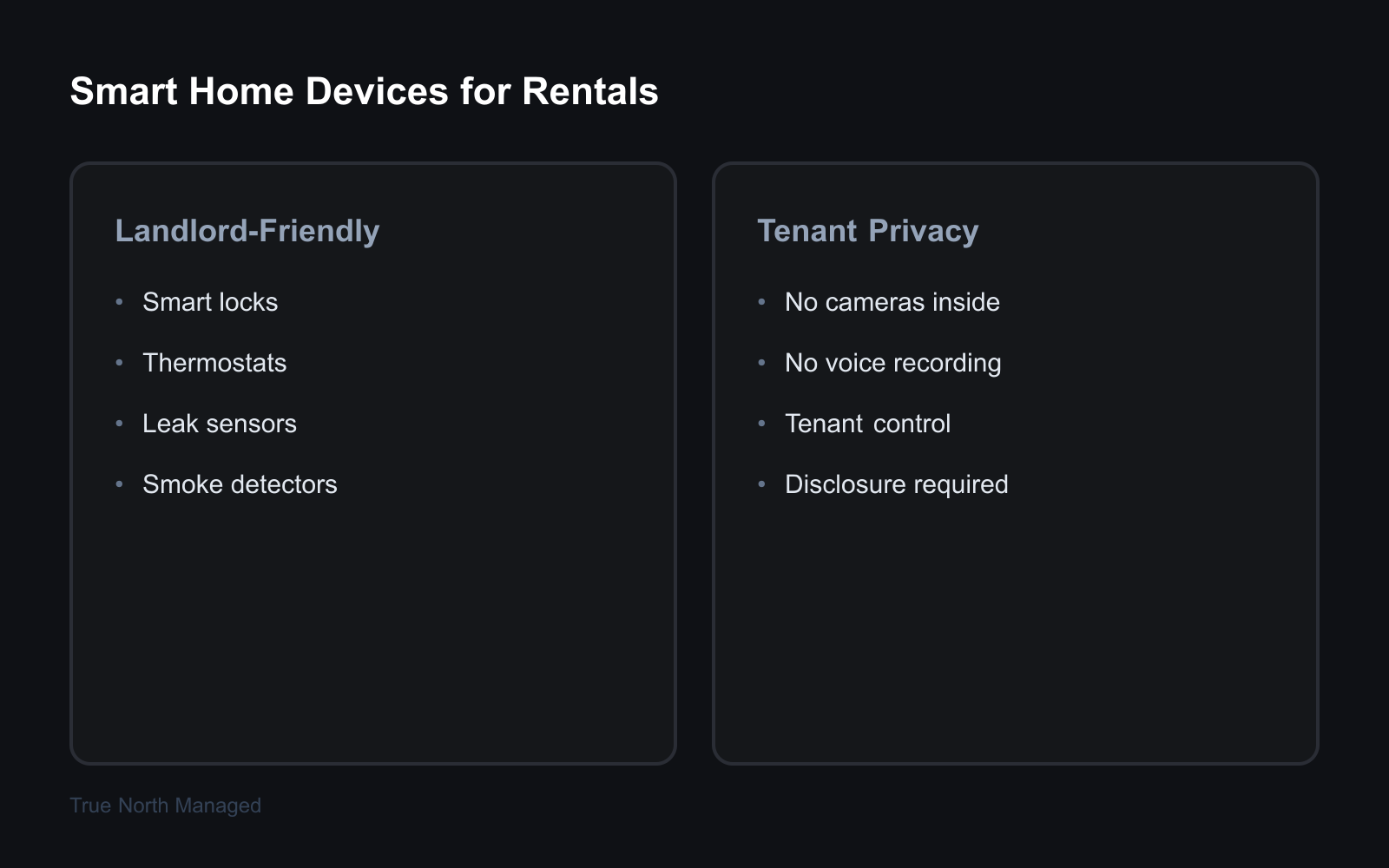
Weigh ROI against tenant privacy. A leak detector is invisible to tenants. A smart thermostat is visible but acceptable if disclosed. Cameras in common areas are common; cameras inside the unit aren't. Disclose all smart devices in the lease.
When to Hire a Property Manager
Managing multiple properties with tech? See our guide on when to hire a property manager in Orlando --the same logic applies across Florida. A full-service manager can handle tech deployment, tenant onboarding, and maintenance. FL landlords in Orlando and Tampa should check local requirements. Managing multiple properties with tech? See our guide on when to
Managing multiple properties with tech? See our guide on when to hire a property manager in Orlando --the same logic applies across Florida. A full-service manager can handle tech deployment, tenant onboarding, and maintenance. FL landlords in Orlando and Tampa should check local requirements.
Managing multiple properties with tech? See our guide on when to hire a property manager in Orlando—the same logic applies across Florida. A full-service manager can handle tech deployment, tenant onboarding, and maintenance.
Smart tech adds value when deployed thoughtfully. Disclose everything, respect privacy, and stay within Florida law. Want help with tech and tenant relations? Get a free rental analysis and we'll walk you through what works for Orlando and Tampa landlords.
What Florida Landlords Actually Install
Smart thermostats pay for themselves in 12--18 months on Florida rentals. AC runs 9--10 months of the year. A programmable thermostat that learns occupancy patterns can cut cooling costs 10--15%. FL landlords in Orlando and Tampa should check local requirements. Smart thermostats pay for themselves in 12–18 months on Florida rentals. AC runs 9–10 months
Smart thermostats pay for themselves in 12--18 months on Florida rentals. AC runs 9--10 months of the year. A programmable thermostat that learns occupancy patterns can cut cooling costs 10--15%. FL landlords in Orlando and Tampa should check local requirements.
Smart thermostats pay for themselves in 12–18 months on Florida rentals. AC runs 9–10 months of the year. A programmable thermostat that learns occupancy patterns can cut cooling costs 10–15%. Smart locks eliminate lockouts and key handoffs at turnover. Smart leak detectors under sinks and water heaters catch problems before -- they become $5,000 water damage claims.
Privacy and Lease Language
Tenants have a reasonable expectation of privacy. Smart devices that record audio or video inside the unit require explicit disclosure in the lease. Florida law doesn't prohibit smart tech, but you must tell tenants what's installed and what data is collected. Tenants have a reasonable expectation of privacy. Smart devices that record audio or video
Tenants have a reasonable expectation of privacy. Smart devices that record audio or video inside the unit require explicit disclosure in the lease. Florida law doesn't prohibit smart tech, but you must tell tenants what's installed and what data is collected.
Tenants have a reasonable expectation of privacy. Smart devices that record audio or video inside the unit require explicit disclosure in the lease. Florida law doesn't prohibit smart tech, but you must tell tenants what's installed and what data is collected. Add a smart device addendum: list each device, its purpose, and whether it records. Video doorbells facing common areas are generally fine; cameras inside the unit aren't.
Cost and ROI
In Florida, Expect $200--400 for a smart thermostat, $150--300 for a smart lock, and $50--100 per leak detector. A typical 3-bedroom rental might run $500--800 total. The payoff comes from fewer emergency calls, faster turnover, and lower insurance claims. Expect $200–400 for a smart thermostat, $150–300 for a smart lock, and $50–100 per leak detector.
Expect $200--400 for a smart thermostat, $150--300 for a smart lock, and $50--100 per leak detector. A typical 3-bedroom rental might run $500--800 total. The payoff comes from fewer emergency calls, faster turnover, and lower insurance claims.
Expect $200–400 for a smart thermostat, $150–300 for a smart lock, and $50–100 per leak detector. A typical 3-bedroom rental might run $500–800 total. The payoff comes from fewer emergency calls, faster turnover, and lower insurance claims. For more on landlord responsibilities in Florida, including habitability standards, see our guide.
Considering smart upgrades? Get a free rental analysis to see how your property stacks up.
Bottom line: start with a smart thermostat and leak detectors. Add a smart lock at turnover if key handoffs are a pain. Disclose everything in the lease. The ROI on basic smart tech usually justifies the upfront cost within 18 months.
Tenants increasingly expect keyless entry and programmable climate control. Properties with smart tech lease faster in competitive markets. Start small, document in the lease, and scale as you see ROI. The upfront cost is recoverable through lower vacancy and fewer emergency calls.
Start Simple, Scale Later
The best approach for rental properties is starting with a smart lock and thermostat. In Florida, Add leak sensors next. Skip the full home automation system until you've the infrastructure to monitor and maintain it across multiple properties. The best approach for rental properties is starting with a smart lock and thermostat -- two devices
The best approach for rental properties is starting with a smart lock and thermostat. In Florida, Add leak sensors next. Skip the full home automation system until you've the infrastructure to monitor and maintain it across multiple properties.
The best approach for rental properties is starting with a smart lock and thermostat -- two devices that pay for themselves within a year through reduced turnover friction and lower utility costs. Add leak sensors next. Skip the full home automation system until you've the infrastructure to monitor and maintain it across multiple properties.
Disclosure is non-negotiable. A tenant who discovers a camera or sensor you didn't mention can claim invasion of privacy. The lease addendum protects you and them. List each device, its location, and whether it records. Update the addendum when you add or remove equipment.
What Tenants Actually Want
In Florida, Smart locks and thermostats reduce support calls. Tenants can let in repair people without you driving over. Programmable thermostats cut AC bills—they'll thank you. Focus on those two items first; they're the highest ROI. Don't over-invest. Smart home tech depreciates. A $2,000 system doesn't add $2,000 to rent. Stick to practical items: lock,
Smart locks and thermostats reduce support calls. Tenants can let in repair people without you driving over. Programmable thermostats cut AC bills—they'll thank you. Focus on those two items first; they're the highest ROI.
Don't over-invest. Smart home tech depreciates. A $2,000 system doesn't add $2,000 to rent. Stick to practical items: lock, thermostat, maybe a doorbell camera. Skip the full-home automation.
Privacy and Access
In Florida, Smart locks log entry. You'll know when the tenant let someone in. That's useful for maintenance—you can verify the contractor showed up. Don't use it to monitor tenant comings and goings. That's creepy and could violate privacy. Thermostats is programmed for efficiency. Set a reasonable range—72-78 in summer. The tenant can adjust within
Smart locks log entry. You'll know when the tenant let someone in. That's useful for maintenance—you can verify the contractor showed up. Don't use it to monitor tenant comings and goings. That's creepy and could violate privacy.
Thermostats is programmed for efficiency. Set a reasonable range—72-78 in summer. The tenant can adjust within that. You save money, they stay comfortable. Win-win.
Bottom Line
Smart locks and thermostats reduce calls. Don't over-invest. Focus on practical items. Respect tenant privacy.
Smart locks can generate temporary codes for contractors. No more key handoffs. Tenant gets a new code after the visit.
When in doubt, document it. Florida landlords who follow the process and keep a paper trail protect themselves when disputes arise. A few minutes of documentation can save months of headaches.
Florida's landlord-tenant statutes—particularly Chapter 83—govern most of what you'll encounter. Familiarize yourself with the notice requirements, timelines, and documentation rules. A well-documented process protects you when disputes arise. In Orlando and Tampa, local ordinances can add layers; check your county and city rules before you act.