

Seasonal Maintenance: Florida's Month-by-Month Property Care Guide
AC runs year-round. Hurricane season hits June through November. A month-by-month calendar keeps you ahead of Florida maintenance demands.
Why a Month-by-Month Calendar Matters in Florida
Florida rentals face different maintenance demands than properties up north. AC runs year-round. Hurricane season hits June through November. FL landlords in Orlando and Tampa should check local requirements. Florida rentals face different maintenance demands than properties up north. AC runs year-round. Hurricane season hits June through November. Pest pressure peaks in summer. Irrigation and lawn care follow a different rhythm than snow-belt properties. A month-by-month calendar keeps you ahead of the curve instead of reacting when something breaks.
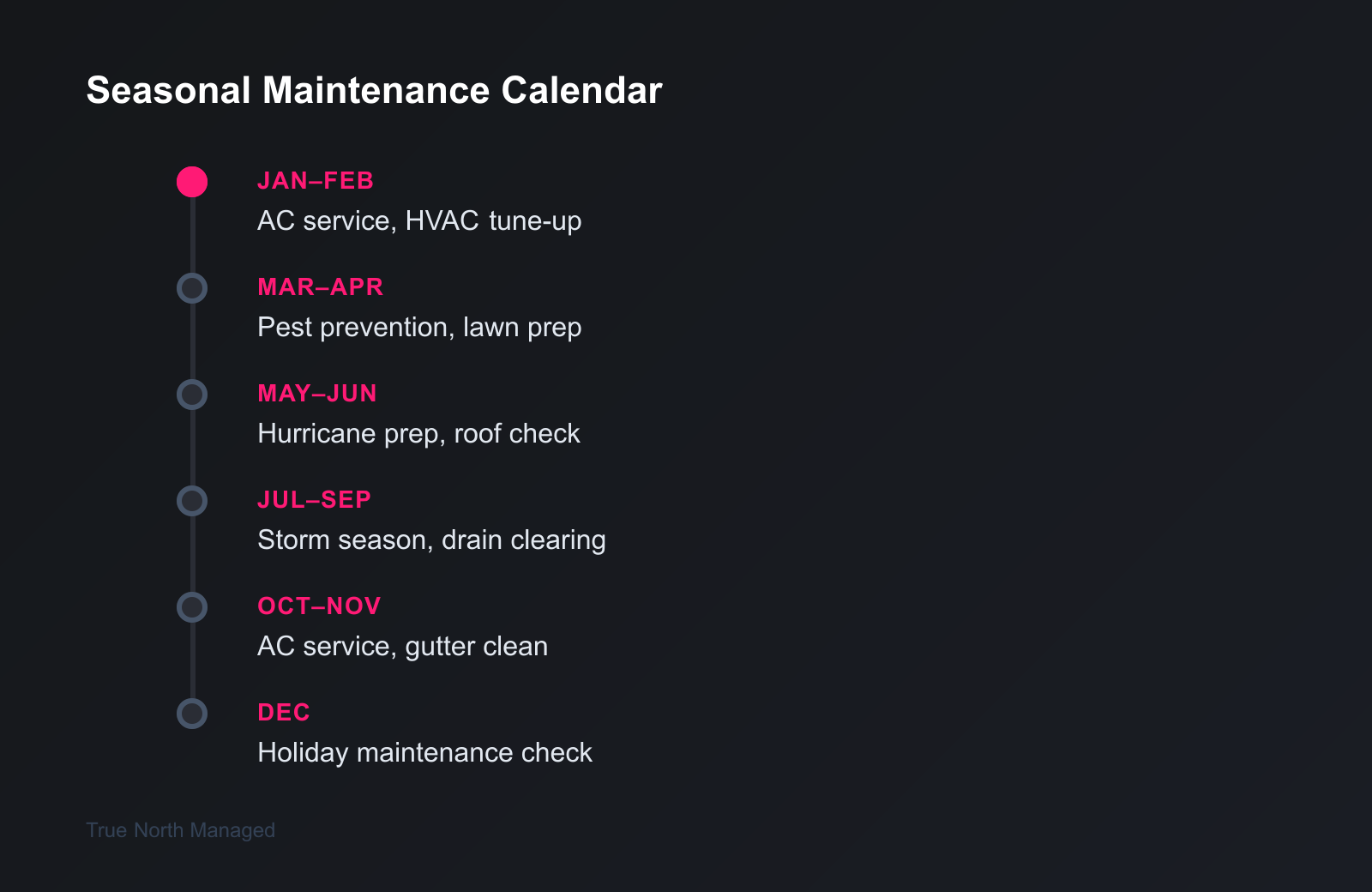
January: HVAC and Filter Check
Start the year with a filter change and HVAC inspection. If your unit hasn't been serviced in 12 months, schedule it now. The Florida Department of Business and Professional Regulation licenses HVAC contractors. FL landlords in Orlando and Tampa should check local requirements. Start the year with a filter change and HVAC inspection. If your
Start the year with a filter change and HVAC inspection. If your unit hasn't been serviced in 12 months, schedule it now. The Florida Department of Business and Professional Regulation licenses HVAC contractors. FL landlords in Orlando and Tampa should check local requirements.
Start the year with a filter change and HVAC inspection. If your unit hasn't been serviced in 12 months, schedule it now. The Florida Department of Business and Professional Regulation licenses HVAC contractors. Use a licensed pro for refrigerant work.
February: Roof and Exterior Inspection
Before spring rains, inspect the roof for loose shingles, damaged flashing, or missing tiles. Check gutters and downspouts. Florida's Florida Building Commission sets construction standards. FL landlords in Orlando and Tampa should check local requirements. Before spring rains, inspect the roof for loose shingles, damaged flashing, or missing tiles. Check gutters and downspouts. Florida's Florida
Before spring rains, inspect the roof for loose shingles, damaged flashing, or missing tiles. Check gutters and downspouts. Florida's Florida Building Commission sets construction standards. FL landlords in Orlando and Tampa should check local requirements.
Before spring rains, inspect the roof for loose shingles, damaged flashing, or missing tiles. Check gutters and downspouts. Florida's Florida Building Commission sets construction standards. Document any issues and repair before hurricane season.
March–April: Pest Control and Lawn Prep
Termites and ants become active as temperatures rise. In Florida, Schedule a preventive pest treatment. Start irrigation checks and lawn care. FL landlords in Orlando and Tampa should check local requirements. Termites and ants become active as temperatures rise. Schedule a preventive pest treatment. Start irrigation checks and lawn care. If you're in a flood zone, verify your FEMA flood map status hasn't changed.
May: Hurricane Prep Begins
Hurricane season starts June 1. Trim trees, inspect shutters or impact windows, and verify insurance coverage. Check our hurricane prep checklist for Florida rentals . FL landlords in Orlando and Tampa should check local requirements. Hurricane season starts June 1. Trim trees, inspect shutters or impact windows, and verify insurance coverage. Check our hurricane prep checklist for Florida rentals . Tenants should know evacuation routes and where to report damage.
June–August: AC Maintenance Peak
AC runs hardest in summer. In Florida, Schedule coil cleaning and refrigerant check. Replace filters monthly if tenants don't handle it. FL landlords in Orlando and Tampa should check local requirements. AC runs hardest in summer. Schedule coil cleaning and refrigerant check. Replace filters monthly if tenants don't handle it. A unit that fails in July is an emergency—prevent it with proactive service. See our preventive maintenance calendar for the full schedule.
September–October: Post-Storm and Fall
After hurricanes, inspect for damage. In Florida, Check roofs, windows, and siding. Fall is a good time for exterior painting and gutter cleaning. FL landlords in Orlando and Tampa should check local requirements. After hurricanes, inspect for damage. Check roofs, windows, and siding. Fall is a good time for exterior painting and gutter cleaning. Schedule any capital improvements before the holidays.
November–December: Year-End Wrap-Up
Review expenses for tax planning. In Florida, Service water heaters if due. Inspect for pest entry points before winter. FL landlords in Orlando and Tampa should check local requirements. Review expenses for tax planning. Service water heaters if due. Inspect for pest entry points before winter. Schedule January HVAC and filter service. A month-by-month rhythm keeps Florida rentals running. Follow the calendar and you'll catch problems before they become emergencies. Need someone to handle the schedule? Get a free rental analysis and see how we manage maintenance in Orlando and Tampa.
May–June: Hurricane Prep
Hurricane season starts June 1. Before it arrives, trim trees, secure outdoor furniture, and verify shutters or impact windows work. The Florida Division of Emergency Management publishes annual preparedness guides. FL landlords in Orlando and Tampa should check local requirements. Hurricane season starts June 1. Before it arrives, trim trees, secure outdoor furniture, and verify shutters or impact windows work. The Florida Division of Emergency Management publishes annual preparedness guides. Document your property's condition with photos for insurance claims. If you're in a flood zone, review your flood insurance coverage before storms hit.
Common Seasonal Mistakes Landlords Make
Skipping the pre-hurricane HVAC check. AC units fail most often in July and August when demand peaks. A $150 tune-up in May can prevent a $3,000 emergency replacement. FL landlords in Orlando and Tampa should check local requirements. Skipping the pre-hurricane HVAC check. AC units fail most often in July and August when demand peaks. A $150 tune-up in May can prevent a $3,000 emergency replacement. Another mistake: ignoring irrigation until the lawn dies. Dead grass signals neglect to tenants and neighbors. Budget $50–100/month for lawn care in Orlando and Tampa. For a full year-round schedule, see our preventive maintenance calendar . Need help staying on top of seasonal tasks? A property manager in Orlando or Tampa handles scheduling, vendor coordination, and documentation so you don't miss critical windows.
July–September: Peak Cooling and Pest Season
AC runs hardest in these months. Change filters every 4--6 weeks. Check condensate drain lines for clogs; a backed-up line can cause water damage. FL landlords in Orlando and Tampa should check local requirements. AC runs hardest in these months. Change filters every 4–6 weeks. Check condensate drain lines for clogs; a backed-up line can cause water damage. Pest pressure peaks in summer. Re-apply barrier treatments if you use them. Inspect for termite damage if the property is older. The Florida DBPR licenses pest control companies.
October–December: Pre-Winter Prep
Cooling demand drops. Schedule HVAC maintenance before the next season. Inspect weather stripping and insulation. FL landlords in Orlando and Tampa should check local requirements. Cooling demand drops. Schedule HVAC maintenance before the next season. Inspect weather stripping and insulation. In South Florida, "winter" is mild but a few cold snaps can stress older systems. Review your annual spend and plan next year's budget. Order supplies for the coming hurricane season if you stock them.
Vendor Relationships
Develop relationships with HVAC, plumbing, and roofing contractors. In Florida, Preferred customers get faster service. Some offer annual maintenance contracts -- $150-$300/year for two HVAC tune-ups. FL landlords in Orlando and Tampa should check local requirements. Develop relationships with HVAC, plumbing, and roofing contractors. Preferred customers get faster service. Some offer annual maintenance contracts -- $150-$300/year for two HVAC tune-ups. That can catch small issues before they become $3,000 replacements.
Cost Estimates per Season
Hurricane prep: $200-$500 for inspection, gutter cleaning, shutter check. In Florida, Winter: $100-$200 for heat check and weatherstripping. Spring: $150-$300 for AC tune-up and filter replacement. FL landlords in Orlando and Tampa should check local requirements. Hurricane prep: $200-$500 for inspection, gutter cleaning, shutter check. Winter: $100-$200 for heat check and weatherstripping. Spring: $150-$300 for AC tune-up and filter replacement. Budget $500-$1,000/year for seasonal maintenance per unit.
Building Vendor Relationships Before You Need Them
The worst time to find a reliable AC technician in Central Florida is July, when every unit in the county seems to fail at once. Build relationships with 2-3 licensed HVAC contractors, a plumber, and a general handyman during the slow months -- January and February. Get on their preferred client list. The worst time
The worst time to find a reliable AC technician in Central Florida is July, when every unit in the county seems to fail at once. Build relationships with 2-3 licensed HVAC contractors, a plumber, and a general handyman during the slow months -- January and February. Get on their preferred client list.
The worst time to find a reliable AC technician in Central Florida is July, when every unit in the county seems to fail at once. Build relationships with 2-3 licensed HVAC contractors, a plumber, and a general handyman during the slow months -- January and February. Get on their preferred client list. When your tenant calls at 10pm in August because the AC died, you want to be the landlord who gets a callback within the hour, not the one waiting three days for a first-available slot.
Staying ahead of seasonal tasks reduces emergency calls and extends the life of your systems. A little prevention goes a long way in Florida's climate. Tenants notice when things work—and when they don't.
Hurricane season runs June 1–November 30. We schedule gutter cleaning and tree trimming in May—before the storms hit. If you wait until August, you're competing with every homeowner in Orlando and Tampa. Book your landscape crew in April and get on the calendar.
Sources: National Hurricane Center, Florida Disaster
Hurricane Season Prep (June–November)
In Florida, Before hurricane season, we walk every property and document: roof condition, tree limbs near the structure, loose gutters, and exterior door seals. Tenants get a hurricane prep checklist in May—where to store patio furniture, how to report damage, what's covered by insurance. A $15 tube of silicone caulk around windows can prevent thousands
Before hurricane season, we walk every property and document: roof condition, tree limbs near the structure, loose gutters, and exterior door seals. Tenants get a hurricane prep checklist in May—where to store patio furniture, how to report damage, what's covered by insurance. A $15 tube of silicone caulk around windows can prevent thousands in water damage.
AC maintenance is the other big one. Florida's AC runs 10–11 months. A $150 annual tune-up in the spring catches refrigerant leaks and dirty coils before they become $2,000 emergency replacements. We schedule ours in April so we're not scrambling in July when everyone's AC dies at once.