

Florida's New 5-Day Eviction Notice Rule: What SB 716 Means for Your Lease Templates
Starting July 1, 2026, Florida landlords must give tenants 5 business days — not 3 — to pay or vacate. SB 716 also bans late fees during the cure period and voids recurring penalty clauses.

Florida's eviction notice window is about to get longer. Senate Bill 716, filed by Sen. Shevrin Jones and introduced January 13, 2026, extends the nonpayment notice period from 3 business days to 5 business days — effective July 1, 2026. That's a 67% increase in the time tenants have to pay or vacate before you can file for eviction.
But the notice timeline isn't even the biggest change. SB 716 also bans any fees or surcharges during the 5-day cure period and voids lease clauses that impose recurring late penalties. The companion House bill, HB 811 (Rep. Daley), uses the same language — framing the changes as eliminating "predatory rental surcharges" that "trap renters in cycles of debt."
If your lease templates haven't been touched since 2024, they almost certainly contain clauses that become unenforceable on July 1. Here's what changes, what stays the same, and what you need to fix before the deadline hits.
What Does SB 716 Actually Change?
SB 716 amends three sections of Florida Statute Chapter 83: §83.47 (prohibited lease provisions), §83.56 (termination of rental agreements), and §83.60 (defenses to actions for rent or possession). Three specific changes matter.
Change 1: The 5-day notice period. The current 3-day notice for nonpayment of rent becomes a 5-business-day notice. Weekends and legal holidays are still excluded from the count — so in practice, a notice served on a Monday gives the tenant until the following Monday to pay. This moves Florida from the shortest-notice tier (alongside Connecticut, Idaho, Iowa, and Kansas at 3 days) into the 5-day group with Arizona, Delaware, Illinois, and Louisiana. Still faster than Alabama's 7 days, Colorado's 10, or Massachusetts' 14.
Change 2: No fees during the cure period. Landlords can't impose any fee or surcharge during the 5-day payment window. If your lease charges a daily late fee starting on day 1 of late payment, that fee can't accrue during the cure period. The tenant has 5 full business days to pay without any additional charges.
Change 3: Recurring late penalty clauses are void. The bill voids rental agreement provisions that impose fees for missed or late rent payments across multiple rental periods. If your lease says "a $50 late fee applies to each rental period the balance remains unpaid," that clause is dead on July 1. A one-time flat late fee triggered after the cure period expires? Still fine. The recurring-penalty structure is what SB 716 targets.
What Stays the Same?
Not everything is changing. And knowing what doesn't change is just as important — it keeps you from overreacting or rewriting your entire lease from scratch.
The eviction process itself is unchanged. Once the 5-day notice expires without payment, the eviction filing process in county court remains the same. File the complaint, wait for the tenant's 5-day response window, proceed to hearing. In Orange County, you're looking at $185 in filing fees plus $10 per summons and $40 per defendant served — and a $90 writ of possession if it goes that far. Total court costs for an uncontested eviction run about $325.
You can still charge late fees — just not during the cure period. Florida has no statutory cap on late fees. Courts apply a reasonableness standard, and 5-10% of monthly rent is generally accepted. On a $2,000/month rental, that's $100-$200. SB 716 doesn't change the amount — it changes when the fee can start. After the 5-day window closes, your contractual late fee kicks in like normal.
Month-to-month termination notices are unaffected. The 15-day written notice requirement for month-to-month tenancies under FL §83.57 isn't touched by SB 716.
Security deposit rules under FL §83.49 are separate. The security deposit return process operates on its own timeline and isn't impacted.
How Does This Affect Your Eviction Timeline and Costs?
Let's map the real-world impact. Under current law, if a tenant doesn't pay rent on April 1:
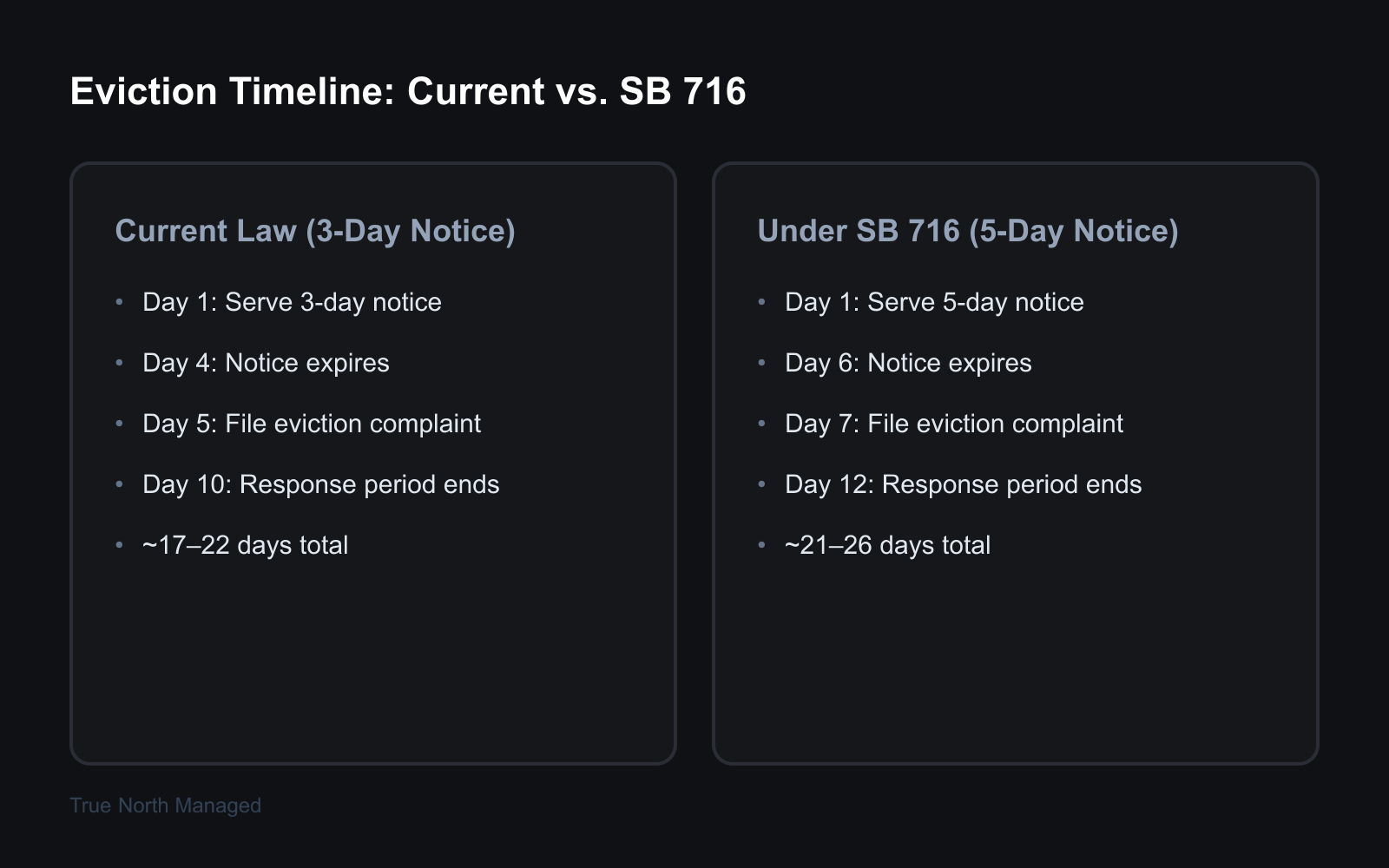
Current process (3-day notice):
- April 2: Serve 3-day notice
- April 4: Notice expires (3 business days, no holidays in this window)
- April 5: File eviction complaint
- April 10: Tenant's 5-day response period expires
- If uncontested: ~7-10 more days for final judgment
- Total: roughly 17-22 days from nonpayment to possession
Under SB 716 (5-day notice):
- April 2: Serve 5-day notice
- April 8: Notice expires (5 business days)
- April 9: File eviction complaint
- April 14: Tenant's 5-day response period expires
- If uncontested: ~7-10 more days for final judgment
- Total: roughly 21-26 days from nonpayment to possession
The difference is 4 business days — call it one work week. On a $2,000/month rental, that's roughly $330 in additional carrying costs per eviction. Not devastating for a one-off, but it compounds. Hillsborough County alone recorded 12,886 eviction filings in 2025 — that's 58 per 1,000 renter households. Landlords managing multiple properties across Orlando and Tampa could see the per-unit impact stack up over a year.
Here's the thing — the real cost of eviction isn't the extra 4 days. It's everything else. Court fees, lost rent, attorney time, turnover, property damage. The average Florida eviction runs $3,500 to $10,000 once you add it all up. SB 716 adds a sliver to that timeline, but the bigger takeaway? Anything you can do to avoid eviction in the first place — better screening, faster communication when rent is late, flexible payment arrangements for good tenants having a bad month — saves you far more than a few days of notice ever will.
Which Lease Clauses Need to Change?
Four specific areas of your lease need review before July 1, 2026:
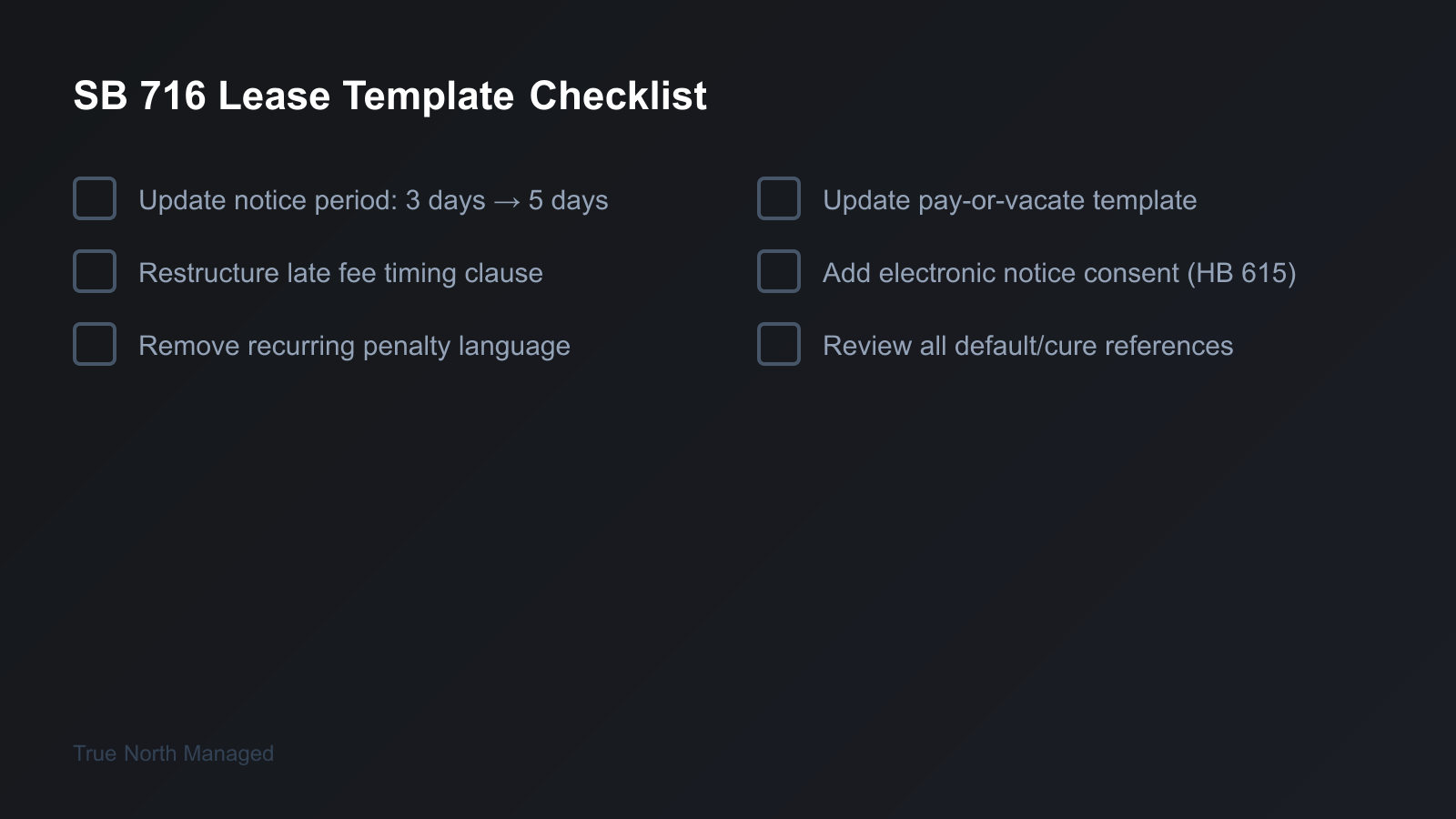
1. The notice period reference. If your lease says "3-day notice" anywhere in the nonpayment or default sections, change it to 5. Even if the lease doesn't override the statute, having incorrect information creates confusion and gives tenants a procedural argument. Under FL §83.60(1)(a), a defective notice doesn't mean automatic game-over — you get a chance to cure and amend. But curing means re-serving the notice and restarting the clock. That's another week you didn't need to lose.
2. Late fee timing. If your lease triggers late fees within the first 5 business days of missed rent, restructure the clause. Late fees should begin after the 5-day cure period expires. A compliant clause: "A late fee of [amount] will apply if rent is not received within 5 business days of the due date, excluding weekends and court-observed legal holidays."
3. Recurring penalty language. Remove any "per-period" or "per-month" late penalty clauses. SB 716 specifically voids provisions imposing recurring fees for ongoing nonpayment across multiple rental periods. A single flat late fee is fine. A clause that stacks penalties month over month is not.
4. The pay-or-vacate notice template. Your 3-day notice template needs a new version reflecting the 5-day timeline. The notice must contain the statutory language required by FL §83.56 — the exact amount owed (rent only, no added fees), the property address, and the correct deadline calculated from the delivery date.
Should You Update Templates Now or Wait?
Don't wait.
Leases signed today may extend past July 1. A 12-month lease signed in March 2026 runs through March 2027. If a nonpayment issue arises after July 1, your lease should already reflect the new rules. Updating now avoids having to issue amendments later — or worse, discovering the problem when you're trying to file an eviction.
Court scrutiny is real. If you end up in eviction court after July 1 and your notice references "3 days" instead of "5 days," the judge may require you to re-serve with corrected language. That's a restart on the entire notice period, plus whatever delay it takes to get the re-served notice in the tenant's hands.
The clause changes are non-controversial. Extending the notice period and removing cure-period fees doesn't weaken your lease. No tenant or tenant's attorney will object to provisions that give the tenant more time to pay.
What Other 2026 Bills Should You Know About?
SB 716 isn't the only piece of Florida rental legislation effective July 1, 2026.
SB 1626 — Rent Reporting to Credit Agencies. This new bill lets landlords report tenant rent payment history to Equifax, Experian, and TransUnion. You'll need written tenant consent, and the fee cap is $10/month or actual cost. The connection to SB 716: positive rent reporting gives tenants a real incentive to pay on time. If on-time payments improve their credit score, you may see fewer nonpayment situations in the first place — which means fewer 5-day notices you need to serve.
HB 615 — Electronic Notice Delivery. Already law since July 1, 2025. You can deliver legal notices — including pay-or-quit notices — by email if both parties agree in writing. Email delivery is instant, which means the 5-day clock starts sooner. It also creates an automatic delivery record with timestamp, which strengthens your position if the eviction goes to court. If you haven't added an electronic notice consent clause to your lease yet, do it during this template update.
Frequently Asked Questions
Does SB 716 apply to commercial leases? No. It amends Chapter 83, Part II, which governs residential tenancies only.
Can I still charge a flat late fee after the cure period? Yes. The restriction applies only during the 5-day window. A one-time late fee that triggers after the cure period expires is still enforceable.
What if my tenant pays on day 4? The notice is satisfied. You can't proceed with eviction, and you can't charge fees for the late payment during the cure period. They cured the default within the statutory window.
Is SB 716 signed into law yet? As of March 2026, SB 716 has been referred to the Senate Judiciary, Community Affairs, and Rules committees. The companion bill HB 811 is in the House Civil Justice & Claims Subcommittee. The July 1 effective date is set in the bill text — don't wait for the governor's signature to update your templates.
Look — SB 716 isn't a radical overhaul of Florida eviction law. It's a timeline adjustment with fee restrictions that require specific lease language updates. Two extra business days. A late fee clause rewrite. A new notice template. That's it.
The landlords who handle this now will have clean templates ready by July 1. The ones who wait will either scramble at the last minute — or worse, serve a defective notice and watch their eviction timeline restart from zero.
If you'd rather have someone else handle the compliance updates, lease template management, and eviction coordination, get a free rental analysis to see how professional management works for your property.