

Florida Protected Series LLC: Asset Protection for Multi-Property Landlords
Signed into law in 2025 and taking effect July 1, 2026, Florida's new Protected Series LLC structure gives multi-property landlords a way to isolate liability between properties without forming a separate LLC for each one.

Florida Protected Series LLC: Asset Protection for Multi-Property Landlords
If you own more than one rental property in Florida, you've probably heard the advice: "Put each property in its own LLC." It's solid advice from a liability standpoint — if a tenant sues over an injury at Property A, Property B's equity is protected behind a separate legal entity.
But forming and maintaining separate LLCs is expensive and tedious. Annual reports, registered agent fees, separate bank accounts, separate tax filings — at 3–5 properties, the administrative overhead becomes a real cost. At 10 properties, it's a full-time job.
Starting July 1, 2026, Florida offers a better option. The Protected Series LLC lets you create multiple internal "series" within a single LLC — each with its own assets, liabilities, and members — while maintaining the liability wall between them.
What Is a Protected Series LLC?
A Protected Series LLC is a single LLC that can create multiple internal divisions called "protected series." Each series functions like a standalone entity for liability purposes, but it all operates under one master LLC.
Think of it as compartments on a ship. If one compartment floods (a lawsuit against one property), the water doesn't reach the other compartments. Your other properties, in their own series, are insulated from that liability.
Florida becomes the 25th U.S. jurisdiction to offer this structure. The law — enacted through CS/SB 316 and CS/HB 403 — amends the Florida Revised LLC Act with new sections 605.2101 through 605.2802.
The three-layer protection model:
- Vertical shield (same as any LLC): Your personal assets are protected from LLC liabilities
- Horizontal shield (new with Protected Series): Assets in Series A are protected from liabilities generated by Series B, and vice versa
- Master LLC shield: The master LLC itself can hold common assets (like a business checking account) separate from any individual series
How Does It Differ From Multiple Separate LLCs?
The traditional approach for multi-property landlords is to form a holding company LLC that owns individual LLCs, each holding one property. It works, but it's expensive.
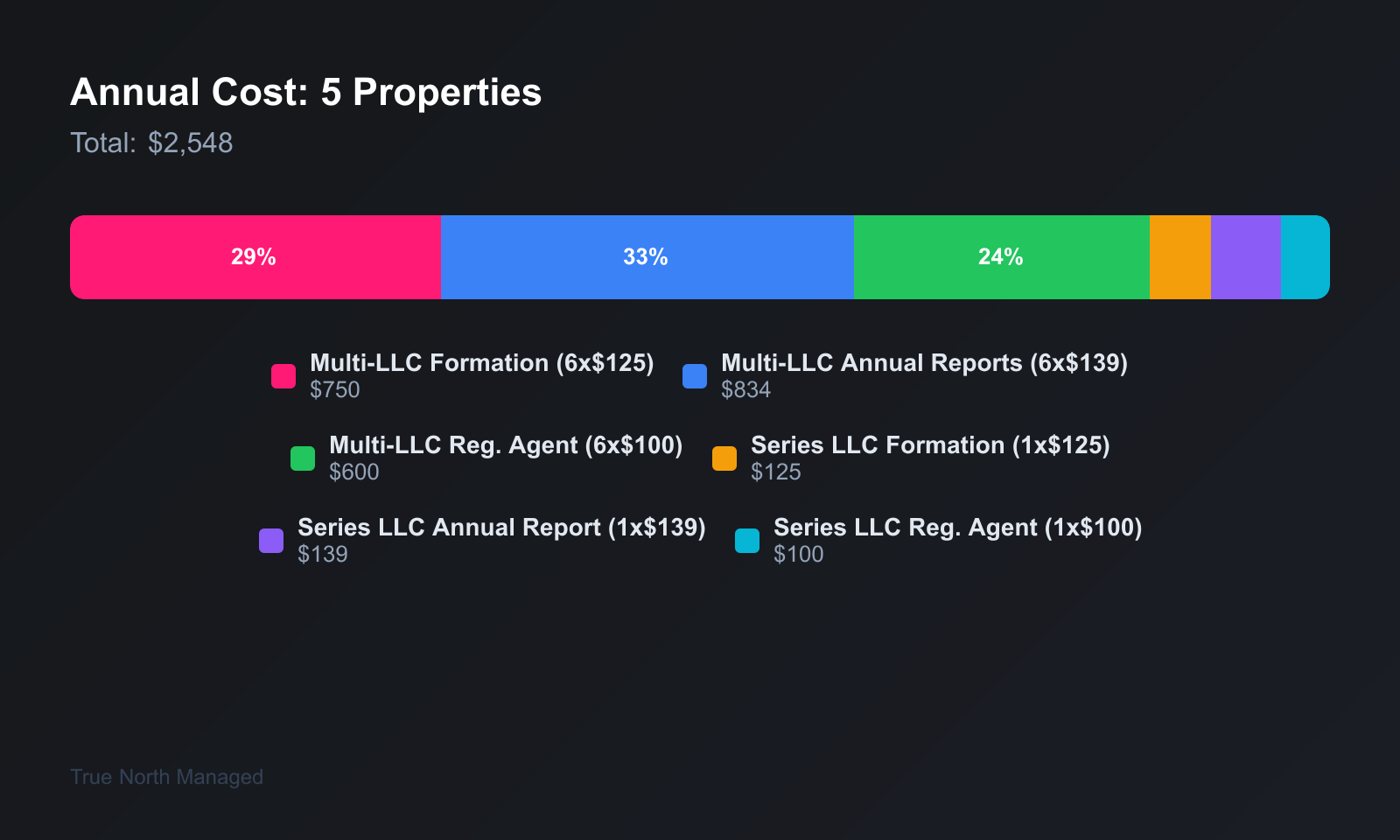
Cost comparison for a 5-property Florida portfolio:
Traditional multi-LLC structure:
- 5 individual LLCs + 1 holding LLC = 6 entities
- Formation: ~$125 filing fee × 6 = $750
- Annual reports: ~$138.75 × 6 = $833/year
- Registered agent: ~$100 × 6 = $600/year
- Separate bank accounts: 6 accounts to manage
- Tax prep: 6 separate returns (or 6 K-1s on your personal return)
- Annual overhead: ~$1,433+ plus accounting fees
Protected Series LLC:
- 1 master LLC + 5 internal series
- Formation: ~$125 filing fee × 1 = $125
- Annual reports: ~$138.75 × 1 = $139/year
- Registered agent: ~$100 × 1 = $100/year
- Separate bank accounts per series (recommended but simpler)
- Tax prep: 1 entity return (though series may need internal tracking)
- Annual overhead: ~$239+ plus accounting fees
The savings scale with the number of properties. At 10 properties, the traditional model costs $2,700+/year in entity maintenance alone. The Protected Series model stays under $300.
How Does the Liability Isolation Work?
Each protected series must be clearly identified and maintain its own records. The law requires:
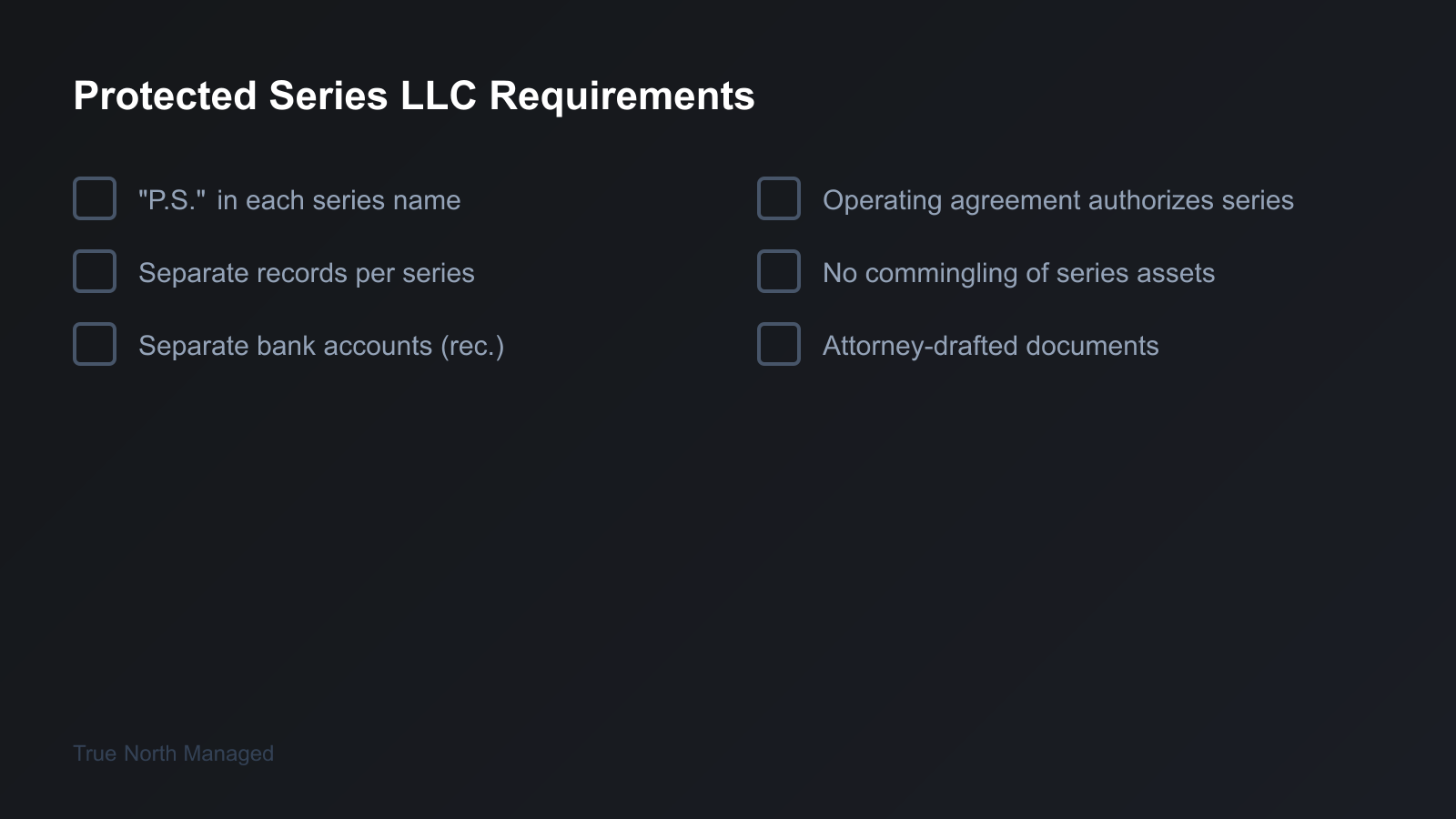
- Separate identification. Each series must include "Protected Series" or "P.S." in its name. Example: "Smith Properties LLC – P.S. 1 (123 Main St, Orlando)"
- Segregated records. Assets, liabilities, income, and expenses attributable to each series must be clearly documented and tracked separately
- Operating agreement. The master LLC's operating agreement must authorize the creation of protected series and establish the rights and obligations of each
When these requirements are met, a creditor with a claim against Series 1 (say, a slip-and-fall lawsuit at your Orlando duplex) cannot reach the assets of Series 2 (your Tampa single-family home) or Series 3 (your Kissimmee condo). The liability is contained within the series that generated it.
The critical caveat: commingling destroys the protection. If you run all series through one bank account, fail to maintain separate records, or treat the series as interchangeable, a court can "pierce" the series shield and treat all assets as one pool. The same rules that apply to piercing the corporate veil of a standalone LLC apply here — the formalities matter.
What Are the Tax Implications?
This is where it gets nuanced, and where you need your CPA involved early.
Federal treatment is uncertain. The IRS hasn't issued definitive guidance on how Protected Series LLCs should be taxed. Delaware's series LLCs (the longest-standing model) have been treated as either:
- One entity with one tax return (each series reported as a line item)
- Multiple disregarded entities each requiring separate reporting
Most tax professionals recommend treating each series as a separate entity for tax tracking purposes — even if you file one return — to support the liability isolation argument. This means separate books for each series, which is required anyway.
Florida state tax: No state income tax, so no Florida filing impact. You'll still file federal returns as normal.
EIN: You can potentially operate all series under one EIN if treated as one entity, or obtain separate EINs for each series. Your CPA and attorney should coordinate on this.
What Are the Limitations?
Protected Series LLCs aren't a magic bullet. There are real limitations.
Interstate recognition. Not all states recognize series LLC structures. If you own property in a state that doesn't recognize Florida's Protected Series LLC, the liability isolation may not hold in that state's courts. For Florida-only investors, this isn't a concern. For multi-state portfolios, it matters.
Lender acceptance. Mortgage lenders are still adapting to series LLC structures. Some lenders may not lend to a protected series directly, requiring the master LLC or a separate entity as the borrower. Check with your lender before restructuring.
Insurance. Insurers may not offer separate policies per series. You may need one blanket policy covering all properties, which partially defeats the liability isolation purpose. Work with your insurance agent to structure coverage that aligns with the series structure.
Novelty in Florida. The law takes effect July 2026. There will be no Florida case law interpreting it for several years. The liability protection is based on the statute and analogies to Delaware's 28+ years of series LLC case law — but until Florida courts rule on these issues, there's some uncertainty.
You still need an attorney. Setting up a Protected Series LLC correctly — with a properly drafted operating agreement, series designations, and record-keeping systems — requires legal expertise. A DIY formation using a template is risky. The cost of attorney setup ($1,500–$3,000) is still less than forming multiple standalone LLCs.
Should You Wait or Set Up Now?
The law doesn't take effect until July 1, 2026. You can't form a Florida Protected Series LLC today. But you can prepare.
If you're currently operating without LLCs, this is a good reason to wait 6 months rather than forming multiple standalone entities now. Form one master LLC and create protected series once the law takes effect.
If you already have multiple LLCs, consult with an attorney about converting to a Protected Series structure. The conversion process isn't defined in the statute yet — it may require forming a new entity and transferring properties, which has title insurance, lender consent, and tax implications.
If you're buying new properties between now and July, you can form a standard LLC and plan to convert or restructure after the law takes effect.
Frequently Asked Questions
Will the Protected Series LLC protect me from lawsuits? It isolates liability between your properties (horizontal shield) and protects your personal assets from LLC liabilities (vertical shield). It doesn't prevent lawsuits or make you judgment-proof — it contains the damage to the assets in the series where the claim originated.
Can I add new series as I buy more properties? Yes. One of the key advantages is scalability. Adding a new series is an internal operating agreement amendment, not a new state filing.
Is this better than umbrella insurance? They serve different functions. Umbrella insurance pays claims up to a coverage limit. The Protected Series LLC limits which assets a creditor can reach. Most attorneys recommend both — umbrella insurance as the first line of defense, entity structure as the second.
What if I only own one property? A standard single-member LLC is sufficient. The Protected Series structure only provides value when you have multiple properties that need liability isolation from each other.
Florida's Protected Series LLC is a meaningful improvement for multi-property landlords who want liability protection without the overhead of maintaining a separate entity for every rental. The law takes effect July 1, 2026 — plenty of time to plan with your attorney and CPA.
If you're building a Florida rental portfolio and want to understand how professional management fits into your asset protection strategy, get a free rental analysis to see the full picture.