
How to Finance Your First Rental Property in Florida
Conventional, FHA house hack, DSCR, portfolio, hard money, HELOC -- how each financing option works for Florida rental properties, with down payments, rates, and pros/cons.
You've got the down payment. You've run the numbers on a few Orlando listings. But how do you actually pay for the thing? The financing options for rental properties are different from buying a primary home -- and the right choice can save you thousands or access deals you otherwise couldn't touch.
Here's how each option works for Florida rentals: down payment requirements, typical rates, and when each one makes sense.
Why Financing Matters for Florida Investors
Financing determines your cash flow, tax treatment, and how fast you can scale. Florida has no state income tax, but loan type and rate still matter. Orlando and Tampa have strong lender options for first-time investors. Interest rates in early 2025 are running around 7% for conventional loans. A 1% difference in rate on a $300,000 loan changes your monthly payment by roughly $200. Florida has no state income tax on rental income, but your financing choice still drives your cash flow, your tax deductions, and how fast you can scale.
Conventional Investment Loans
In Florida, How it works. You qualify based on your income, credit score, and debt-to-income ratio. The property is treated as an investment, not a primary residence. Down payment. Usually 15-25%. Most lenders want 20%. Rates. Typically 0.5-0.875% above owner-occupant rates. At 7% owner-occupant, expect 7.5-7.875%. Good for. First-time investors with W-2 income, 680+ credit,
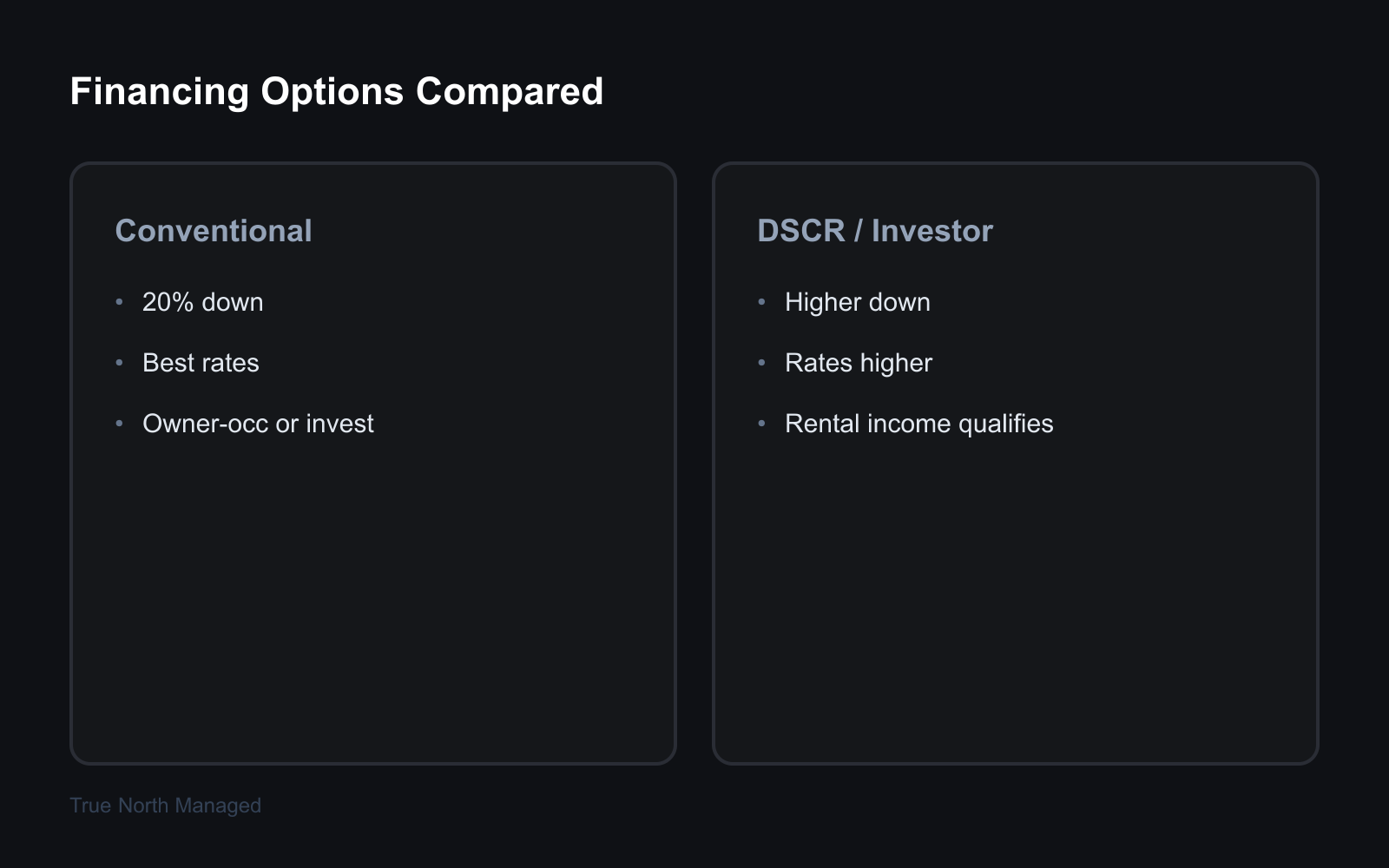
How it works. You qualify based on your income, credit score, and debt-to-income ratio. The property is treated as an investment, not a primary residence.
Down payment. Usually 15-25%. Most lenders want 20%.
Rates. Typically 0.5-0.875% above owner-occupant rates. At 7% owner-occupant, expect 7.5-7.875%.
Good for. First-time investors with W-2 income, 680+ credit, and 20% down. A $300,000 Orlando single-family with 20% down means $60,000 plus closing costs.
FHA House Hack Loans
How it works. You buy a 2-4 unit property and live in one unit for at least one year. FHA allows 3.5% down on multi-unit properties.
Down payment. 3.5% of purchase price. On a $350,000 duplex, that's $12,250.
Good for. First-time buyers willing to live in a duplex. Tampa duplexes in Brandon or Riverview run $320,000-$400,000.
DSCR Loans
In Florida, How it works. The lender qualifies you based on the property's rental income, not your personal income. DSCR = Net Operating Income / Annual Debt Service. Most lenders want 1.0-1.25x. Down payment. Usually 20-25%. Rates. Often 1-2% higher than conventional. Expect 8-9%. Good for. Self-employed investors or those past the conventional limit. Portfolio
How it works. The lender qualifies you based on the property's rental income, not your personal income. DSCR = Net Operating Income / Annual Debt Service. Most lenders want 1.0-1.25x.
Down payment. Usually 20-25%.
Rates. Often 1-2% higher than conventional. Expect 8-9%.
Good for. Self-employed investors or those past the conventional limit.
Portfolio Loans
Portfolio loans: for investors with 5+ properties. Not for first-timers. Conventional or DSCR is the typical path for a first Florida rental. A local bank or credit union holds the loan on its books. More flexible terms, but fewer lenders offer them. Good for scaling beyond 4 properties.
Hard Money Loans
Hard money: short-term, high-rate bridge financing for rehab. Use for BRRRR or flip, not for buy-and-hold. Florida rates run 10-14%. Short-term, asset-based loans from private lenders. Rates run 10-14% plus 2-5 points. Fast funding, but expensive. Used for BRRRR rehabs or flips with a 6-12 month exit plan.
HELOC and Cash-Out Refinancing
HELOC and cash-out refinancing: for tapping equity. Useful if you've a paid-off primary or existing rental. Orlando and Tampa have seen strong appreciation -- equity is there. Tap equity in an existing property to fund the next purchase. HELOC = revolving line of credit. Cash-out refi = new mortgage with larger principal. Our HELOC vs. cash-out refi comparison breaks down when to use each.
3 Financing Mistakes to Avoid
1. Shopping for rate alone. A lender with a slightly lower rate might have worse terms, fees, or service. 2. Assuming you'll qualify. Get pre-approved before you make offers. Investment loans have stricter requirements. 3. Ignoring the 4-property limit. If you plan to scale beyond 4, plan for DSCR or portfolio loans early.
Next Step: Run Your Numbers
Run your numbers before you buy. True North Managed offers free rental analyses for Orlando and Tampa. Compare financing scenarios. Financing is one piece. The other is whether the deal makes sense. Our first rental property guide walks through the full buying process. For an LLC perspective, see our LLC for rental property guide . When you're ready, a free rental analysis gives you market rent for Orlando or Tampa.
Conventional vs. FHA vs. DSCR
Conventional: 15-25% down, good for 1-4 properties. FHA: owner-occupied only. DSCR: for rental income qualification. Florida lenders offer all three. Conventional loans typically require 15–25% down for investment properties. FHA is for owner-occupied only. DSCR (Debt Service Coverage Ratio) loans use the property's income to qualify, not your W-2. They're common for investors with multiple properties. Rates run 0.5–1% higher than conventional. Compare offers from 2–3 lenders.
Florida-Specific Financing
Florida-specific: DSCR loans ( qualify on property income , no personal income verification) are popular for investors. They qualify on the property's income, not your W-2. Orlando and Tampa have plenty of DSCR lenders. Florida has no state income tax, which helps cash flow. Insurance costs more than most states—factor that into your debt coverage.
Florida-specific: DSCR loans (qualify on property income, no personal income verification) are popular for investors. They qualify on the property's income, not your W-2. Orlando and Tampa have plenty of DSCR lenders.
Florida has no state income tax, which helps cash flow. Insurance costs more than most states—factor that into your debt coverage. Flood insurance is required in certain zones. See our flood insurance guide. For hidden costs, we break down what first-time buyers miss.
Common Financing Mistakes
Common mistakes: under-budgeting for insurance, ignoring reserves, and over-leveraging. Florida insurance has doubled in places. Budget 2-3% of value. Keep reserves. Not shopping rates. Half a point can save thousands. Ignoring reserves. Lenders want 6–18 months of PITIA in reserves. Buying at max approval. Leave room for repairs and vacancies. Skipping the pro forma review.
Common mistakes: under-budgeting for insurance, ignoring reserves, and over-leveraging. Florida insurance has doubled in places. Budget 2-3% of value. Keep reserves.
Not shopping rates. Half a point can save thousands. Ignoring reserves. Lenders want 6–18 months of PITIA in reserves. Buying at max approval. Leave room for repairs and vacancies. Skipping the pro forma review. Run the numbers before you make an offer. For a free rental analysis, we'll show the income potential.
Bottom line: shop 2–3 lenders. Conventional needs 15–25% down for investment. DSCR loans use property income, not your W-2. Factor Florida insurance into debt coverage. Reserves matter—lenders want 6–18 months PITIA. Run the pro forma before you offer.
Common Mistakes to Avoid
One of the biggest mistakes we see: skipping the written notice. Florida law is strict about documentation. If you don't have a paper trail—or email trail that meets SB 716's requirements—you can lose an eviction or deposit dispute. Document everything. Another mistake: underbudgeting for turnover. A typical Florida turnover runs $1,500–$3,000 when you include paint,
One of the biggest mistakes we see: skipping the written notice. Florida law is strict about documentation. If you don't have a paper trail—or email trail that meets SB 716's requirements—you can lose an eviction or deposit dispute. Document everything.
Another mistake: underbudgeting for turnover. A typical Florida turnover runs $1,500–$3,000 when you include paint, carpet, cleaning, and minor repairs. If you're only setting aside 5% of rent for maintenance, you're short. Plan for 8–12% in year one until you know your property.
Third: treating every tenant the same. A military family near MacDill has different needs than a UCF grad student. Screen for fit, not just credit score. The right tenant in the right property stays longer and costs you less.
Florida-Specific Considerations
Florida Statute 83 applies to residential tenancies. Know the notice requirements: 3 days for non-payment (soon 5 under SB 716), 7 days for cure or vacate for lease violations, 15 days for month-to-month termination. Wrong notice = delayed eviction.
Insurance is another Florida reality. Wind and flood can double your premium in certain zones. Run quotes before you buy. A $200/month insurance difference changes your cash flow by $2,400/year.
Finally, property taxes. Homestead doesn't apply to rentals. You'll pay non-homestead rates. In Florida County, that's typically 1.2–1.5% of assessed value. Appeal if your assessment seems high—many landlords overpay.
When to Get Help
If you're out of state, hire a local property manager. The 8–10% fee pays for itself in faster leasing, better screening, and someone who can show up when the AC dies at 10 PM. Self-managing from another state is a recipe for deferred maintenance and tenant frustration.
For legal issues—evictions, deposit disputes, lease breaks—consult a Florida-licensed attorney. Landlord-tenant law has traps. A $500 consult can save you $5,000 in a botched eviction. We've seen it.
Finally, for complex financial decisions—1031 exchanges, LLC structuring, depreciation—talk to a CPA who works with rental owners. The tax code rewards those who plan. Don't wing it.
When to Get Help
If you're out of state, hire a local property manager. The 8–10% fee pays for itself in faster leasing, better screening, and someone who can show up when the AC dies at 10 PM. Self-managing from another state is a recipe for deferred maintenance and tenant frustration.
For legal issues—evictions, deposit disputes, lease breaks—consult a Florida-licensed attorney. Landlord-tenant law has traps. A $500 consult can save you $5,000 in a botched eviction. We've seen it.
Finally, for complex financial decisions—1031 exchanges, LLC structuring, depreciation—talk to a CPA who works with rental owners. The tax code rewards those who plan. Don't wing it.
When to Get Help
If you're out of state, hire a local property manager. The 8–10% fee pays for itself in faster leasing, better screening, and someone who can show up when the AC dies at 10 PM. Self-managing from another state is a recipe for deferred maintenance and tenant frustration.
For legal issues—evictions, deposit disputes, lease breaks—consult a Florida-licensed attorney. Landlord-tenant law has traps. A $500 consult can save you $5,000 in a botched eviction. We've seen it.
Finally, for complex financial decisions—1031 exchanges, LLC structuring, depreciation—talk to a CPA who works with rental owners. The tax code rewards those who plan. Don't wing it.
Credit unions and community banks sometimes offer better investment property rates than big banks. Shop locally. Relationship lenders is more flexible on reserves or DSCR if you've other accounts with them. Don't assume the first quote is the best.
Build credit before you shop. Lenders pull scores for pre-approval. A 720+ score gets better rates than 680. Pay down cards, avoid new credit, and fix errors on your report. Six months of clean credit behavior can move you into a better rate tier. That's real money over 30 years.
If you own a rental in Orlando or Tampa and want a clear picture of what it could earn, get a free rental analysis. No obligation—just real numbers.