
Hillsborough County Tenant Bill of Rights: What Tampa Landlords Need to Know
Hillsborough County's Tenant Bill of Rights adds local rules on top of state law. Here's what Tampa landlords must follow and what changed.

You've got an extra layer of rules in Hillsborough County
If you own a rental property in unincorporated Hillsborough County, Florida Statute 83 isn't the whole story. In March 2021, the county passedOrdinance 21-7— the Tenant Bill of Rights — adding local requirements that don't exist anywhere else in Central Florida. Not in Orange County. Not in Tampa proper. Just unincorporated Hillsborough.
And here's the twist: in July 2023, the state passedHB 1417, which preempted local landlord-tenant enforcement. That means the ordinance is still technically on the books, but enforcement shifted from the county to the state. Most Tampa landlords have no idea what that means for them day-to-day.
Let's break it down.
What does the Tenant Bill of Rights actually require?
The ordinance created four main requirements for landlords in unincorporated Hillsborough County:

1. 60-day notice for rent increases over 5%.If you're raising rent by more than 5% on a lease renewal, you must give the tenant at least 60 days' written notice. That's double what most landlords think they owe. For context, state law underFL Statute 83.57requires 30 days' notice to terminate a month-to-month tenancy — but doesn't specifically regulate how much advance notice you give for a rent increase on a fixed-term lease. The county ordinance filled that gap.
2. Source of income protection.You can't deny a tenant based on their source of income — including Section 8 Housing Choice Vouchers, Social Security, disability payments, or housing assistance. This is a bigger deal than most landlords realize. Florida has no statewide source of income protection. The federal Fair Housing Act doesn't cover it either. But in Hillsborough County, rejecting someone because they're paying with aTampa Housing Authorityvoucher can get you a $500 fine.
3. Written late fee notice.Before you charge a late fee, you must send the tenant a separate written notice that includes the amount, the justification, and whether the fee continues to accrue. Putting the late fee terms in the lease isn't enough — the ordinance requires a standalone written notice each time. That's a procedural step most landlords skip entirely.
4. Bilingual disclosure form.Before a prospective tenant fills out an application, you must provide them with a copy of the Tenant Bill of Rights in both English and Spanish. The county provides a template form. Skipping this step — even accidentally — is a violation.
What changed after HB 1417?
Here's where it gets complicated.
Governor DeSantis signedHB 1417on June 29, 2023. It took effect July 1. The bill added Section 83.425 to Florida Statutes, which preempts local governments from regulating most aspects of the landlord-tenant relationship — screening, deposits, fees, notice requirements, lease terms, and disclosures.
In plain English: the state said, "We handle this now. Counties, step back."
What that means for Hillsborough County's Tenant Bill of Rights:
- The ordinance isstill on the books.It hasn't been repealed.
- County-level enforcement ispaused.Complaints initiated after July 1, 2023 go to the state, not the county.
- TheFlorida Department of Agriculture and Consumer Services(FDACS) now handles complaints for properties with fewer than five units. Call them at (800) 435-7352.
- The Florida Department of Business and Professional Regulation (DBPR) handles complaints for properties with five or more units, at (850) 487-1395.
So should you still follow the ordinance? Short answer: yes. The preemption shifted enforcement, not the underlying rules. And if the state ever rolls back HB 1417 — or a court challenges it — landlords who were already compliant won't be scrambling. The practical cost of compliance is minimal. The risk of ignoring it isn't.
Does this apply to my property?
The Tenant Bill of Rights applies tounincorporated Hillsborough County— not to properties within the city limits of Tampa, Temple Terrace, or Plant City. Those cities have their own municipal codes. Tampa itself has Ordinance 2022-51, which has separate anti-retaliation protections for tenants who report health and safety violations.
If you're not sure whether your property falls in unincorporated Hillsborough, check your property address on theHillsborough County Property Appraisersite. The jurisdiction line matters.
For the statewide rules on security deposits — the 15-day and 30-day deadlines, the three holding methods, the certified mail requirement — those apply everywhere in Florida, including Tampa. We covered those in detail in ourFlorida security deposit law guide.
What are the penalties?
$500 per violation. That's the fine the ordinance specifies for a first offense, with additional fines for repeat violations. Before HB 1417, the county's code enforcement division handled these. Now, enforcement flows through FDACS or DBPR depending on your portfolio size.
But here's what the fine misses: the real cost of a violation isn't $500. It's the fair housing complaint that follows. If you reject a Section 8 voucher holder and they file a complaint withHUDor the Tampa Office of Human Rights at (813) 274-5869, you're dealing with an investigation, legal fees, and potential damages that make $500 look like a parking ticket. First-time fair housing violations can run $16,000 or more.
What should Tampa landlords do right now?
Here's the compliance checklist. None of this is expensive or complicated — it's mostly paperwork and process.
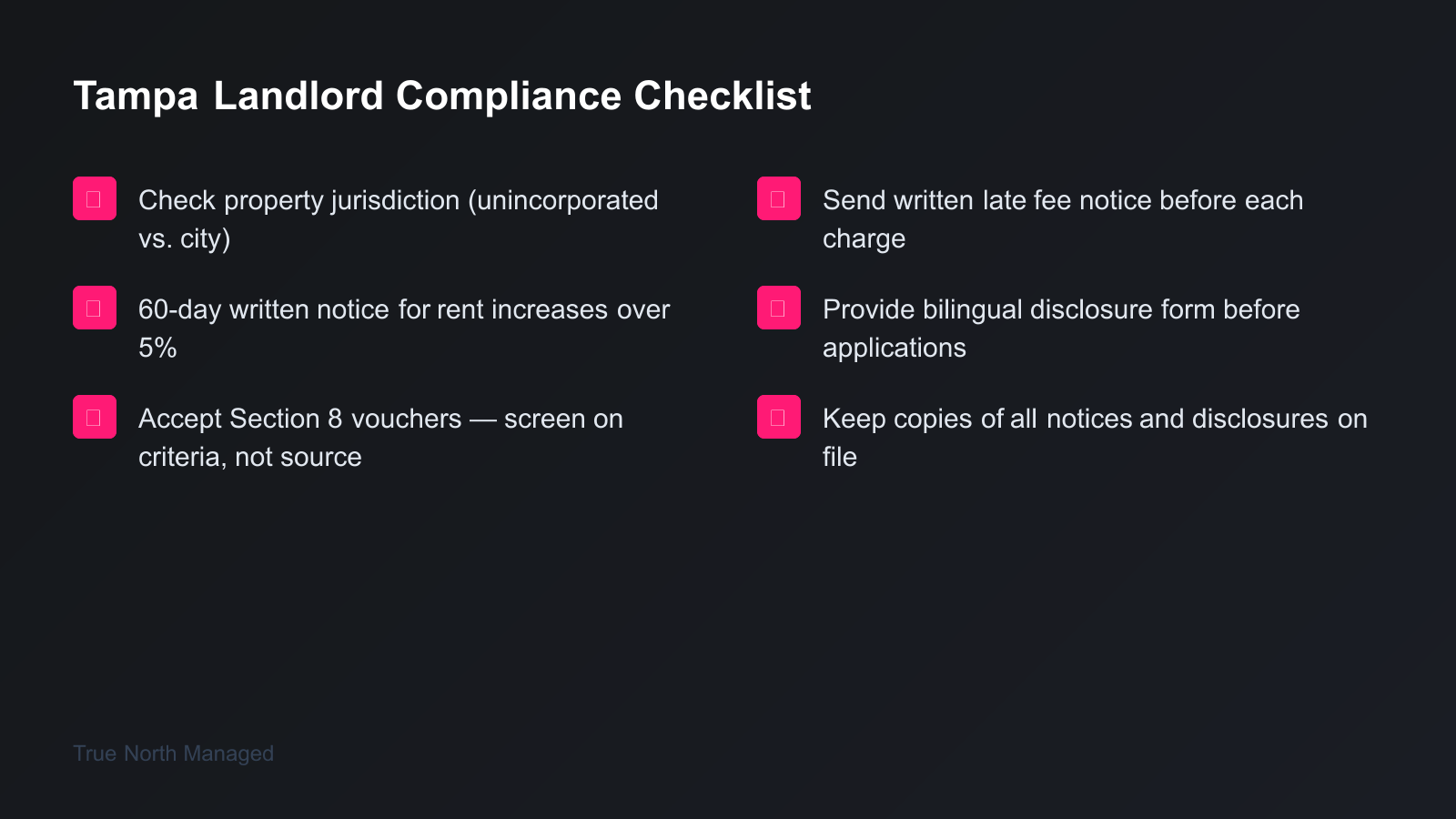
- Check your property jurisdiction.Unincorporated Hillsborough County? You're subject to the ordinance. City of Tampa? Different rules apply. Verify on hcpafl.org.
- Build the 60-day notice into your renewal process.If you're raising rent by more than 5%, send written notice at least 60 days before the new lease term starts. Even if enforcement is in limbo, this protects you if the rules tighten again.
- Don't reject voucher tenants on income source alone.Screen them the same way you'd screen anyone else — credit, rental history, income verification (the voucher counts toward income). If they meet your criteria, the source of the money shouldn't matter. For a full walkthrough of legal screening in Florida, see ourtenant screening guide.
- Send a written late fee notice every time.Don't rely on the lease language alone. A quick written notice with the amount, reason, and accrual status takes two minutes and covers you.
- Provide the bilingual disclosure form before applications.Download the template from thecounty's website, print copies, and hand one to every prospective tenant before they apply.
- Keep records of everything.Copies of notices, disclosure forms, screening criteria, and communication. If a complaint is filed — county or state level — your documentation is your defense.
Common mistakes Tampa landlords make
Assuming "preemption" means "the rules don't apply."HB 1417 shifted enforcement, not the substance. The ordinance is still law. And source of income protection exists independently through fair housing channels. Treating preemption as a free pass is how landlords end up in front of a HUD investigator.
Listing "No Section 8" on rental ads.Even before the ordinance, this was risky. Now it's an invitation for a complaint. If you don't want to participate in the Housing Choice Voucher program, don't advertise that fact. Screen every applicant using the same criteria. Let the numbers — not the income source — make the decision.
Charging late fees without written notice.Florida has no statutory cap on late fees, but the ordinance requires a written notice before you charge one. Landlords who just auto-deduct late fees from the next month's rent without sending notice are out of compliance. And if the tenant disputes it, you've got no paper trail.
Next steps
TheTampa rental marketis competitive enough without adding compliance headaches to your plate. The Tenant Bill of Rights isn't going away — and even with state preemption clouding the enforcement picture, the smart move is to build these steps into your process now.
If you own a rental in Hillsborough County and want someone to handle the compliance, tenant screening, and day-to-day management, we do that. Start with a free rental analysis — we'll look at your property, your lease, and your current process, and tell you where you stand.
Hillsborough's Tenant Bill of Rights went into effect in 2021. If you manage rentals in Tampa, unincorporated Hillsborough, or Plant City, you're covered. The county provides a summary pamphlet—keep a copy in your lease packet. We've seen landlords miss the habitability disclosure requirement.
What the Hillsborough Ordinance Actually Requires
Hillsborough County's Tenant Bill of Rights went into effect in 2021. It applies to residential rentals in unincorporated Hillsborough. Key requirements: you must provide a copy of the ordinance at lease signing, and you can't charge application fees above $50. Security deposits must be held in a Florida bank, and you must return an itemized statement within 30 days of move-out.
Violations can carry fines. More importantly, tenants who sue can recover attorney's fees. We've seen landlords lose deposit disputes because they didn't include the ordinance in the lease packet. The county provides a PDF—include it. Tampa city limits have different rules; Orlando and Orange County don't have a comparable ordinance.