
Renting to Military Tenants Near MacDill AFB: The Tampa Landlord's Guide
MacDill AFB puts 12,000+ military tenants in Tampa's rental market. Here's how to attract them and what to know about BAH and SCRA.
MacDill isn't just a base. It's a tenant pipeline.
MacDill Air Force Base sits on the southern tip of the Tampa peninsula, and it's not small. The base employs 16,799 personnel — 6,652 active-duty military, plus thousands of civilians and contractors. It's home to U.S. Central Command and U.S. Special Operations Command, two of the most important unified commands in the military. And it supports 11,147 military dependents in the Tampa area.. See our advanced guide to renting near MacDill AFB for more.
Most of those families need housing. On-base options are limited to Harbor Bay's inventory of single-family homes and duplexes. The rest — the majority — rent off-base. And they come with something most civilian tenants don't: a federal housing allowance that's deposited like clockwork on the 1st and 15th of every month.
If you own a rental property anywhere in South Tampa, Palma Ceia, Bayshore, Ballast Point, or even Brandon and Riverview, MacDill tenants are part of your market whether you're targeting them or not. Here's how to do it right.
MacDill Air Force Base sits on the southern tip of the Tampa peninsula, and it's not small. The base employs 16,799 personnel — 6,652 active-duty military, plus thousands of civilians and contractors. It's home to U.S. Central Command and U.S. Special Operations Command, two of the most important unified commands in the military. And it supports 11,147 military dependents in the Tampa area.. See our advanced guide to renting near MacDill AFB for more.
Most of those families need housing. On-base options are limited to Harbor Bay's inventory of single-family homes and duplexes. The rest — the majority — rent off-base. And they come with something most civilian tenants don't: a federal housing allowance that's deposited like clockwork on the 1st and 15th of every month.
If you own a rental property anywhere in South Tampa, Palma Ceia, Bayshore, Ballast Point, or even Brandon and Riverview, MacDill tenants are part of your market whether you're targeting them or not. Here's how to do it right.
What is BAH and why should you care?
BAH — Basic Allowance for Housing — is a monthly stipend the military pays service members to cover rent and utilities when they live off-base. The amount depends on rank, whether they have dependents, and the duty station's zip code. It's non-taxable income, and it's calculated using local rental data.

For MacDill AFB in 2026, here's what the BAH rates look like for common ranks:
| Rank | With Dependents | Without Dependents |
|---|---|---|
| E-5 (Staff Sergeant) | $2,721/mo | $2,187/mo |
| E-6 (Tech Sergeant) | $2,991/mo | $2,346/mo |
| E-7 (Master Sergeant) | $3,213/mo | $2,526/mo |
| O-3 (Captain) | $3,087/mo | $2,478/mo |
| O-4 (Major) | $3,468/mo | $2,925/mo |
Those numbers are the tenant's housing budget. An E-6 with a family has $2,991/month earmarked for rent. That's real money — and it's guaranteed by the federal government, not an employer who might lay them off. MacDill ranks 11th highest among all Air Force bases nationally for BAH rates.
For a typical 3-bedroom single-family home in South Tampa renting at $2,500-$2,800/month, an E-6 or O-3 with dependents can comfortably afford it.
BAH — Basic Allowance for Housing — is a monthly stipend the military pays service members to cover rent and utilities when they live off-base. The amount depends on rank, whether they have dependents, and the duty station's zip code. It's non-taxable income, and it's calculated using local rental data.
For MacDill AFB in 2026, here's what the BAH rates look like for common ranks:
| Rank | With Dependents | Without Dependents |
|---|---|---|
| E-5 (Staff Sergeant) | $2,721/mo | $2,187/mo |
| E-6 (Tech Sergeant) | $2,991/mo | $2,346/mo |
| E-7 (Master Sergeant) | $3,213/mo | $2,526/mo |
| O-3 (Captain) | $3,087/mo | $2,478/mo |
| O-4 (Major) | $3,468/mo | $2,925/mo |
Those numbers are the tenant's housing budget. An E-6 with a family has $2,991/month earmarked for rent. That's real money — and it's guaranteed by the federal government, not an employer who might lay them off. MacDill ranks 11th highest among all Air Force bases nationally for BAH rates.
For a typical 3-bedroom single-family home in South Tampa renting at $2,500-$2,800/month, an E-6 or O-3 with dependents can comfortably afford it.
How do you screen a military tenant?
The same way you screen anyone else — just with different documents. The standard screening criteria still apply: credit check, rental history, income verification, eviction search, criminal background. But there are a few things that work differently with military applicants.
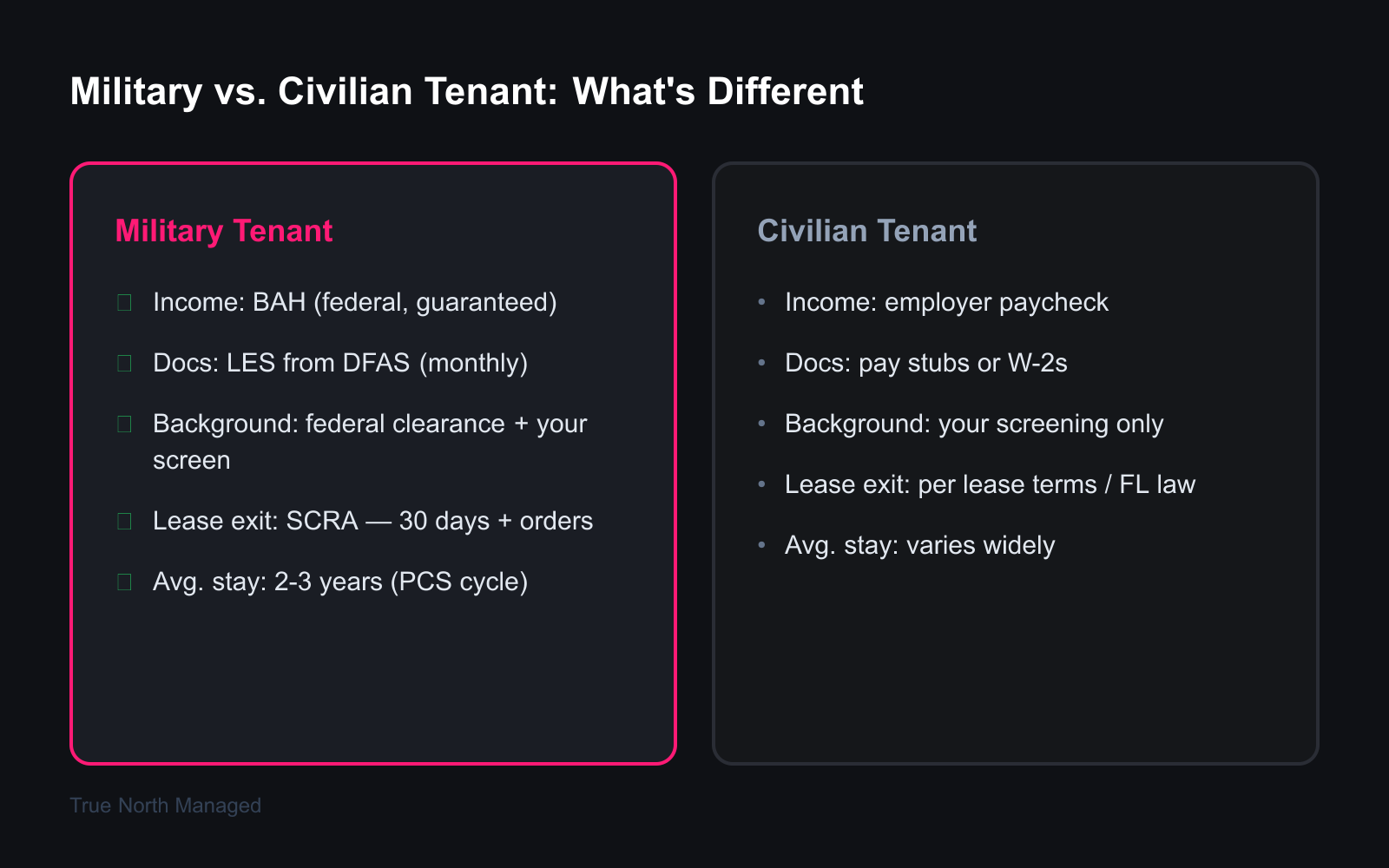
Income verification uses an LES, not pay stubs. The Leave and Earnings Statement is the military equivalent of a pay stub, issued monthly by the Defense Finance and Accounting Service. It shows base pay, BAH, all allowances, deductions, and net pay. Ask for the two most recent LES statements. BAH counts toward the 3x rent income threshold — it's real income even though it's non-taxable.
Military tenants have already passed a federal background check. That doesn't mean you skip yours — you still run credit, rental history, and eviction checks. But the security clearance process they've already gone through is more thorough than anything you'll run on a civilian applicant.
Deployment isn't a red flag. A tenant who deploys for six months still gets paid. Their BAH still comes in. And their family (if they have one) stays in the home. Deployment doesn't create a rent risk — it actually reduces wear and tear on the property because there's one fewer person living in it.
The same way you screen anyone else — just with different documents. The standard screening criteria still apply: credit check, rental history, income verification, eviction search, criminal background. But there are a few things that work differently with military applicants.
Income verification uses an LES, not pay stubs. The Leave and Earnings Statement is the military equivalent of a pay stub, issued monthly by the Defense Finance and Accounting Service. It shows base pay, BAH, all allowances, deductions, and net pay. Ask for the two most recent LES statements. BAH counts toward the 3x rent income threshold — it's real income even though it's non-taxable.
Military tenants have already passed a federal background check. That doesn't mean you skip yours — you still run credit, rental history, and eviction checks. But the security clearance process they've already gone through is more thorough than anything you'll run on a civilian applicant.
Deployment isn't a red flag. A tenant who deploys for six months still gets paid. Their BAH still comes in. And their family (if they have one) stays in the home. Deployment doesn't create a rent risk — it actually reduces wear and tear on the property because there's one fewer person living in it.
What is SCRA and what does it mean for your lease?
The Servicemembers Civil Relief Act is a federal law that protects active-duty military members from certain civil obligations — including lease agreements. If your tenant receives PCS orders (Permanent Change of Station) or gets deployed for more than 90 days, SCRA gives them the right to terminate the lease early.
Here's how it works:
- The tenant provides written notice plus a copy of their military orders.
- The lease terminates 30 days after the next rent payment is due following proper notice.
- You cannot charge an early termination fee. Period. This is federal law. It overrides whatever your lease says.
- You must return any advance rent covering the period after termination within 30 days.
- Security deposit rules still apply — you keep it for damages beyond normal wear and tear, same as any tenant.
What happens if you violate SCRA? It's not a county fine. It's a federal matter. Landlords who knowingly seize deposits or charge termination fees in violation of SCRA face potential criminal prosecution under Title 18, U.S. Code, plus civil liability. The DOJ's Servicemembers and Veterans Initiative actively investigates these cases. Don't test it.
The Servicemembers Civil Relief Act is a federal law that protects active-duty military members from certain civil obligations — including lease agreements. If your tenant receives PCS orders (Permanent Change of Station) or gets deployed for more than 90 days, SCRA gives them the right to terminate the lease early.
Here's how it works:
- The tenant provides written notice plus a copy of their military orders.
- The lease terminates 30 days after the next rent payment is due following proper notice.
- You cannot charge an early termination fee. Period. This is federal law. It overrides whatever your lease says.
- You must return any advance rent covering the period after termination within 30 days.
- Security deposit rules still apply — you keep it for damages beyond normal wear and tear, same as any tenant.
What happens if you violate SCRA? It's not a county fine. It's a federal matter. Landlords who knowingly seize deposits or charge termination fees in violation of SCRA face potential criminal prosecution under Title 18, U.S. Code, plus civil liability. The DOJ's Servicemembers and Veterans Initiative actively investigates these cases. Don't test it.
How should you structure the lease?
The smartest move is to include a military clause in your lease. SCRA protections apply regardless of lease language, but a clear military clause does two things: it tells the tenant you understand their situation, and it avoids confusion when orders come through.
A good military clause includes:
- Explicit reference to SCRA lease termination rights
- 30-day written notice requirement with copy of orders
- Prorated rent through the termination date
- Security deposit return timeline per FL Statute 83.49
- No early termination fee language
What you should never include: an SCRA waiver clause. Some landlords try to add language asking the tenant to waive their SCRA rights. Military OneSource explicitly warns service members against signing these, and any judge reviewing the clause will throw it out. It just makes you look bad.
Lease term strategy: Military PCS moves peak in summer — roughly May through August. If you sign a 12-month lease in June, that lease expires the following June, right in the middle of PCS season. That's actually ideal timing: if the tenant PCSes out, you're listing the property in peak season when the next wave of military families is arriving. If they stay, you renew. Either way, the timing works.
Tampa landlords should also be aware of the Hillsborough County Tenant Bill of Rights requirements — including the 60-day notice for rent increases over 5% — which apply on top of SCRA if your property is in unincorporated Hillsborough County.
The smartest move is to include a military clause in your lease. SCRA protections apply regardless of lease language, but a clear military clause does two things: it tells the tenant you understand their situation, and it avoids confusion when orders come through.
A good military clause includes:
- Explicit reference to SCRA lease termination rights
- 30-day written notice requirement with copy of orders
- Prorated rent through the termination date
- Security deposit return timeline per FL Statute 83.49
- No early termination fee language
What you should never include: an SCRA waiver clause. Some landlords try to add language asking the tenant to waive their SCRA rights. Military OneSource explicitly warns service members against signing these, and any judge reviewing the clause will throw it out. It just makes you look bad.
Lease term strategy: Military PCS moves peak in summer — roughly May through August. If you sign a 12-month lease in June, that lease expires the following June, right in the middle of PCS season. That's actually ideal timing: if the tenant PCSes out, you're listing the property in peak season when the next wave of military families is arriving. If they stay, you renew. Either way, the timing works.
Tampa landlords should also be aware of the Hillsborough County Tenant Bill of Rights requirements — including the 60-day notice for rent increases over 5% — which apply on top of SCRA if your property is in unincorporated Hillsborough County.
Where do MacDill tenants want to live?
Location matters more to military tenants than you can think. The daily commute to base goes through one access point — the Dale Mabry gate on the north end of the peninsula. Traffic backs up during shift changes. So proximity and commute time are real factors.
South Tampa (10 min or less): Palma Ceia, Bayshore, Ballast Point, and the neighborhoods along Gandy and MacDill Avenue. These command the highest rents — $2,300-$3,200/month for a 3BR SFH — but they're walking distance to the gate. Officers and senior NCOs with BAH to match tend to land here.
Brandon and Riverview (20-25 min): Newer construction, bigger lots, lower prices — $1,800-$2,400 for a 3BR SFH. E-5s and E-6s with families who need the space gravitate toward these suburbs. The commute is manageable, and the school ratings are solid.
Temple Terrace and New Tampa (25-30 min): USF-adjacent, more affordable, but the commute starts to stretch. Works for personnel who don't need to be on base every day — CENTCOM and SOCOM staff who work irregular schedules.
For a broader look at what's happening across these submarkets, check out the Tampa rental market overview.
Location matters more to military tenants than you can think. The daily commute to base goes through one access point — the Dale Mabry gate on the north end of the peninsula. Traffic backs up during shift changes. So proximity and commute time are real factors.
South Tampa (10 min or less): Palma Ceia, Bayshore, Ballast Point, and the neighborhoods along Gandy and MacDill Avenue. These command the highest rents — $2,300-$3,200/month for a 3BR SFH — but they're walking distance to the gate. Officers and senior NCOs with BAH to match tend to land here.
Brandon and Riverview (20-25 min): Newer construction, bigger lots, lower prices — $1,800-$2,400 for a 3BR SFH. E-5s and E-6s with families who need the space gravitate toward these suburbs. The commute is manageable, and the school ratings are solid.
Temple Terrace and New Tampa (25-30 min): USF-adjacent, more affordable, but the commute starts to stretch. Works for personnel who don't need to be on base every day — CENTCOM and SOCOM staff who work irregular schedules.
For a broader look at what's happening across these submarkets, check out the Tampa rental market overview.
Common mistakes landlords make with military tenants
Pricing above BAH. If your rent is $3,200/month and the tenant's BAH is $2,991, they're paying $209 out of pocket every month. Military tenants are savvy about this — they know their BAH to the dollar. Price your property at or slightly below the BAH for your target rank, and you'll fill it faster.
Refusing to include a military clause. Some landlords think a military clause only protects the tenant. Wrong. It protects you too — it sets clear expectations for the PCS termination process instead of leaving you scrambling when orders arrive. And it makes your listing more attractive to the MacDill tenant pool.
Treating PCS turnover as a negative. Yes, your military tenant might leave after 2-3 years. But they leave cleanly — with notice, with documentation, and usually with the property in good shape. And the next PCS cycle brings a new wave of tenants looking for exactly what you've got. The turnover is predictable. That's a feature, not a bug.
Pricing above BAH. If your rent is $3,200/month and the tenant's BAH is $2,991, they're paying $209 out of pocket every month. Military tenants are savvy about this — they know their BAH to the dollar. Price your property at or slightly below the BAH for your target rank, and you'll fill it faster.
Refusing to include a military clause. Some landlords think a military clause only protects the tenant. Wrong. It protects you too — it sets clear expectations for the PCS termination process instead of leaving you scrambling when orders arrive. And it makes your listing more attractive to the MacDill tenant pool.
Treating PCS turnover as a negative. Yes, your military tenant might leave after 2-3 years. But they leave cleanly — with notice, with documentation, and usually with the property in good shape. And the next PCS cycle brings a new wave of tenants looking for exactly what you've got. The turnover is predictable. That's a feature, not a bug.
Next steps
MacDill's 16,799 personnel aren't going anywhere. CENTCOM and SOCOM are permanent installations, and the base's economic footprint in Tampa runs into the billions. That's a tenant pipeline that renews every PCS cycle.
If you own a rental within a 30-minute drive of MacDill and want to know how your property stacks up for military tenants — what it would rent for, whether it fits the BAH range, and what updates would make the biggest difference — start with a free rental analysis. We'll run the numbers.
MacDill's 16,799 personnel aren't going anywhere. CENTCOM and SOCOM are permanent installations, and the base's economic footprint in Tampa runs into the billions. That's a tenant pipeline that renews every PCS cycle.
If you own a rental within a 30-minute drive of MacDill and want to know how your property stacks up for military tenants — what it would rent for, whether it fits the BAH range, and what updates would make the biggest difference — start with a free rental analysis. We'll run the numbers.
Military tenants receive Basic Allowance for Housing (BAH). Rates are published by rank and dependency status. An E-5 with dependents gets about $2,200/month in Tampa. Price your unit accordingly.
Include a military clause: early termination for PCS orders with 30 days' notice. The SCRA protects them—you can't charge a penalty for breaking the lease for military orders. But you can require prorated rent and notice.
Military tenants receive Basic Allowance for Housing (BAH). Rates are published by rank and dependency status. An E-5 with dependents gets about $2,200/month in Tampa. Price your unit accordingly.
Include a military clause: early termination for PCS orders with 30 days' notice. The SCRA protects them—you can't charge a penalty for breaking the lease for military orders. But you can require prorated rent and notice.
If you own a rental in Orlando or Tampa and want a clear picture of what it could earn, get a free rental analysis. No obligation—just real numbers.