
First Rental Property in Florida: A Step-by-Step Buying Guide
Buying your first rental property in Florida? Here's the step-by-step process -- from financing and location analysis to closing costs, insurance, and finding your first tenant.
You've been thinking about buying a rental property in Florida. Maybe you've run the numbers on a duplex in Orlando, or you keep seeing "investor special" listings in Tampa pop up on Zillow. But there's a gap between wanting to invest and actually closing on your first deal -- and that gap is full of questions nobody answers in a straight line.
This guide walks you through the entire process, from setting your budget to collecting your first rent check. No theory. Just the steps, the numbers, and the Florida-specific details that matter.
How Much Money Do You Actually Need to Buy a Rental in Florida?
You typically need 15-25% down for a conventional investment loan. On a $250K Orlando property, that's $37,500-$62,500. Add closing costs (2-3%) and reserves. Plan for $50K-$70K total. More than you think, but less than most people fear. A typical investment property in Orlando runs $300,000-$400,000 for a single-family home. You'll need 15-25% down (that's $45,000-$100,000 on a $300,000 property), plus closing -- costs of 2-5% ($6,000-$15,000), plus reserves. Here's how the math breaks down on a $325,000 single-family home in an Orlando suburb like Lake Nona or Avalon Park: Cost Amount Down payment (20%) $65,000 Closing costs (~3%) $9,750 Reserves (3 months PITI) $6,000 Initial repairs/updates $3,000-$8,000 Total cash needed $83,750-$88,750 That's real money. But Florida's lack of state income tax means your rental income isn't taxed at the state level -- a built-in advantage over states like California or New York where state tax bites into your cash flow.
What Type of Loan Should You Use?
Conventional loans are best for first-time investors -- 15-25% down, no owner-occupancy requirement. FHA is for owner-occupied only. DSCR qualifies on rental income. Florida has plenty of lenders. For your first investment property, you've got a few options. Each one works differently, and the right choice depends on your financial situation. Conventional investment loan. The
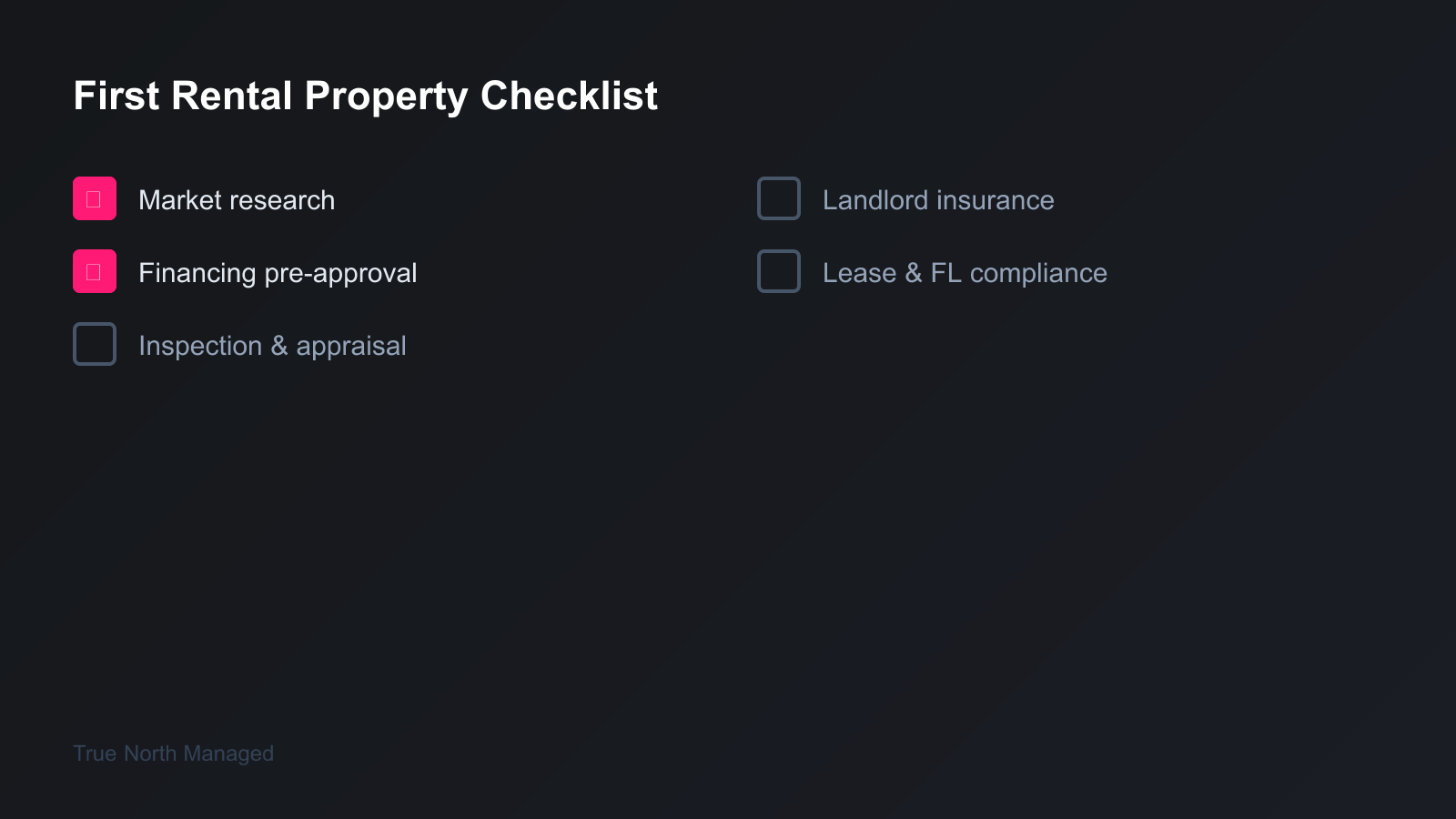
Conventional loans are best for first-time investors -- 15-25% down, no owner-occupancy requirement. FHA is for owner-occupied only. DSCR qualifies on rental income. Florida has plenty of lenders.
For your first investment property, you've got a few options. Each one works differently, and the right choice depends on your financial situation.
Conventional investment loan. The standard path. You'll need a 680+ credit score, 15-25% down, and proof of income. Rates typically run 0.50-0.875% above primary residence rates -- so if owner-occupant mortgages are at 6.5%, expect 7.0-7.375% for an investment property. This is the cheapest money for most first-time investors. DSCR loan. These qualify you based on the property's rental income, not your personal income. Great if you're self-employed or already maxed on conventional loans. The trade-off: rates are 1-2% higher, and most lenders want 20-25% down. House hack loan (FHA or conventional). Buy a duplex, triplex, or fourplex. Live in one unit, rent the others. FHA lets you put down as little as 3.5% on a 2-4 unit property -- as long as you live in one unit for at least a year. This is the lowest cash barrier to entry. A $350,000 duplex in a Tampa suburb like Brandon or Riverview with 3.5% down means $12,250 out of pocket, plus closing costs. The rent from the other unit offsets most or all of your mortgage.
How Do You Pick the Right Location in Florida?
Pick location by submarket demand, schools, and employment. Orlando: Lake Nona, Dr. Phillips, Winter Park. Tampa: South Tampa, Seminole Heights, Carrollwood. Run comps. Location drives everything -- your rent, your vacancy rate, your tenant quality, and your long-term appreciation. Florida is a big state, and not every market performs the same way. What to look for: - Job growth. Properties near major employers fill faster. Orlando has Disney, Universal, Lockheed Martin, and the Lake Nona Medical City. Tampa has MacDill AFB, Raymond James, and a growing tech corridor downtown. - Rent-to-price ratio. Divide the monthly rent by the purchase price. In Orlando, you're looking at 0.5-0.7% for most single-family homes. That means a $300,000 house should rent for $1,500-$2,100/month. Anything above 0.6% in a good school district is worth a closer look. - Vacancy rate. Orlando's running about 6% vacancy in Orange County. That's normal for a growing market. Anything under 7% is healthy. - School districts. Even if you're renting to young professionals, good school ratings (7+ on GreatSchools) protect your property value and attract stable tenants. Don't chase the cheapest property in the state. A $150,000 house in a rough area with 12% vacancy costs you more in turnover and headaches than a $350,000 house in a solid school district with 4% vacancy.
How Do You Analyze a Deal Before Making an Offer?
Analyze with the 1% rule, cap rate, and cash-on-cash. Florida expense ratios run 45-55%. Factor in insurance -- it's doubled in some areas. Orlando and Tampa comps vary by neighborhood. Run the numbers before you fall in love with the kitchen. Every rental property is a math problem, and the math doesn't lie. Cash flow formula: Monthly rent - mortgage payment - taxes - insurance - maintenance - vacancy allowance - management fee = cash flow Here's an example on a $325,000 single-family home in Orlando's Avalon Park area: Line Item Monthly Gross rent $2,100 Mortgage (20% down, 7%, 30yr) -$1,451 Property tax -$375 Insurance -$210 Maintenance (10% of rent) -$210 Vacancy allowance (6%) -$126 Property management (10%) -$210 Net cash flow -$482 Wait -- that's negative? Here's the thing: at today's interest rates, many Florida single-family homes don't cash flow on day one when you include a property manager. And that's okay if you're building long-term wealth through appreciation and mortgage paydown. But if you need positive cash flow from day one, you'll need to either put more down, find a below-market deal, or look at multi-unit properties. Cap rate formula: (Annual net operating income / Purchase price) x 100 Using the same property: NOI = ($2,100 x 12) - taxes - insurance - maintenance - vacancy = $25,200 - $4,500 - $2,520 - $2,520 - $1,512 = $14,148. Cap rate: $14,148 / $325,000 = 4.35%. What's good or bad? Orlando residential cap rates run 4-6%. Below 4% means you're paying a premium for the location. Above 6% usually signals deferred maintenance or a tougher neighborhood. A 4.35% cap rate on a turnkey property in a good school district is reasonable -- you're betting on appreciation and rent growth over time.
What Florida-Specific Costs Will Surprise You?
Florida-specific costs: insurance (2-3% of value), flood, wind mitigation, and HOA. Property taxes run 1-2%. Closing costs add 2-3%. Budget for surprises. Florida has costs that landlords from other states don't expect. Budget for these before you close. Insurance. Florida homeowner's insurance is the most expensive in the country. The median is $2,273/year, but coastal
Florida-specific costs: insurance (2-3% of value), flood, wind mitigation, and HOA. Property taxes run 1-2%. Closing costs add 2-3%. Budget for surprises.
Florida has costs that landlords from other states don't expect. Budget for these before you close.
Insurance. Florida homeowner's insurance is the most expensive in the country. The median is $2,273/year, but coastal properties and older homes can run $4,000-$6,000+. Wind mitigation features (hip roof, hurricane shutters, impact windows) can cut premiums 30-60%. Get insurance quotes before you finalize your purchase price analysis -- a $500/month insurance bill changes the math fast. Property tax. Florida's average effective property tax rate is about 0.86%, but it varies by county. Orange County (Orlando) runs roughly 1.1-1.4% when you include all the special assessment districts. On a $325,000 property, that's $3,575-$4,550/year. And here's the kicker: investment properties don't qualify for the homestead exemption, so you're paying the full assessed value. Flood insurance. If the property sits in a flood zone (check FEMA's flood maps), you'll need separate flood insurance. NFIP policies start around $600-$800/year but can run $2,000+ in high-risk zones. Private flood insurance is sometimes cheaper. CDD fees. Many newer Orlando communities (Lake Nona, Horizon West, Avalon Park) have Community Development Districts that charge $1,500-$4,000/year on top of HOA dues. CDDs are a tax, not a fee -- they show up on your property tax bill and you can't negotiate them down.
What Legal Steps Do New Florida Landlords Need to Take?
Legal steps: FL 83.49 for security deposits (30-day notice of where it's held), proper lease, and landlord insurance. No state license required for individual landlords. Orlando and Tampa have local nuances. Florida has specific landlord-tenant laws under Chapter 83 of the Florida Statutes that you need to follow from day one. Security depo
Legal steps: FL 83.49 for security deposits (30-day notice of where it's held), proper lease, and landlord insurance. No state license required for individual landlords. Orlando and Tampa have local nuances.
Florida has specific landlord-tenant laws under Chapter 83 of the Florida Statutes that you need to follow from day one.
Security deposits. Under FL 83.49, you must hold security deposits in a separate Florida-based account (interest-bearing or non-interest-bearing) and notify the tenant in writing within 30 days of receiving the deposit. This isn't optional. Miss this step and you lose the right to make any claims against the deposit. Lease requirements. Florida doesn't require a written lease for month-to-month tenancies, but you absolutely need one. Your lease should cover rent amount, due dates, late fees, maintenance responsibilities, pet policies, and lease violation procedures. A handshake agreement leaves you exposed. LLC consideration. Many Florida investors hold rental properties in an LLC for liability protection. Filing Articles of Organization with the Florida Division of Corporations costs $125, plus $138.75/year to maintain. It's not required, but it creates a wall between your rental property and your personal assets. Talk to a real estate attorney before your first purchase to decide if this makes sense for your situation. For more on this, see our guide to LLCs for Florida rental properties. Fair housing. The Fair Housing Act applies to every landlord, even if you own just one rental. You can't discriminate based on race, color, religion, sex, national origin, disability, or familial status in any aspect of renting -- advertising, screening, lease terms, or evictions. Florida adds additional protections. Learn the rules before you start showing the property. Our tenant screening guide covers the details.
What Are the 3 Biggest Mistakes First-Time Florida Landlords Make?
In Florida, 1. Underestimating insurance costs. You ran the numbers with a $150/month insurance estimate because that's what you pay on your primary home. Then the actual quote comes back at $280/month. Suddenly your "cash-flowing" property is $130/month in the red. Get real insurance quotes during due diligence, not after closing. 2. Ignoring the property
1. Underestimating insurance costs. You ran the numbers with a $150/month insurance estimate because that's what you pay on your primary home. Then the actual quote comes back at $280/month. Suddenly your "cash-flowing" property is $130/month in the red. Get real insurance quotes during due diligence, not after closing. 2. Ignoring the property management math. "I'll just manage it myself to save the 10%." That works until you're fielding a maintenance call during your daughter's soccer game, or trying to serve a 3-day notice while you're on vacation. Budget for management from the start -- even if you plan to self-manage initially. If the deal only works without a manager, it doesn't really work. 3. Skipping the inspection. "It's an investment property, not my dream home." True. But a failed HVAC system ($6,000-$10,000), a bad roof ($8,000-$15,000), or active plumbing leaks can turn your investment into a money pit in the first year. Never waive an inspection on a rental property. The $400 inspection fee is the cheapest insurance you'll buy.
Ready to Run the Numbers on Your First Florida Rental?
Run the numbers before you buy. True North Managed offers free rental analyses for Orlando and Tampa. Validate your assumptions. Buying your first rental property in Florida isn't as complicated as it seems -- but it does require doing the math honestly, understanding the Florida-specific costs, and knowing the law before you sign a lease with your first tenant. If you own a property in Orlando or Tampa and want to know what it could rent for -- or you're looking at a deal and want a second opinion on the numbers -- our Free Rental Analysis breaks down the rent, expenses, and cash flow for your specific property. No pressure, no sales pitch. Just the numbers. Sources: Florida Statute 83.51 – Landlord's obligation to maintain premises , MyFloridaLicense.com – Verify licenses, DBPR Sources: Florida Statute 83.51 – Landlord's obligation to maintain premises , MyFloridaLicense.com – Verify licenses, DBPR