
Tampa Rental Market Update — March 2026
Tampa rents held flat in March 2026 while vacancy tightened to 10.7%. Here's what the numbers mean for Hillsborough County landlords.
$1,768. That's your average Tampa rent right now.
And it's going down.
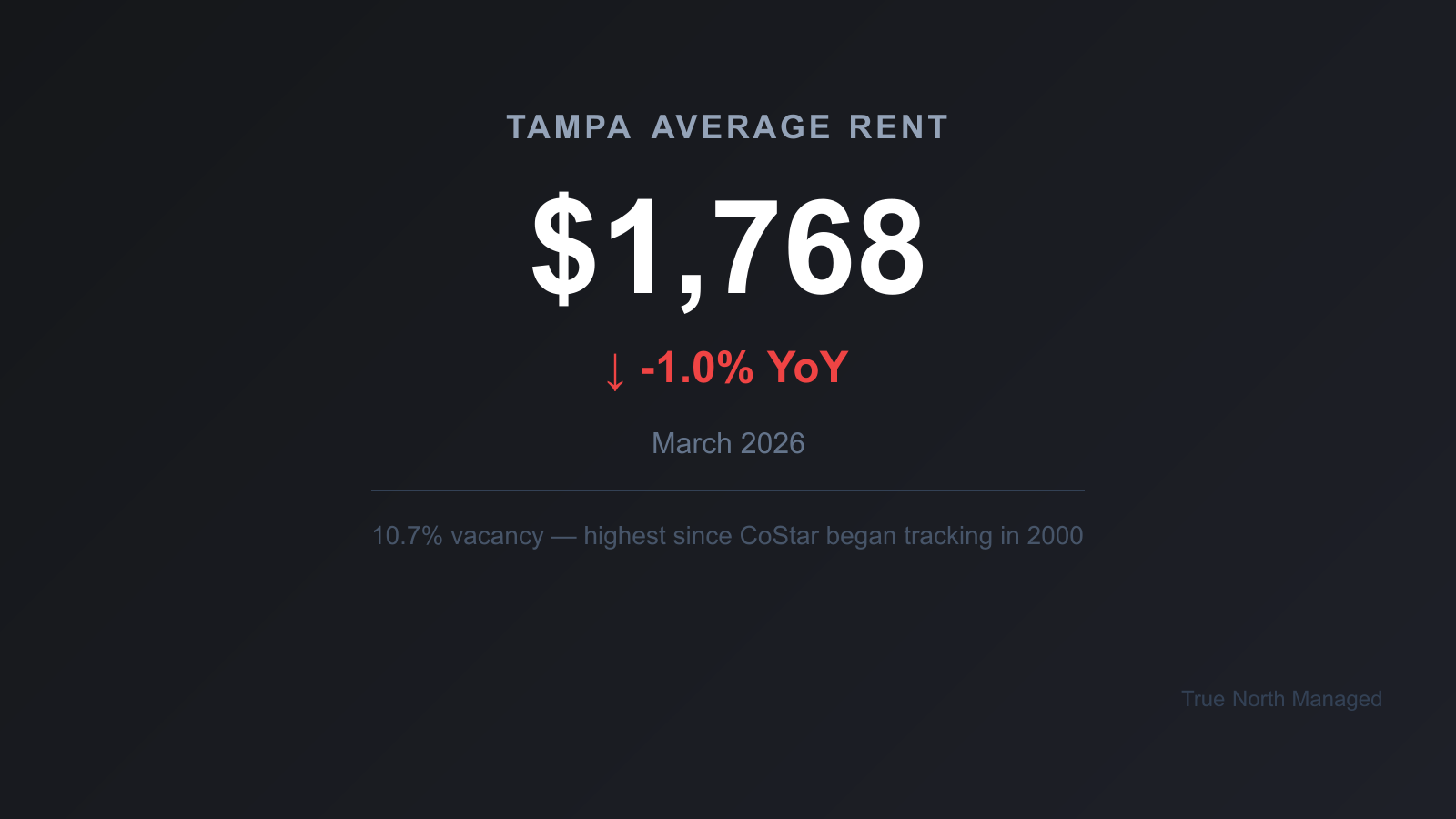
Tampa's multifamily market just hit 10.7% vacancy — the highest level since CoStar began tracking the metro in 2000. Average effective rent dropped to $1,768, with forecasters projecting another 1% decline through Q4 2026. Over a third of apartment complexes in the metro are running concessions — free months, waived fees, the works.
This is a different market than two years ago. Here's what changed, why, and what it means if you own a rental property in Tampa.
What changed
Supply hit like a wave. Tampa delivered over 12,500 new apartment units in 2024 alone — shattering the previous record by more than 4,000 units. Another 7,559 units are projected to deliver in 2026, expanding total metro inventory by 4.5%. That's nearly double the national average of 2.6%. The hardest-hit areas: downtown Tampa, Pasco County, and Southeast Tampa, where concentrated construction pushed vacancy into record territory.
Absorption can't keep up. In the second half of 2025, Tampa absorbed just 1,060 units while 3,800 were delivered. That's a four-to-one gap between supply and demand. Full-year 2026 absorption is forecast at 6,126 units against 7,559 deliveries — better, but still negative. The market needs deliveries to slow before the math flips.
Population is still growing — just not fast enough. Tampa Bay added 497,000 residents between 2020 and 2025, and Hillsborough County alone is projected to gain 121,000 more by 2030. That demand is real. But when you build 25,000 apartments in three years, even strong migration can't fill them all at once.
Orlando is seeing similar softening, but Tampa's supply pipeline is larger relative to its market size, which is why vacancy here is running 2+ points higher.
What the numbers say
| Metric | Tampa | National Average |
|---|---|---|
| Avg. Effective Rent | $1,768/mo | $1,765/mo |
| Vacancy Rate | 10.7% | ~6.5% |
| YoY Rent Change | -1.0% | -1.5% |
| Supply Growth (% of inventory) | 4.5% | 2.6% |
| Q4 2026 Occupancy Forecast | 91.1% | ~93.5% |
| Days on Market (SFH rentals) | 47 | 35-40 |
The big number: 10.7% vacancy. That's not a blip. It's structural oversupply that will take 12-18 months to absorb, even with Tampa's population growth tailwind.
What it means for landlords
If you own a single-family rental, you're in better shape than apartment investors. SFH rents in Tampa are holding up — median of $2,600/month for Hillsborough and Pinellas combined, up 4% year-over-year. That's because SFH supply isn't expanding the way apartment supply is. Nobody's building 7,000 new single-family rentals in a year. Your competition is other landlords, not a 300-unit complex offering two months free.
Pricing precision matters more than it did in 2022. The days of listing $200 above market and getting 10 applications are over. Tampa rental listings are taking 47 days on market — up 17 days from a year ago. If your property sits vacant for six weeks because you overpriced it by $100/month, you've lost $2,600+ in vacancy cost. Price it right on day one.
Tenant retention is worth more than a rent increase. If you've got a good tenant paying $2,200/month, think hard before pushing to $2,400. A turnover costs $3,000-$5,000 in vacancy, cleaning, repairs, and re-listing — and in this market, it might take 6-7 weeks to fill. Neighborhoods like Seminole Heights are bucking the metro trend with lower vacancy, but master-planned communities like Westchase also maintain resilience through family-focused demand.
Concessions are an apartment game. If you're a SFH landlord, don't panic because apartment complexes are giving away free months. That's their problem — they have 300 identical units and need to fill them. You have a unique property with a yard, a garage, a neighborhood. Your value proposition is different. But do make sure your listing photos are sharp, your property is clean, and your price is competitive.
When does it get better?
The supply pipeline is already slowing. New construction starts dropped to fewer than 350 units in Q4 2024 — the lowest quarterly total in nine years. By late 2027, deliveries will drop bigly, and Tampa's demand (driven by continued migration and job growth) should catch up with supply. The MMG Real Estate Advisors forecast calls it "near-term softness giving way to improving fundamentals as the supply cycle matures."
Translation: this is temporary pain. Tampa's fundamentals — population growth, job diversification, no state income tax — haven't changed. The market over-built, and now it needs time to absorb. Landlords who price smart, retain tenants, and maintain their properties will come through this cycle in solid shape.
Next steps
The Tampa rental market isn't broken — it's recalibrating. If you're unsure whether your rent is priced right for this market, or you're weighing whether to push a renewal or hold steady, we can run the numbers. A free rental analysis gives you the current market rent for your specific property, based on actual Tampa comps.