

Will your flood policy start before your Citizens renewal?
Citizens now wants flood on most rentals it insures, starting with January renewals. A January 1 renewal should apply and pay by December 2.
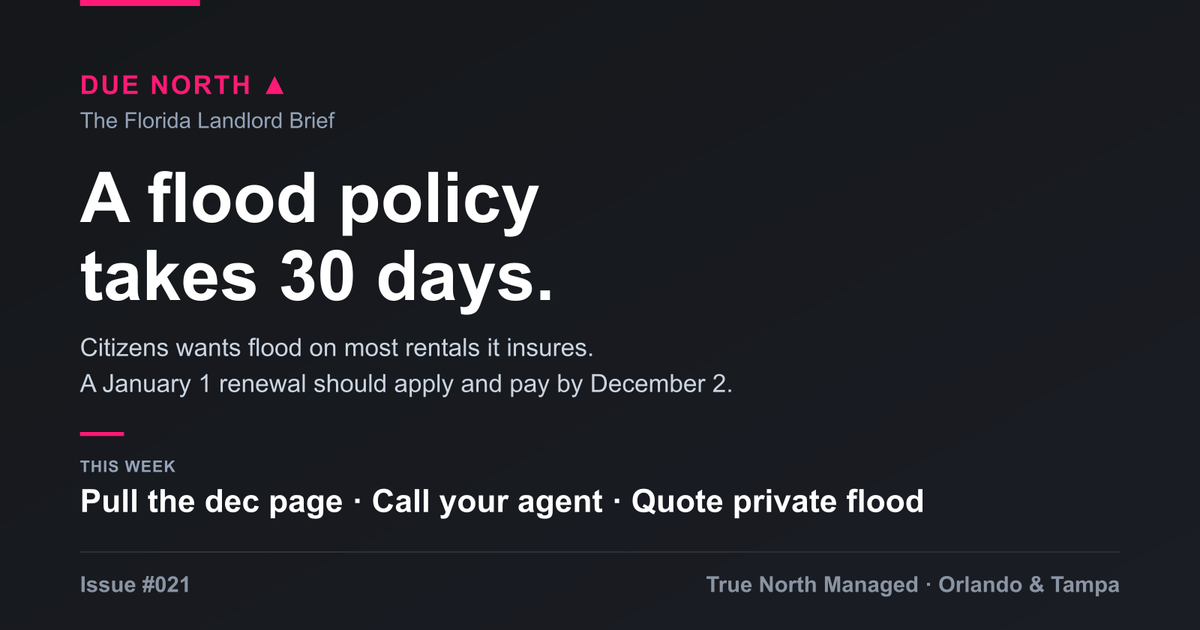
DUE NORTH ▲ The Florida Landlord Brief Your weekly bearing on Florida rental law, insurance, and the market. Tuesday, November 10, 2026 · Issue #021 · Orlando & Tampa | |||||||||||||||||||||||||||||||||||||||||||||||||||||||||||||||||
If Citizens insures your rental, flood is next.Starting with renewals on or after January 1, Citizens wants a flood policy on almost every home it insures for wind. Homes in a FEMA high-risk flood zone have needed one since 2023, and the bigger houses came in over the last three years. January takes in everything else, including the ordinary Zone X rental that has never carried flood:
So your deadline is your first Citizens renewal on or after January 1, not the date itself. Without flood, the form the statute has you sign says the risk “will not be eligible for coverage by the corporation.” Two kinds of policy are let off:
A Citizens wind-only policy does cover wind, so it isn’t exempt. A rented condo is exempt only if its declarations page shows a unit-owners form. And a new NFIP policy doesn’t start on the day you buy it:
Apply and pay on December 2 for a January 1 renewal, and coverage starts at 12:01 a.m. on January 1. That is the last day, not a target. The exceptions start it sooner: in the 13 months after “a revised Flood Hazard Boundary Map or Flood Insurance Rate Map” takes effect for your community; for a purchase “in connection with the making, increasing, extension, or renewal of a loan” that is requested in writing and applied for and paid “at or prior to the loan closing”; and for flooding from wildfire on federal land. A Citizens renewal on its own fits none of them. Congress runs the other clock. The NFIP is authorized only to 11:59 p.m. on December 11, and FEMA says a lapse means it “would stop selling and renewing policies.” Citizens’ list of accepted proof includes “A copy of the submitted application and proof of payment as initial proof of compliance if an application for flood coverage is pending.” Don’t plan on applying after the 11th. This week I’d pull the declarations page for each rental Citizens insures and check the renewal date, whether wind is covered, and the form. If it renews in January, call your agent now. Already carry flood? Check its building limit; raising it mid-term waits 30 days too. Ask for an NFIP quote with a building limit at least equal to your Coverage A, which is what Citizens wants, or the $250,000 NFIP maximum where that’s lower. Ask for a private flood quote alongside it as the hedge, and ask how long that one takes to start. Get it in writing that it meets the statute’s minimum, “the dwelling coverage available from the National Flood Insurance Program or the requirements of s. 627.715(1)(a)1., 2., and 3.” Those three leave out the fourth kind in that subsection, flexible flood. Renewing later in 2027? Count back 30 days from your date and give yourself a margin. If the NFIP lapses on December 11, private flood is the only way to buy new coverage until Congress acts. If you own from out of state, ask whoever looks after the house whether flood has come up yet — the renewal notice may be going to an address nobody checks. Our guide to choosing between NFIP and private flood for a rental goes further. — The True North Team | |||||||||||||||||||||||||||||||||||||||||||||||||||||||||||||||||
▲ The numbers this week
Rate: Freddie Mac Primary Mortgage Market Survey, a weekly national average rather than a quote. Fed: FOMC statement, October 28. NFIP: FEMA, page updated September 28.
| |||||||||||||||||||||||||||||||||||||||||||||||||||||||||||||||||
▲ Rents and values by ZIP · September Ten more from Zillow’s September release, ones we haven’t shown in the last two issues:
Zillow Home Value Index (mid-tier homes) and Zillow Observed Rent Index, September 2026 release. The value index models a typical home, sold or not, so read it as a trend rather than a sale price. Rents are listed asking rents, not signed leases. | |||||||||||||||||||||||||||||||||||||||||||||||||||||||||||||||||
▲ From the Playbook A storm claim’s year starts at landfall.A Florida property-insurance claim has a notice deadline, and for a storm the clock doesn’t wait for you to find the damage:
Isaias made landfall near Destin on October 9, so for anything it did to a Tampa-area rental, the year counts from October 9, not from the turnover in March when someone finds the stain. After any named storm, have someone walk each rental within a few weeks and photograph the roof, ceilings and windows with the date showing. Then put the landfall date, plus one year, on your calendar as the outer limit. Our guide to what to do when a landlord’s claim is denied starts with that clock. | |||||||||||||||||||||||||||||||||||||||||||||||||||||||||||||||||
▲ New on the site since the last issue
| |||||||||||||||||||||||||||||||||||||||||||||||||||||||||||||||||
▲ Florida news worth knowing Amendment 3 passed. Florida voters approved Amendment 3 on November 3 with 61.98% of the vote, according to unofficial results; it needed 60%. Our Amendment 3 explainer for landlords has what it changes for a rental’s bill. Helene’s emergency was renewed again. Milton’s runs to about November 17. Executive Order 26-224, signed October 27, renews the Helene declaration for 60 days, to about December 26, and the Helene order names Orange, Seminole, Osceola, Hillsborough and Pasco. Milton’s renewal of September 18 runs to about November 17 unless it is renewed again. Whether Florida’s price-gouging rent limit reaches a given unit under either is a question for a Florida lawyer, and you should ask it before you price a unit for a household a storm put out of its home. Separately, Executive Order 26-227, the Governor’s November 2 flooding emergency, has also named Seminole since Executive Order 26-228 amended it on November 4. If you own in Seminole, put that order to a Florida lawyer too, for a lease renewal as well as a new lease. Executive Order 26-224 · Executive Order 24-209 · Executive Order 26-193 · Executive Order 26-228 · Fla. Stat. § 501.160 The 4% tax discount runs through November 30. The statute sets it at “4 percent in the month of November or at any time within 30 days after the sending of the original tax notice,” so a late mailing carries it past the 30th. Don’t wait for the mail; look your rental up at the county tax collector. | |||||||||||||||||||||||||||||||||||||||||||||||||||||||||||||||||
| |||||||||||||||||||||||||||||||||||||||||||||||||||||||||||||||||
Has your agent quoted flood yet? Hit reply and tell us what came back: NFIP or private, how long until it starts, and what it costs. We read every one. Reply with your quote | |||||||||||||||||||||||||||||||||||||||||||||||||||||||||||||||||