

The File, Not the Felony
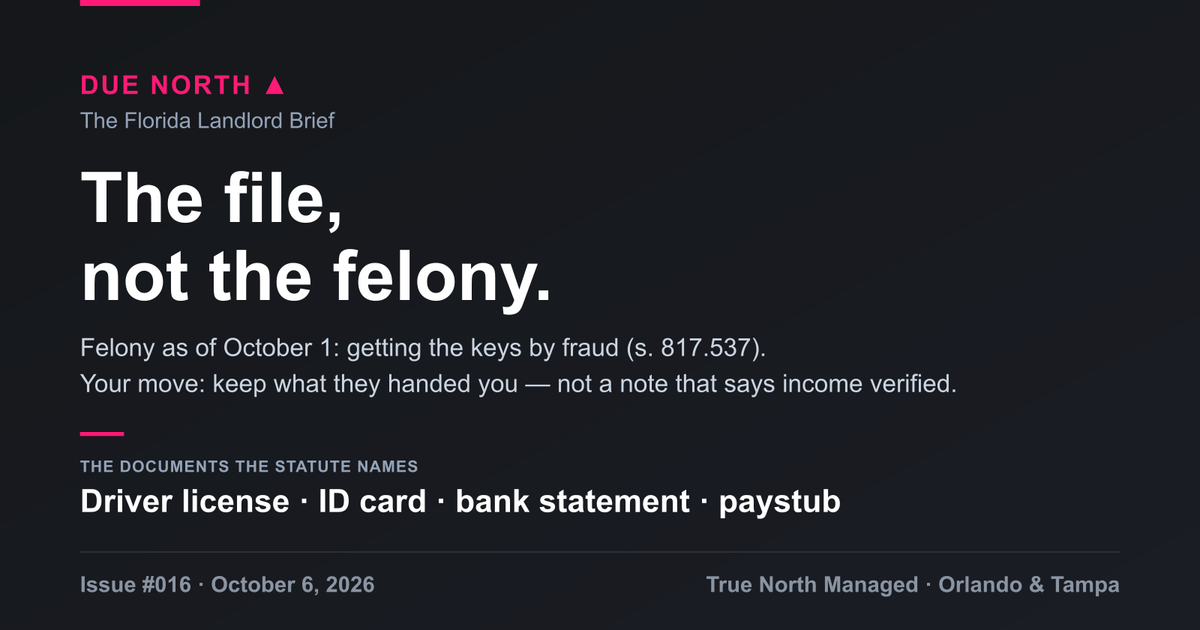
Getting the keys by fraud is a felony as of October 1. The thing you change is what your file keeps.
Two things took effect in Florida on October 1, and the second one is the one that changes your week.
The first is the headline. Chapter 2026-143 creates Florida Statute 817.537, and subsection (2) reads:
A person may not enter into and take possession of a residential dwelling unit by knowingly and willfully: (a) Making or causing to be made any materially false statement, in writing, relating to the person's identity in any rental application for a residential tenancy. (b) Presenting forged, fictitious, or counterfeit documents to the landlord of a residential dwelling unit, including, but not limited to, a driver license, an identification card, a bank statement, or a paystub. (c) Impersonating another person in whose name a rental application is submitted to a landlord for the purpose of executing a rental agreement or taking possession of a residential dwelling unit.
Third-degree felony. Unanimous in both chambers — 110–0 in the House, 34–0 in the Senate.
Enter into and take possession. Those five words are doing more work than the headline does. The offense is written around getting the keys, not around lying. So if your screening catches a fake paystub and you decline the applicant, this particular felony hasn't been completed. That is not the same as nothing having happened — attempt is its own offense in Florida. But section 817.537 itself only ever engages on your worst day: the one where screening didn't catch it and somebody is already living in your house.
On that day, what decides whether any of this is usable is whether you still have what they handed you. The law names the artifacts: a driver license, an identification card, a bank statement, a paystub. Clause (b) is about documents presented to you. Clause (a) is narrower than people assume — a materially false statement, in writing, in the application, about identity. A common habit is to verify income by opening the paystub, nodding, and moving on, and the file ends up holding a note that says income verified. That note is not the thing they submitted.
Ten minutes, this week. Pull up the file on your most recent approved tenant (or ask whoever screens for you to send it). Is the signed application still there, with the identity fields as they filled them in? Is the actual paystub there — the file they sent, not your summary of it? The bank statement? A forged document is far harder to prove once the original is gone. Fix the folder — every applicant's, approved or declined, kept the same way and somewhere locked down — before the next application comes in.
The same act has a second section, and it is the reason the folder is worth ten minutes. It amended Florida Statute 83.56(2)(a) to add fraudulent entry to the named examples of noncompliance a tenant gets no opportunity to cure — the seven-day unconditional notice to vacate. The statute's own words are "regardless of whether criminal proceedings have commenced." Whether anyone is ever charged is the state attorney's call. That part isn't. The eviction ground is real and it is yours, and in your own termination case you are the one who has to show the fraudulent entry — knowing and willful, not a paystub that looks off — so get an eviction attorney's read of the file before you serve the notice.
A smaller thing that surprised me, and it is in the same drawer. If you have ever seen the line that Florida law makes a late fee of "$20, or 20 percent of the monthly rent, whichever is greater" reasonable, that sentence is real and it is not about your rental. It lives in Florida's self-storage statute, in the part of Chapter 83 whose own definitions say no individual storage space may be used for residential purposes. There is no statutory cap for a residential late fee at all. What governs yours is whether a court will enforce it — and the 5–10% figure you will see everywhere isn't a statute and isn't a safe harbor, it's a rule of thumb. Worth knowing where the number came from if your lease carries 20% on its authority.
Last week we published the Q3 reads: Lake Nona, Winter Park and Avalon Park, plus October's Orlando numbers.
If you are newer to this than you would like to be, our First 30 Days checklist walks the setup most accidental landlords end up doing twice — screening included.
— The True North Team