

A Tax Cut That Pays by Seniority
Rewards whoever has held longest. If it passes, your rental helps fund the part it can't claim.
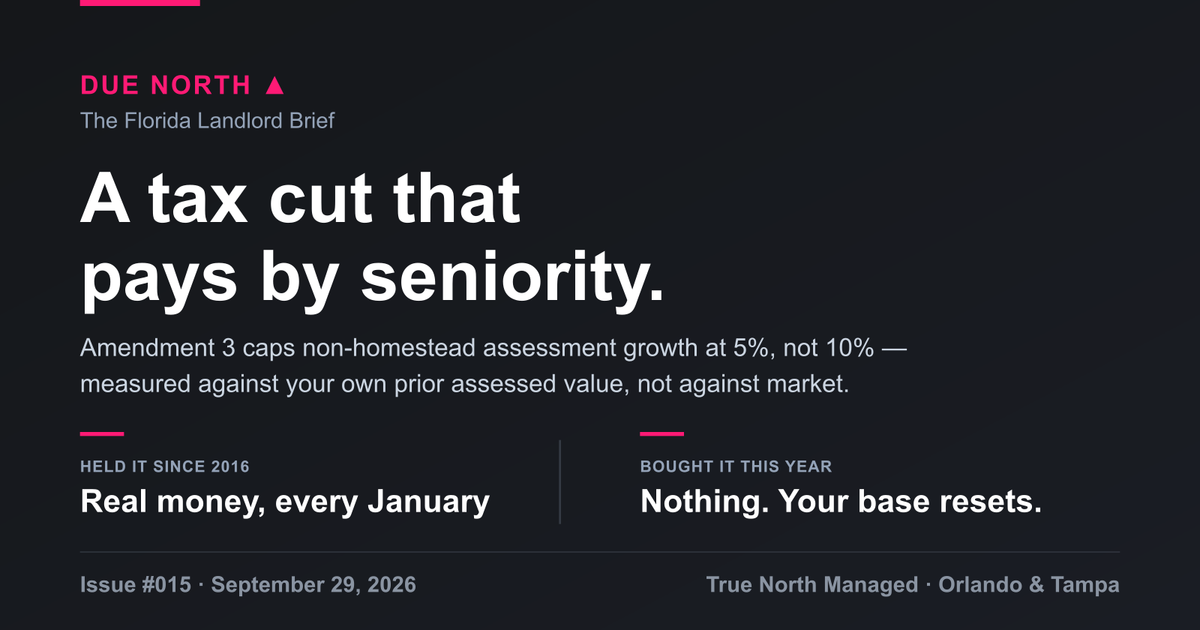
Hi again. Florida votes on a property-tax amendment in five weeks, and what the landlord half of it is worth to you turns on something almost nobody is pricing: how long you have owned the place.
The measure is CS/HJR 1-F — Amendment 3 on your ballot, and it needs 60% to pass. It does three things. It raises the homestead exemption to $150,000 in 2027 and $250,000 in 2028, on every levy except schools, and a house you rent out isn't your homestead, so none of that reaches it. (Nor, if you weren't a Florida resident on December 31, 2026, does the full amount reach the house you live in: you get $50,000 until you've held residency five years.) It lowers the cap on how fast a non-homestead assessment can climb, from 10% to 5%, on those same non-school levies, starting January 1, 2027. And it restricts what counties may spend property-tax money on — the uses, not the rate, which matters at the end of this letter.
The cap is one line of statute. Section 193.1554(3) has your rental reassessed every January 1, and: "Any change resulting from such reassessment may not exceed 10 percent of the assessed value of the property for the prior year." Read the end of that sentence again. The cap limits growth over your own prior assessed value, not over market value — so it only does work when the market has pulled away from your assessed number. An owner who has held a Tampa rental since 2016 sits on an assessed value well under what the house would sell for, and every January the county walks it back toward market until the cap stops it. For that owner, ten down to five is real money on the non-school part of the bill, every year the market keeps climbing.
Now buy the same house. We flagged this reset in passing four weeks ago; here is why it decides the whole question. Subsection (5): "Except as provided in this subsection, property assessed under this section shall be assessed at just value as of January 1 of the year following a change of ownership or control." The exceptions are narrow and mostly technical — a title correction, a transfer between spouses including on death or divorce, and two others. A purchase is not one of them. You reset to market the January after you close, and there is no gap left for the cap to live in.
So it is a seniority benefit, and seniority doesn't transfer. Hold for a decade and this is one of the few pieces of Florida tax news in years that is straightforwardly good for you. Buy, and you start from zero: nothing in year one, and after that only what a year of above-5% appreciation hands you, while the long holder draws on ten years of it. Price it at zero for the first couple of years and don't underwrite past that unless you're modelling appreciation above 5%. And it never shows up in your exit price — the accrued cap dies with the sale, and your buyer resets exactly as you did.
It doesn't only reset on a sale, either: deeding the house into an LLC, handing over either control of the entity that holds it or more than half its ownership (counting transfers cumulatively), or leaving it to a child can each do it — and in the entity case, with no deed moving at all. A surviving spouse is covered; a child isn't. Ask your attorney before you move title. And if you moved out of a house and rented it instead, the reset already happened the year your homestead came off.
The market isn't helping anyone here right now. Of the 35 Orlando and Tampa ZIPs we track, 25 are down year over year on home value, on Zillow's August read — slower to reach your bill than it sounds, since assessed values lag and a long-held parcel is still climbing toward a number that already moved. But if values fall far enough, subsection (4) drops your assessed value to just value outright: the gap doesn't narrow, it closes, and the seniority advantage closes with it. This cap is only worth something in a rising market.
If it passes, the bill still gets paid somewhere. Orange County's own page estimates the exemption increase alone costs it roughly $165 million in 2027 and $275 million in 2028, and says: "There is no single revenue source currently available that would fully replace a loss of this magnitude, meaning County leaders would likely need to consider a combination of spending reductions, fees, and other legally authorized revenue options." Hillsborough projects a $366.9 million annual hole from the larger exemption by fiscal 2029, 23.2% below its fiscal 2026 revenue, with the county administrator cautioning that balancing future budgets could require layoffs and new or increased taxes, assessments and fees. Those are the two we've found published numbers for; the mechanism reaches every county in both metros. That third provision lands here — it constrains what a county may spend, not what it may charge. Fees and special assessments don't check whether a parcel is homesteaded, so your rental would carry them at the same rate as the house next door that just picked up a $250,000 exemption.
How you vote is your business, and plenty of our owners will do well out of this on the house they live in. What I'd ask is that you not underwrite a Florida purchase on a headline that says taxes are being cut. Run the tax line at just value with no cap benefit, and carry headroom on top.
One thing I'd go do, and it isn't about the vote. Pull your parcel record from the county property appraiser and read the whole millage stack, not just the county's line — the school board, the water district, your city if the house sits inside one, each adopted by a different body on a different night. Total millage divided by a thousand, times taxable value, is the bill. Then look for the rolled-back rate each authority has to publish alongside the rate it adopted: that's the rate that would have raised the same money on this year's values, so anything above it is an increase however the headline moved. It's the half of the arithmetic this amendment never touches, and you can pull it from a thousand miles away.
While you're in the file: if you own from another state, put two interior walkthroughs a year into the lease at signing. Not to catch anyone — most of what surfaces at move-out is the slow kind, a supply line weeping behind a vanity, a filter nobody changed, and the tenant who never calls is usually the one it's happening to. Agreed in writing when they sign, and you still give notice each time the way the lease says; the clause schedules the visit, it doesn't replace the notice. It needn't be you holding the camera — a manager, an inspector, a local you trust — as long as what comes back is dated. And it only helps if you act on it: a leak you photographed in March and left alone isn't evidence for you at move-out, it's evidence against you. Our guide for owners managing from another state has the rest.
Two new pieces since the last issue. Written screening criteria is the long version of the note in #014 — the exception clause is the line that matters most. And September's briefing runs the month: what changes on October 1, the flood program's new December 11 date, and where the Homes for Veterans pilot stands for Hillsborough landlords (in law since July 1, but no public landlord portal as of our last check).
Plenty of our owners handle all of this themselves, and everything above is how. But if you're reading from New Jersey or Chicago and the honest answer is that you won't track a millage vote, a parcel record and a slow leak behind a vanity from there, that is the job. Here's what we actually handle for owners who don't live in Florida.
— The True North Team