

The $2,000 With a Gate On It
Florida's new veterans program pays landlords twice. Skip the first claim and you forfeit the second.
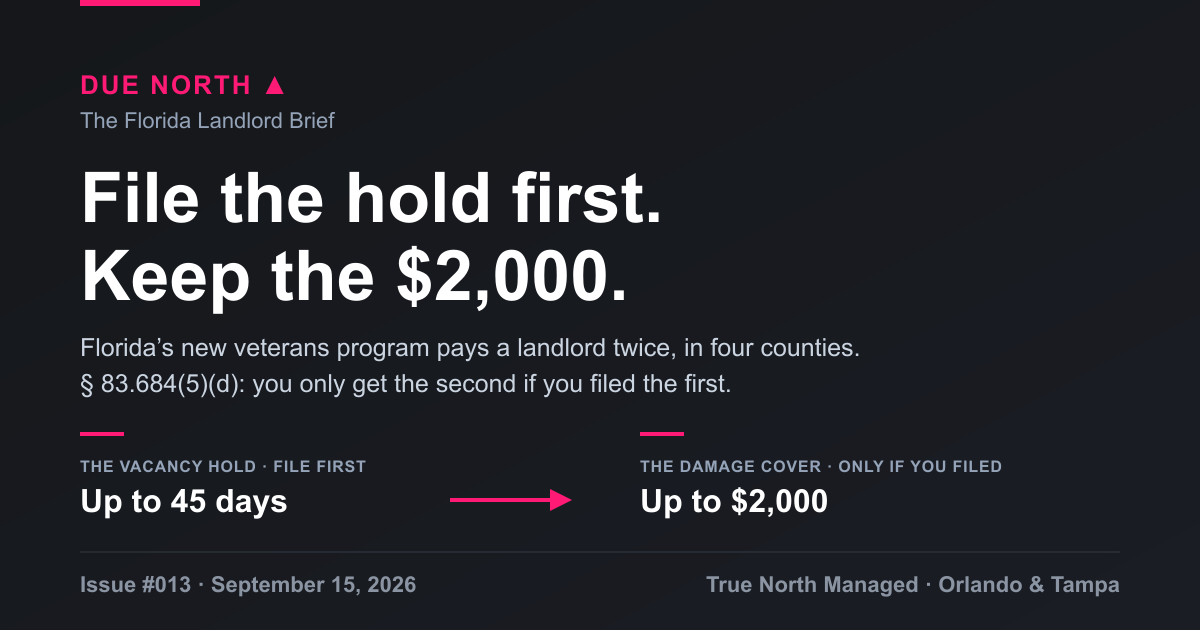
Hi again. In July we wrote about Florida paying landlords to house veterans, and said that in a soft leasing market the trade was better than it looked. That still holds. What I'd missed is a single sentence in the statute that decides whether you get the part of the money that's worth having.
The program is Section 83.684, created by SB 1602 and on the books since July 1. It runs in four counties — Hillsborough, Broward, Escambia and Santa Rosa — and it pays an eligible landlord twice. Sign a lease with a veteran on a HUD-VASH voucher and the state will cover proportional rent while the unit sits waiting for them, for up to 45 days or until they actually move in, whichever comes first. Then, if that veteran does damage past what the deposit covers — either by moving out in the first 12 months of a year-to-year agreement, or after a lease of any length expires — you can claim up to $2,000 beyond the deposit.
Most owners rank those two payments the obvious way and skip the one that looks smaller. That instinct is where the money goes — and it isn't even right about the sizes. The damage backstop is capped at two thousand dollars. The hold isn't capped in dollars at all: it runs up to 45 days of proportional rent, so on anything renting above roughly $1,350 a month it is the larger of the two numbers. The case where you'd genuinely skip it is narrow — the veteran moves in fast and the hold is worth nine days of rent, so you don't bother with the paperwork.
Here is subsection (5)(d), in full: "A landlord may apply for funding under paragraph (a) only if the landlord previously applied for funding under paragraph (4)(a)."
Paragraph (a) there is the damage money. Paragraph (4)(a) is the hold. Skip the first claim and the second is gone — not reduced, not delayed. You are simply not eligible, and you find that out at move-out, which is the worst possible moment to learn it.
The clocks are just as unforgiving, and they run in opposite directions. The hold application has to be submitted within 60 days after the veteran moves in. The damage application, within 60 days after they move out. And the damage claim requires you to hand over the move-out checklist, dated photos, and a copy of the written notice you gave the veteran under 83.49(3)(a) — the deposit-claim notice you have 30 days to send, by certified mail or e-mail. So the state backstop is bolted onto the deposit process you already have to run correctly. Miss that notice and you lose the deposit claim and the two thousand behind it.
The money is finite, awarded first-come first-served, and the statute lets Florida Housing suspend intake outright once the appropriation is fully obligated. This is a pilot funded year to year, not an entitlement.
So what do you do this month. Not much on the filing side yet: when I last checked there was still no public landlord portal and no named administrator for Hillsborough — Florida Housing has to contract those out and write rules first, and anyone selling you a filing service today is guessing. What you can do now is the part that has to happen before any of it anyway: get your unit on the pre-inspected list. Tampa's housing authority says outright that it's looking for owners, and when I looked it was pre-inspecting one-bedroom units only, aiming for thirty to forty ready at a time — ask whether that's still the case, because it's the kind of thing that changes with the voucher count. Getting inspected takes weeks, and it's what puts you on the referral list before the vacancy, rather than starting from zero on a first-come clock after it.
If you're on the Orlando side, the state top-up isn't yours — Orange, Seminole and Osceola aren't in the pilot. HUD-VASH itself is, though, and the underlying trade is the same one: a voucher that pays most of the rent on time, and a VA case manager who is explicitly a resource for the landlord when something goes sideways in the tenancy. You just don't get the two thousand.
A number for the pricing conversation you're probably about to have. Yardi's July report put 16,146 apartment units under construction in Tampa, with occupancy at 93.3% as of April — down 140 basis points across twelve months — and 3,128 units already delivered through May. That's this year's supply, and it's what's behind every concession you're competing against.
So I'd change one habit before you set a fall rent. When you pull comps, pull the ones that actually leased, not the ones sitting there asking — and then take the concession out before you use the number. A comp advertising a month free on a twelve-month lease isn't renting at its asking rent; it's renting 8.3% below it. Half a month is a bit over 4%. Do that subtraction on three or four leased comps and the real market number is usually well under what the listings imply. That's why units sit. Our pricing guide for a softening market has the rest of it, including why a one-time move-in credit usually beats cutting the ask.
Three more worth your time. We ran a Brandon owner's numbers after her mortgage payment jumped $607 in month eight of a twelve-month lease — a good tenant, no vacancy, nothing wrong with the tenancy, and the property still went cash-flow negative because her costs reprice on the county's calendar and her rent doesn't. Since we've been talking about damage claims, where normal wear and tear ends is worth twenty minutes; Florida's statute never defines the phrase, which is why it decides more deposit disputes than any deadline does. And if a lease is ending soon, the holdover rules include one move that quietly ends your double-rent remedy: accepting a single ordinary rent check after the lease expired.
And if the reason any of this is on your mind is that you're weighing whether to hold a unit, re-let it, or buy the next one, that decision starts with a number you can trust. Ask us what yours would rent for — leased comps, concessions netted out, no obligation.
File the hold claim first. Without it, the $2,000 is not available to you at all.
— The True North Team