

The 25-day clock in your mail
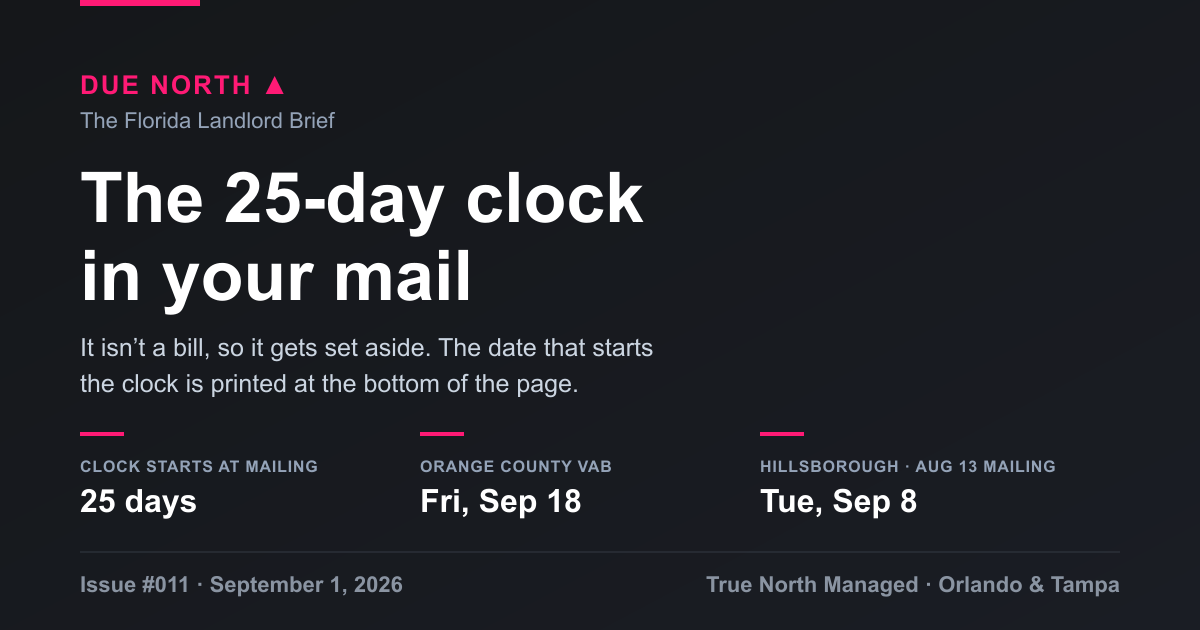
Orange County's is September 18, and its online portal is under construction. Hillsborough's is sooner.
Hi again. There's a piece of mail sitting in your pile right now with a clock on it, and the clock started when the county dropped it in the post — not when you opened it.
It's the TRIM notice: your proposed property taxes for the year. It isn't a bill, which is exactly why it gets set aside. But it's the only moment you get to argue with the number, and Florida law gives you twenty-five days from the day it was mailed to file a petition with the Value Adjustment Board. Not twenty-five days from when it reached you. Not twenty-five business days. Twenty-five days from a date printed in small type at the bottom of the page.
We walked these mechanics on August 4. I'm coming back to them because the two counties we work in have landed on different dates this year, and because one of them isn't taking petitions online right now.
Orange County's deadline is Friday, September 18 — the county says so on its own VAB page. Read the next sentence on that page too, because it matters more than the date: the online filing portal for 2026 is under construction. Right now you file the paper form, by mail or courier or in person, with the $50 fee. If you've been assuming you'd handle this from a laptop on the night of the seventeenth, that assumption is currently wrong — and a paper filing is one you start a week early, not the night before.
Hillsborough is the tighter one. The property appraiser began mailing on August 13, but the Clerk counts twenty-five days from the date printed on your page, not from the day the run started — so count it off your own notice rather than off my arithmetic, and a notice dated later than the thirteenth has a later deadline. For the batch that went out on the thirteenth, twenty-five days lands on Labor Day, and the Clerk rolls a holiday deadline to the next business day: Tuesday, September 8. And note the part that bites remote owners hardest: Hillsborough petitions have to be received by the deadline, not postmarked. A form you drop in a mailbox in New Jersey on day twenty-three is late.
The burden of proof is on you. The statute says so in as many words, so any guide that tells you as much is quoting it correctly. What tends to get left out is the rest of the section, which is the useful part.
The county's number is presumed correct — but the statute conditions that on the appraiser first proving, by a preponderance of the evidence, that the assessment was arrived at under s. 193.011 and professionally accepted appraisal practices. And it names what you'd have to prove, also by a preponderance, to knock that presumption down: that the assessed value doesn't represent just value, doesn't represent the classified use or fractional value where the property must be assessed that way, or is arbitrarily based on appraisal practices different from those the appraiser generally applies to comparable property in the same county. Satisfy one and the presumption is overcome, and the board or the court establishes the value.
That last route is the one you rarely see mentioned, and it's the one that turns a complaint into an argument: not that your number feels high, but that the appraiser used a different method on your property than on comparable ones nearby. You still have to show up with something real.
And before you spend the fifty dollars: you're entitled to an informal conference with the property appraiser's office, and the statute says plainly that it is not a prerequisite to a formal petition. Sometimes a wrong square-footage figure or a missing condition adjustment comes off with one phone call. But be strict about the clock while you do it — nothing about that conversation stops the twenty-five days, and a callback that lands on day twenty-six is worth nothing. Confer if there's room; file anyway if the date is close. Filing preserves the date.
So: pull the notice, find the mailing date at the bottom, and look at the market value line. The question isn't whether the number feels high — it's whether you'd have gotten that number in a sale on January 1. If you wouldn't, call the appraiser's office this week — and if your county's date is inside two weeks, file first and keep talking after. If the notice is genuinely defensible, put it down and go do something else; that's a legitimate answer too.
One thing that catches new-ish owners: rental property doesn't get Save Our Homes. Non-homestead residential — nine units or fewer — is capped at 10% a year, that cap excludes school district levies, and it resets to full market value the January after the property changes hands. If you bought in 2025, this is your first fully-reassessed notice; it is supposed to look bigger than the seller's did. It's also the tax line to underwrite the next purchase on — never the one printed on the listing.
While you're in the file drawer, pull your insurance declarations page too. You'll have read this month that Florida premiums are falling, and it's true as far as it goes — the state's July stability report shows the average homeowners premium including wind down in 51 of 67 counties since January. But read what that report is required to measure: homeowners' and condominium-unit-owners' policies. If your rental is on a dwelling-fire form rather than a homeowners policy, your policy isn't in that number at all. The headline can be accurate and still have nothing to do with your renewal.
Once a year, read three lines on your own dec page — the dwelling limit, the wind or hurricane deductible as a percentage, and whether loss of rents is on there — and compare it to a quote you actually asked for. Our landlord insurance guide walks the same three lines if you want it next to you.
Rates, briefly. The 30-year fixed printed at 6.66% on August 27 — a basis point above the week before. Same week last year: 6.56%. The level hasn't really moved.
Two more worth your time. We published what a landlord can hold as advance rent versus a security deposit, which is a distinction that decides who owes what when a tenancy ends badly — and it's the one owners most often get wrong in the lease itself. There's also the August briefing, which collects the month's insurance, flood and legislative moves in one place if you'd rather read it all at once.
If you own here but don't live here, the tax notice is a good illustration of the general problem: the clocks that matter run on mailing dates and county calendars, and none of them care where you are. That's most of what a manager is actually for — not the 3 a.m. plumbing call everyone pictures, but the boring dated things that only ever go wrong quietly.
Find the date at the bottom of the notice. Everything else can wait behind it.
— The True North Team